Last Updated: Aug 04, 2026
Florida is a Constitutional Carry state that does not require a background check for most private, person-to-person sales. Unlike most states, county and city governments have almost no power to regulate firearms — Florida's preemption law occupies 'the whole field' of firearm regulation, so local rules rarely apply to a private sale. The one notable exception is a transaction conducted at a public venue such as a gun show, where Miami-Dade County still enforces its own background-check and waiting-period ordinance. What does apply everywhere is Fla. Stat. § 790.065, which makes it a third-degree felony to transfer a firearm if the seller has 'reasonable cause to believe' the buyer is a prohibited person. Recording the buyer's Florida-issued photo ID or Concealed Weapon License (CWL) number alongside the firearm's exact serial number is what allows you to prove that due diligence later, if the firearm is ever traced by law enforcement or the ATF.
📄 Florida Firearms Form Document Blueprint:
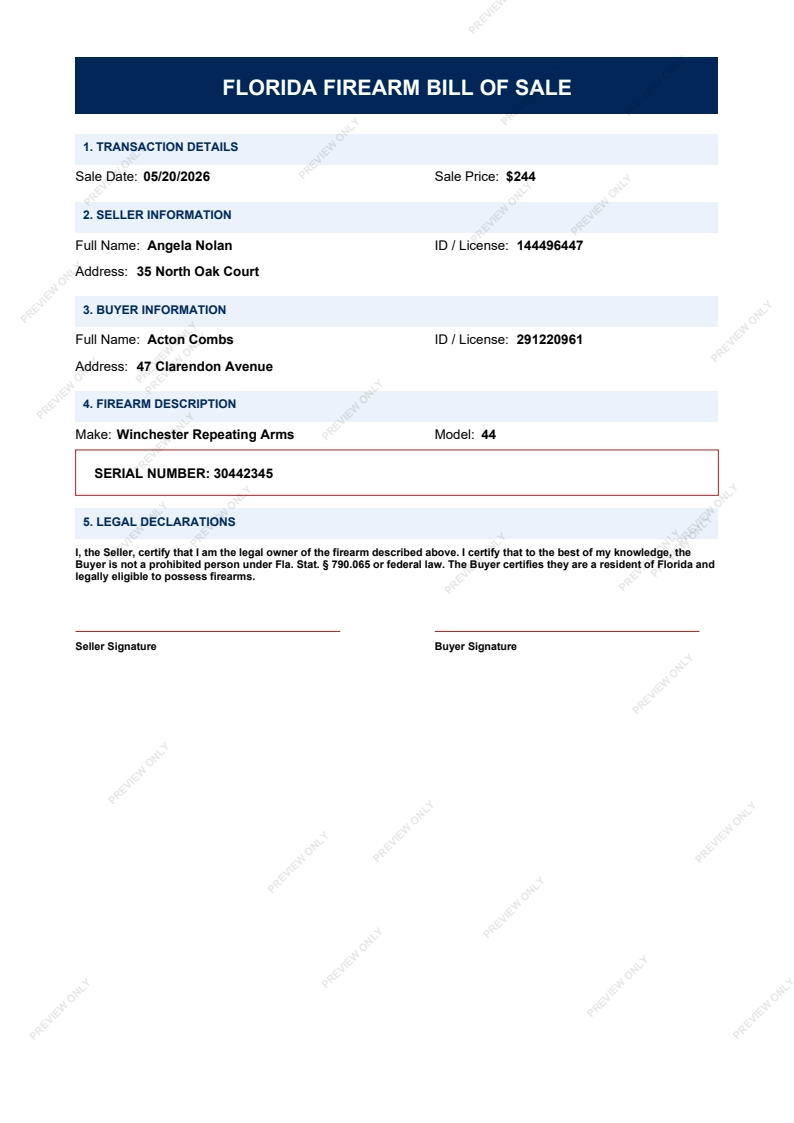
Completing Your Florida Bill of Sale
This page covers Florida's specific rules. For a field-by-field breakdown of how to fill out and execute any state's Bill of Sale — from verifying ID to keeping your copy — see our nationwide Step-by-Step Firearm Bill of Sale Guide.
📋 Florida Legal Essentials for Private Sellers
1. Minimum Age: Treat 21 as Your Floor
Since the 2018 Marjory Stoneman Douglas Act, licensed dealers cannot sell any firearm to a buyer under 21. This age floor is written into the law governing dealer sales, so it does not technically bind a private, unlicensed seller — but 21 is the safest personal minimum, since federal law still requires you to refuse anyone you have reasonable cause to believe is ineligible.
⚠️ A common error is applying the old federal 18-year rule for long guns, or assuming private sellers are exempt from the spirit of the 21 rule entirely.
2. Waiting Periods Rarely Apply to Private Sales
Florida has no statewide waiting period for private, in-home sales. The one narrow exception: transactions conducted at a public venue such as a gun show or flea market may fall under a local ordinance — most notably Miami-Dade County's 5-day waiting period and background-check requirement. This exception survives only because of specific, separately-litigated circumstances, not as a general rule counties can apply.
⚠️ Don't assume a waiting period applies to a private, in-home sale just because you've heard a county has 'gun laws' — and don't assume a public-venue sale is exempt just because it's between two individuals.
3. How ATF Trace Works in Florida
If a firearm you sold privately is later used in a crime, the ATF will trace the serial number back to the last known seller — you. Florida law enforcement works closely with the ATF. A detailed Bill of Sale showing the buyer's full name, Florida-issued photo ID or CWL number, date of transfer, and exact serial number is your strongest defense.
⚠️ Recording the serial number from a box label or receipt instead of the firearm frame itself is not accepted as proof during an ATF trace.
4. Risk Protection Orders (Red Flag Law)
Florida's Risk Protection Order (RPO) law lets a law enforcement agency petition a court to temporarily remove firearms from someone who poses a significant danger to themselves or others. Family members and school officials cannot file the petition directly — they report concerns to police, who decide whether to seek the order. Selling to someone under an active RPO is illegal.
⚠️ Relying only on the buyer's verbal assurance that no RPO is active provides no legal protection — ask directly and document that you asked.
5. Local Governments Have Almost No Power Here
Florida's preemption law (§ 790.33) gives the state legislature sole authority over firearm regulation — local ordinances that conflict with state law are void, and officials who knowingly violate this can face personal fines up to $5,000. This is why Florida's private-sale rules stay consistent statewide, aside from the narrow Miami-Dade exception above.
⚠️ Don't assume your city or county has special gun rules beyond that one exception — and don't assume the reverse either, that Miami-Dade's rule can't possibly apply to you.
This information reflects publicly available Florida statutes and enforcement practices. Firearm laws can change and county ordinances vary. Always verify the latest rules in your specific county and consult a qualified Florida attorney if needed.
Florida Firearm Transfer FAQ
Does Florida have a 'Red Flag Law'?
Yes. Florida's Risk Protection Order (RPO) law allows a law enforcement agency to petition a court to temporarily remove firearms from a person who poses a significant danger to themselves or others. Family members, domestic partners, and school officials cannot file the petition directly — they must report their concerns to local police, who decide whether to seek the order. Selling a firearm to someone under an active RPO is illegal. Always ask the buyer to confirm they are not subject to such an order. Fla. Stat. § 790.401
Is there a waiting period for private gun sales in Florida?
Generally, no — Florida has no statewide waiting period for private, in-person sales conducted away from public venues. However, a narrow exception exists: some jurisdictions, most notably Miami-Dade County, impose a waiting period and mandatory background check on any firearm transaction — including between private parties — that takes place on property the public has a right to access, such as a gun show or flea market. Because Florida's preemption law otherwise bars counties from regulating firearms, these exceptions are limited and can be legally contested — always confirm current local rules before selling at a public venue. Fla. Stat. § 790.33
Can I sell my gun to a friend at a gun show in Florida?
Yes, but the rules differ from a private, in-home sale. Because a gun show is a venue the public can access, transactions there may fall under stricter local requirements — including a background check and waiting period in counties like Miami-Dade. Bring valid ID, complete a proper Bill of Sale, and check with the show organizer or county clerk about any local procedure that applies on-site.
What is the minimum age for private firearm sales in Florida?
Since the 2018 Marjory Stoneman Douglas Act, licensed dealers cannot sell any firearm to a buyer under 21. This age floor was written into the law that governs dealer sales, so it does not technically bind a private, unlicensed seller — but treating 21 as your personal minimum is by far the safest practice, since federal law still requires you to refuse anyone you have reasonable cause to believe is ineligible. Fla. Stat. § 790.065
Does the buyer need a Concealed Weapon License (CWL) for a private sale?
No, a CWL is not required for private purchases in Florida. However, a valid Florida CWL is one of the strongest forms of proof that the buyer has already passed a background check. Recording the CWL number on the Bill of Sale significantly strengthens your legal protection.
Can I sell a firearm to someone with an out-of-state ID in Florida?
No. Federal law (18 U.S.C. § 922) prohibits private person-to-person firearm transfers across state lines. The buyer must be a Florida resident with valid Florida-issued photo ID. Out-of-state buyers must go through a licensed FFL dealer.
Do I need to report the private sale to the FDLE or local police?
No. Florida does not have a statewide firearm registry, and state law actually prohibits the creation of one. Your Bill of Sale remains your primary private record proving when legal ownership transferred.
Can I transfer a firearm to a family member in Florida?
Yes, gifts and transfers between immediate family members are generally allowed without a background check. However, it is still strongly recommended to use a Bill of Sale to document the transfer and protect both parties.
What should I do if the buyer refuses to show ID or sign the Bill of Sale?
This is a major red flag. Under Florida law, you must not sell a firearm if you have 'reasonable cause' to believe the buyer is prohibited. Refusal to provide valid photo ID is sufficient reason to cancel the sale.
Can my county pass its own gun sale rules that are stricter than state law?
Almost never. Florida has one of the strongest firearm preemption laws in the country: the state occupies 'the whole field' of firearm and ammunition regulation, and any local ordinance that conflicts with state law is void. Local officials who knowingly violate this can face personal fines of up to $5,000. This is why the Miami-Dade gun-show exception is unusual — it survives only under a narrow, separately-litigated carve-out, not as a general rule. Fla. Stat. § 790.33