Last Updated: Aug 05, 2026
Alabama does not require a background check or waiting period for private, person-to-person firearm sales. That said, Ala. Code § 13A-11-72 makes it a Class C felony for certain people to own or possess a firearm at all — including anyone convicted of a violent crime, subject to a domestic-abuse protection order, or convicted of any felony within the past five years. A seller who knowingly arms someone in one of these categories can face accomplice liability under general Alabama criminal law, even without a transfer-specific statute like some other states have. Recording the buyer's Alabama-issued photo ID alongside the firearm's exact serial number is what allows you to demonstrate that due diligence later, if the firearm is ever traced by law enforcement or the ATF.
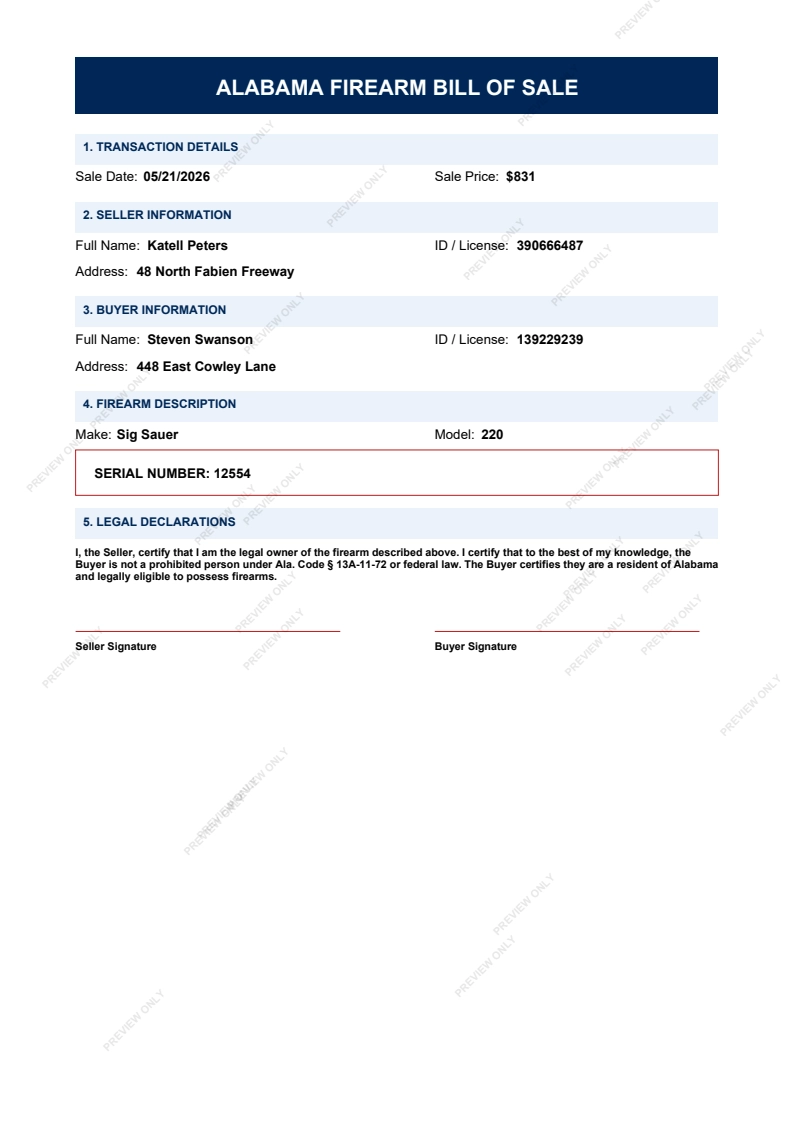
📄 Alabama Form Preview:
Completing Your Alabama Bill of Sale
Generating your official Alabama Gun Bill of Sale takes less than 5 minutes using the interactive form above. While not legally required by Alabama law, creating a written record is a best practice. The most critical step is accurately recording the buyer’s full name, valid Alabama-issued photo ID information, and the firearm’s exact serial number copied directly from the frame. This level of detail provides personal protection if the firearm is ever traced.
The sections above cover what's specific to Alabama. For the mechanics of filling out and executing the document itself — which don't change from state to state — see our nationwide Step-by-Step Firearm Bill of Sale Guide.
📋 Alabama Legal Essentials for Private Sellers
1. The 2025 Glock Switch Ban Affects Sellers Too
Act 2025-54 (SB116), signed into law in March 2025, makes it a Class C felony to possess, receive, sell, or use any part designed to convert a pistol into a machine gun — commonly known as a 'Glock switch.' This is separate from selling a lawful firearm itself, but if you're selling a pistol, inspect it to confirm no conversion parts are attached or included in the sale.
⚠️ Don't assume this only applies to obvious full-auto conversions — the law covers any part or combination of parts designed for that purpose, even ones that look minor.
2. Selling a Handgun to a Minor Is a Specific Offense
Ala. Code § 13A-11-75 makes it a distinct violation to sell, give, or lend a handgun to anyone under 18. This sits alongside the broader possession restrictions in § 13A-11-72 and gives sellers a clear, specific age line to check for handgun sales.
⚠️ Don't rely on a buyer's word about their age — Alabama-issued photo ID is the only reliable way to confirm they're 18 or older before a handgun changes hands.
3. How ATF Trace Works in Alabama
If a firearm you sold privately is later used in a crime, the ATF will trace the serial number back to you as the last known owner. A well-completed Bill of Sale with the buyer's full name, Alabama-issued photo ID details, date of transfer, and exact serial number copied from the frame significantly speeds up the process and protects you from unnecessary investigation.
⚠️ Recording the serial number from a box label or receipt instead of the firearm itself is not accepted as proof during an ATF trace.
4. Local Governments Can't Add Their Own Rules
Alabama's preemption statute gives the state legislature exclusive authority over firearm regulation — Birmingham, Huntsville, Mobile, and every county follow the same rules. A political subdivision that passes a conflicting ordinance can be sued, and the person who challenges it can recover attorney's fees.
⚠️ Don't assume a city ordinance you've heard about locally overrides state law — under § 13A-11-61.3, it almost certainly doesn't and may already be void.
This information reflects publicly available Alabama statutes and enforcement practices. Firearm laws can change and county ordinances vary. Always verify the latest rules and consult a qualified Alabama attorney if needed.
Alabama Firearm Transfer FAQ
Is a Bill of Sale required for private gun sales in Alabama?
No, Alabama law does not require a Bill of Sale for private firearm transfers. However, arming someone you know is prohibited from possessing a firearm can expose you to accomplice liability under Alabama criminal law. A Bill of Sale is a recommended best practice for documenting the transfer, but it is not a legal guarantee of the buyer's eligibility. Source: Ala. Code § 13A-11-72
What is the minimum age for private gun sales in Alabama?
Alabama does not set a specific state-mandated minimum age for private firearm sales. The 18-and-21 age floors most people know come from federal law, but those only bind licensed dealers (FFLs) — not private sellers. Treating 18 as your personal minimum, and verifying the buyer's Alabama ID to confirm it, is the safest practice for a private transaction.
What if the buyer does not have a Driver's License?
A valid Alabama-issued photo ID (such as an ALEA state-issued identification card) is acceptable. The ID must be government-issued, include a clear photo, and prove Alabama residency. Do not complete a private transfer if you cannot verify that the buyer is a resident of Alabama.
Who is considered a 'prohibited person' in Alabama?
Under § 13A-11-72, a person may not own or possess a firearm at all if they have been convicted of a crime of violence, a misdemeanor domestic-violence offense, are subject to an active domestic-abuse protection order, are of unsound mind, or have been convicted of any felony within the past five years (or three or more felonies at any time). Knowingly arming someone in one of these categories can expose the seller to accomplice liability, separate from the buyer's own possession offense. Source: Ala. Code § 13A-11-72
Is an Alabama Pistol Permit useful in a private sale?
While a permit indicates that an individual has undergone a background check, Alabama is a Constitutional Carry state since 2023. A permit is not required for carry, and its absence does not mean an individual is ineligible to purchase a firearm privately.
Do Birmingham or Huntsville have different private sale rules than rural Alabama?
No. Alabama's firearm preemption statute gives the state legislature exclusive authority over firearm regulation, expressly covering the purchase, transfer, and possession of firearms — cities and counties cannot pass rules stricter than state law. A person harmed by a violating local ordinance can sue the locality and recover attorney's fees. Source: Ala. Code § 13A-11-61.3
What happens if the gun I sold in Alabama is later used in a crime?
Law enforcement may trace the firearm to the last known owner. A Bill of Sale documenting the date of transfer and the buyer's information is a helpful tool for personal records to show when the firearm left your possession.
Can I sell a firearm to someone from Georgia, Tennessee, or another state?
No. Under federal law, private individuals are prohibited from transferring firearms across state lines. The buyer must be a resident of Alabama. Out-of-state buyers must complete the transfer through a licensed FFL dealer. Source: 18 U.S.C. § 922
How does an ATF trace work in Alabama after a private firearm sale?
If a firearm is traced, the ATF typically contacts the last known purchaser. Maintaining a record of the transaction (Bill of Sale) is a prudent practice to verify the date of the sale and the identity of the person to whom the firearm was transferred.