Mississippi's Freedoms Are Above — The Form Itself Is Standard
The open carry holster rule, the SFP/E-SFP permit system, and Mississippi's preemption law above are specific to this state. Filling out and signing the actual Bill of Sale — the fields, the description, the signatures — works the same basic way everywhere.
See our nationwide Step-by-Step Firearm Bill of Sale Guide for that walkthrough.
Mississippi vs. Deep South Neighbors: 2026 Comparison
| Feature | Mississippi (MS) | Alabama (AL) | Louisiana (LA) | Tennessee (TN) |
|---|---|---|---|---|
| Private Sale Background Check | No | No | No | No |
| Constitutional Carry | Yes | Yes | Yes | Yes |
| State-Level Firearm Registry | None | None | None | None |
| Enhanced Permit Option | Yes (E-SFP) | No | No | Yes |
| Red Flag Law | No | No | No | No |
| Minimum Age (Private Handgun) | 18 | 18 | 18 | 18 |
Last Updated: Sep 13, 2026
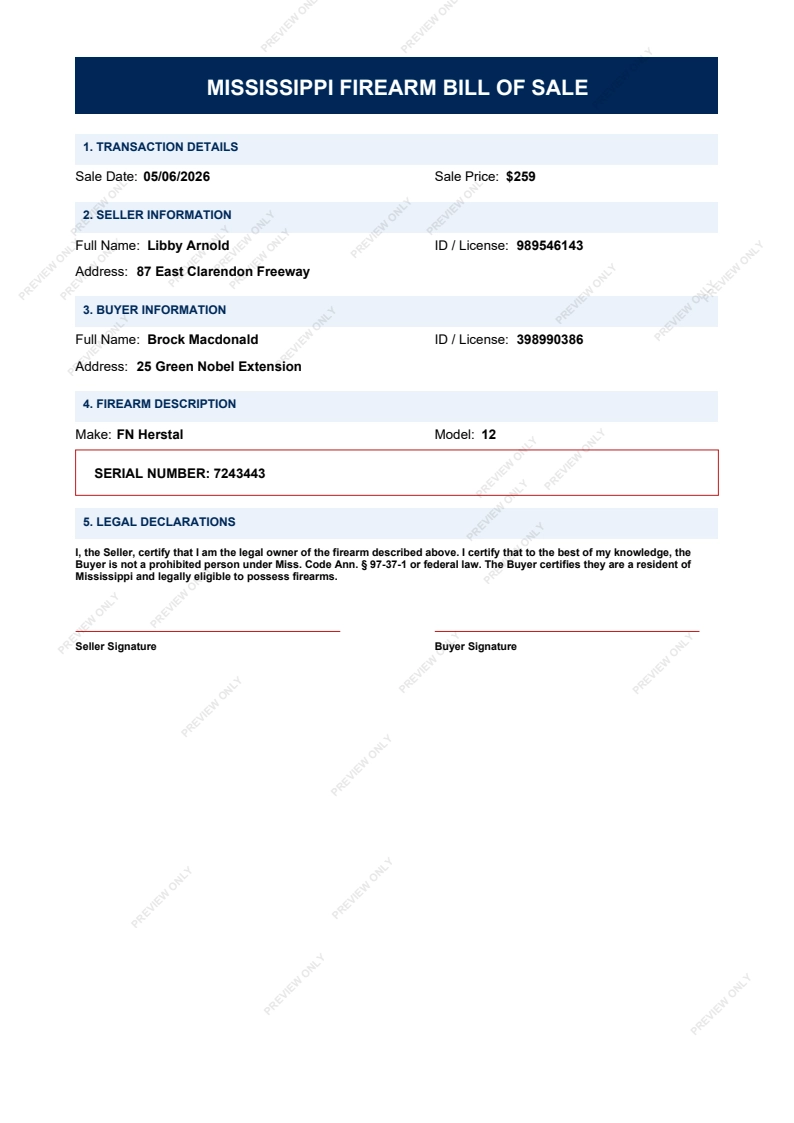
Mississippi is one of the most firearms-friendly states in the country. Private sales require no background check, no permit, no waiting period, and no paperwork under state law. Mississippi's strong preemption law also prohibits any county or city from adopting its own rules on the possession, sale, or transfer of firearms. Federal law still holds: selling to a prohibited person is a federal felony. Mississippi also has a distinctive open carry rule — a handgun carried in a holster, sheath, or scabbard that is wholly or partially visible is not legally considered 'concealed' at all, meaning open carry requires no permit anywhere concealed carry would otherwise be restricted. This Bill of Sale documents the buyer's ID, the firearm's serial number, and the transfer date — your paper trail in a state with strong protections for private ownership.
📄 Magnolia State Form Blueprint Preview:
📋 Mississippi Legal Essentials for Private Sellers
1. No State Rules, But Federal Liability Still Applies
Mississippi imposes no background check, permit, or waiting period on private firearm transfers. That doesn't erase federal law: 18 U.S.C. § 922(d) still makes it a crime, punishable by up to 10 years, to knowingly sell to someone you have reasonable cause to believe is prohibited from possessing a firearm.
⚠️ Don't treat Mississippi's hands-off state law as the complete picture — federal prohibited-person rules apply on top of state law no matter how few state-level requirements exist.
2. The Open Carry Exception Has a Specific Technical Requirement
A handgun carried in a sheath, belt holster, or shoulder holster that's wholly or partially visible isn't legally 'concealed' at all under Mississippi law — no permit needed. But this exception is specific to holstered carry; simply tucking a handgun into a waistband without a holster doesn't qualify, and that method of carry may require a permit to be lawful.
⚠️ Don't assume any visible handgun automatically qualifies as legal open carry — the exception specifically requires a holster, sheath, or scabbard, not just visibility.
3. An E-SFP Represents Real, Documented Vetting — An SFP Doesn't
Mississippi's Standard Firearms Permit (SFP) requires only a background check with no training component, while the Enhanced version (E-SFP) requires an 8-hour firearms safety course from a state-certified instructor. If your buyer holds an E-SFP, that's meaningfully stronger evidence of vetting than an SFP or no permit at all.
⚠️ Don't treat all Mississippi firearm permits as equivalent proof of buyer vetting — an E-SFP reflects real training, while a bare SFP or no permit reflects only (or none of) a background check.
4. Permitless Carry Doesn't Mean No Age or Eligibility Rules
Since Mississippi became a Constitutional Carry state in 2016, most eligible adults 18 and older can carry without a permit — but this doesn't relax who's eligible to buy a firearm in the first place. The absence of a permit tells you nothing about a buyer's eligibility, since most law-abiding Mississippians simply don't bother obtaining one.
⚠️ Don't treat a buyer without any permit as more suspicious than one who has one — permitless carry means the vast majority of eligible buyers carry no credential at all.
5. Strong Preemption Keeps the Rules the Same Statewide
Mississippi law bars counties and cities from adopting their own rules on the possession, carrying, transportation, sale, transfer, or ownership of firearms. This means the permissive private-sale environment described here is uniform across the entire state, from Jackson to the smallest rural county.
⚠️ Don't assume a city ordinance you've heard about changes your obligations as a private seller — Mississippi's preemption law makes that extremely unlikely to hold up.
This information reflects publicly available Mississippi statutes and enforcement practices. Firearm laws can change — always verify the latest rules and consult a qualified attorney.
Mississippi Firearm Transfer FAQ
Is a Bill of Sale required in Mississippi?
No — Mississippi requires zero documentation for private firearm transfers. With no state or local registry of firearm transfers, a signed Bill of Sale is your only proof the gun ever left your hands if it surfaces in a criminal investigation years later.
Are background checks required for private sales in Mississippi?
No. Mississippi is one of the most permissive states for private transfers, requiring no background check, permit, or waiting period. However, federal law under 18 U.S.C. § 922(d) still prohibits selling to a prohibited person; the Bill of Sale records the buyer's self-certification as your good-faith defense.
What is the minimum age for private gun sales in Mississippi?
The minimum age to purchase any firearm in a private sale in Mississippi is 18 for both handguns and long guns. The federal 21-year requirement applies only to licensed FFL dealer sales. Always verify the buyer's Mississippi ID to confirm age and residency.
What is the open carry holster requirement in Mississippi?
Under Miss. Code § 97-37-1, a handgun carried in a sheath, belt holster, or shoulder holster that is wholly or partially visible is not legally considered 'concealed' at all — meaning it can be carried this way without any permit. Simply tucking a handgun into a waistband without a holster doesn't qualify for this exception, so that method of carry may still require a permit to be lawful. Source: Miss. Code § 97-37-1
What is the difference between Mississippi's SFP and E-SFP permits?
The Standard Firearms Permit (SFP) provides reciprocity, while the Enhanced Firearms Permit (E-SFP) requires an 8-hour training course and allows carry in locations otherwise off-limits, such as public parks and certain government meetings. If your buyer holds an E-SFP, it represents the highest level of voluntary vetting available in the state.
Can I sell to a buyer with no permit in Mississippi?
Yes. Mississippi has been a Constitutional Carry state since July 1, 2016. Any resident 18 or older who can legally possess a firearm can carry openly or concealed without a permit. Verify residency via a state ID and ask the buyer to certify eligibility on your Bill of Sale.
Does Mississippi have a Red Flag law?
No. As of 2026, Mississippi has no Red Flag law or Extreme Risk Protection Order (ERPO) mechanism. The state also lacks waiting periods, safe storage mandates, and assault weapons bans.
Who is prohibited from owning a gun in Mississippi?
Prohibited persons include convicted felons, fugitives, unlawful drug users, and those subject to domestic violence protective orders under 18 U.S.C. § 922(g). Selling to such a person is a federal felony punishable by up to 10 years in prison.
Related Forms & Regional Compliance:
Mississippi is bordered by five states—Tennessee, Alabama, Arkansas, Louisiana, and indirectly Florida—and federal law strictly prohibits hand-to-hand private transfers to residents of any of them. If your buyer is from Alabama or Tennessee, the transaction must be facilitated by a licensed FFL dealer. Mississippi is regionally unique for its robust preemption laws that nullify local restrictions (as seen in the 2024 Gulfport challenge), providing a more uniform legal environment than some neighboring Southern states where local municipalities are more litigious.