Louisiana vs. Gulf Coast Neighbors: 2026 Comparison
| Feature | Louisiana (LA) | Texas (TX) | Mississippi (MS) | Arkansas (AR) |
|---|---|---|---|---|
| Constitutional Carry | Yes | Yes | Yes | Yes |
| Duty to Inform Officer | Yes (Mandatory) | No (Only if Asked) | No | No |
| Notarized Bill of Sale | Common Practice, Not Required | No | No | No |
| State Registry | No | No | No | No |
| Magazine Limits | None | None | None | None |
Last Updated: Sep 05, 2026
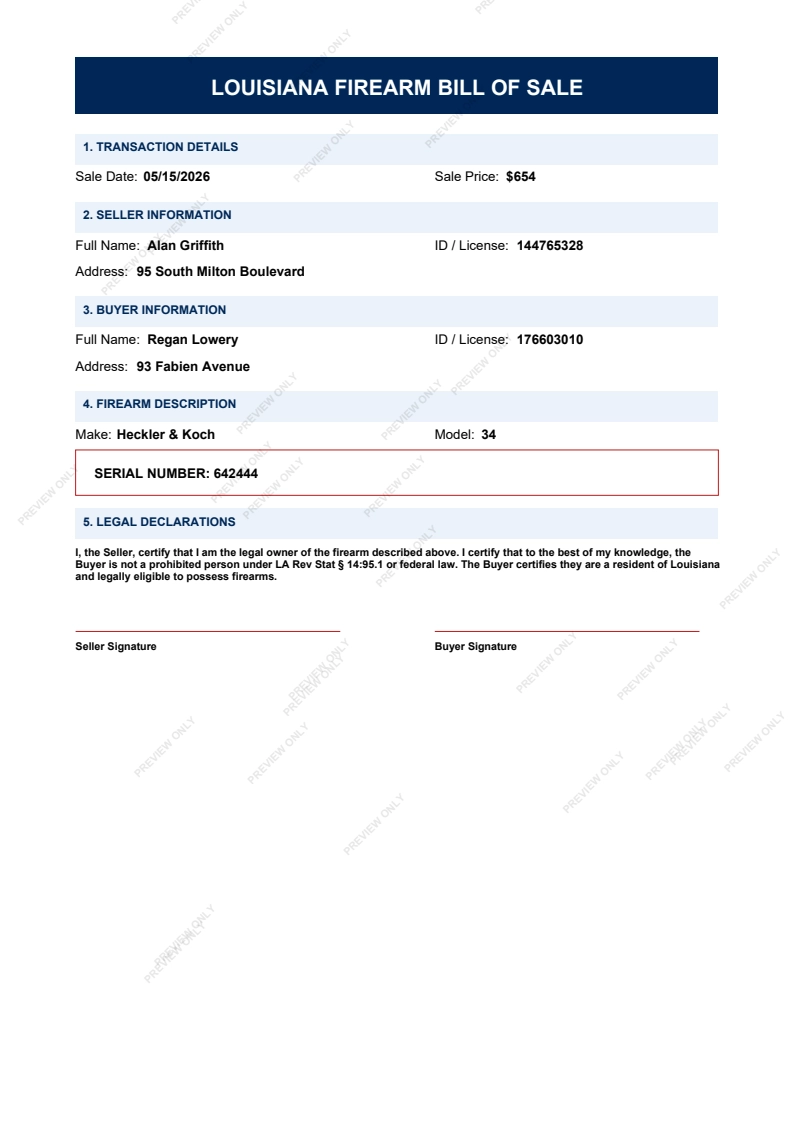
Louisiana became a Constitutional Carry state on July 4, 2024, when Governor Jeff Landry signed Senate Bill 1 into law — making it the 27th state to adopt permitless carry. Private sales here require no background check, no waiting period, and no state paperwork. Louisiana's civil law tradition also makes notarized signatures common practice for private transactions generally, and many sellers choose to have their firearm Bill of Sale signed before a notary public and witnesses for extra legal protection — though this isn't a specific requirement written into Louisiana's firearm statutes. This 2026 form documents the agreed price, the firearm's serial number, and the buyer's ID, with space for witness signatures and notary acknowledgment if you choose to use them.
📄 Pelican State Form Blueprint Preview:
Louisiana's Quirks Are Above — The Form Itself Isn't One of Them
The duty-to-inform rule, notarization tradition, and strict scrutiny standard above are specific to Louisiana. Filling out and signing the Bill of Sale itself works the same basic way in every state.
See our nationwide Step-by-Step Firearm Bill of Sale Guide for that walkthrough.
📋 Louisiana Legal Essentials for Private Sellers
1. Constitutional Carry Arrived Later Than Most Sources Say — And Comes With a Duty to Inform
Louisiana became a Constitutional Carry state on July 4, 2024, via Senate Bill 1, making it one of the more recent states to adopt permitless carry. Unlike most Constitutional Carry states, Louisiana imposes a mandatory 'duty to inform' — a permitless carrier stopped by a law enforcement officer must immediately disclose that they're armed and submit to a pat-down if requested.
⚠️ Don't confuse Louisiana's permissive private-sale environment with a lack of any rules for the buyer afterward — the duty to inform is a real, mandatory obligation your buyer should understand before carrying the firearm you sold them.
2. Notarization Is Tradition, Not a Legal Requirement
Louisiana's civil law system — a legacy of its French and Spanish colonial history, unique among U.S. states — makes notarized 'authentic acts' a common and respected practice for private transactions generally. A notarized Bill of Sale isn't required by any specific firearm statute, but it does carry stronger evidentiary weight in court than an unnotarized document.
⚠️ Don't assume notarization is legally mandatory for a Louisiana firearm sale — it's a strong, traditional best practice rooted in the state's unique legal history, not a statutory requirement you're violating by skipping it.
3. Louisiana's 'Strict Scrutiny' Standard Is One of the Strongest in the Country
Since a 2012 constitutional amendment, Louisiana courts must apply strict scrutiny — the highest level of judicial review — to any law restricting the right to keep and bear arms. This has triggered numerous court challenges to existing firearm regulations, and while most have survived so far, it makes any future restriction on private sales significantly harder to enact and defend.
⚠️ Don't assume Louisiana's current permissive private-sale rules are at risk of tightening easily — the state's strict scrutiny standard sets an unusually high bar for any new restriction to survive a legal challenge.
4. Felon Prohibition Periods Aren't One-Size-Fits-All
A felony conviction suspends Louisiana firearm rights during any active probation or parole, and for certain offenses, the prohibition extends an additional 10 years after the sentence is fully completed. Not every felony triggers the same timeline, so a buyer's felony history isn't something you can safely estimate on your own.
⚠️ Don't assume a buyer's felony conviction from years ago automatically means they're cleared to buy — the specific offense and completion date both matter, and this isn't something you can verify without asking directly.
5. Strong Preemption Protects Private Sales From Local Interference
Louisiana's statewide firearm preemption law, combined with the state's strict scrutiny constitutional standard, makes it very difficult for parishes or cities to impose additional rules — like magazine limits or extra paperwork — on top of state law.
⚠️ Don't assume a parish or city ordinance you've heard about changes your obligations as a private seller — Louisiana's combination of preemption and strict scrutiny review makes local firearm restrictions unusually hard to sustain.
This information reflects publicly available Louisiana statutes and enforcement practices. Firearm laws can change — always verify the latest rules and consult a qualified attorney.
Louisiana Firearm Transfer FAQ
Why use a Bill of Sale in Louisiana?
Louisiana is a highly permissive state, but without a state registry, you have no proof the gun ever left your hands. Louisiana law prohibits intentionally transferring a firearm to someone you know is a convicted felon, and the Bill of Sale is your primary good-faith defense if that claim is ever made against you.
Does Louisiana require a notary for a private gun sale?
No, it isn't legally required for firearm sales specifically. However, Louisiana's civil law tradition — inherited from its French and Spanish legal history — makes notarized 'authentic acts' common practice for private transactions generally, and a notarized Bill of Sale carries stronger evidentiary weight in court than a simple signed document if the transaction is ever questioned.
What is the 'Duty to Inform' rule in Louisiana?
Louisiana's permitless concealed carry law, enacted via Senate Bill 1 in 2024, includes a mandatory duty to inform. If a permitless carrier is approached by a law enforcement officer in an official capacity, they must immediately disclose that they are armed, and submit to a pat-down and temporary disarmament if requested. This is a critical rule for buyers to know after the sale is complete.
What is the minimum age to buy a gun privately in Louisiana?
The minimum age is 18 for both handguns and long guns in private transactions. Always verify the buyer's Louisiana Driver's License or State ID to confirm they meet this age requirement.
What makes Louisiana's constitutional protection of gun rights unique?
In 2012, Louisiana voters passed an amendment to Article I, Section 11 of the State Constitution, declaring the right to keep and bear arms 'fundamental' and subjecting any restriction to strict scrutiny — the highest level of judicial review. This has led to multiple court challenges to existing firearm laws, making it one of the strongest state-level gun rights protections in the country.
Are there magazine limits in Louisiana?
No. There are no state-level restrictions on magazine capacity or 'assault weapons.' Louisiana's strict scrutiny standard and statewide preemption law make it very difficult for parishes or cities to enact their own stricter rules.
Who is a prohibited person in Louisiana?
Under Louisiana law, a felony conviction suspends firearm rights during probation or parole, and for certain offenses, that prohibition extends for an additional 10 years after the sentence, parole, or probation is completed. Other prohibited persons include those adjudicated as mentally incompetent or subject to domestic violence protective orders.
Can I sell to a resident of Texas, Arkansas, or Mississippi?
No. Federal law prohibits private person-to-person transfers across state lines. The transaction must go through an FFL dealer in the buyer's home state. Selling directly to an out-of-state resident is a federal felony.
Related Forms & Regional Compliance:
Louisiana is part of a solid block of Gulf Coast states with permissive firearm laws. While Texas, Mississippi, and Arkansas all recognize permitless carry, Louisiana’s 'Duty to Inform' law is a critical distinction for travelers. If you are selling to a resident of a neighboring state, federal law mandates that the transfer must be processed by a licensed FFL dealer in the buyer's home state; hand-to-hand sales across the Sabine or Pearl rivers are federal felonies.