Last Updated: Aug 04, 2026
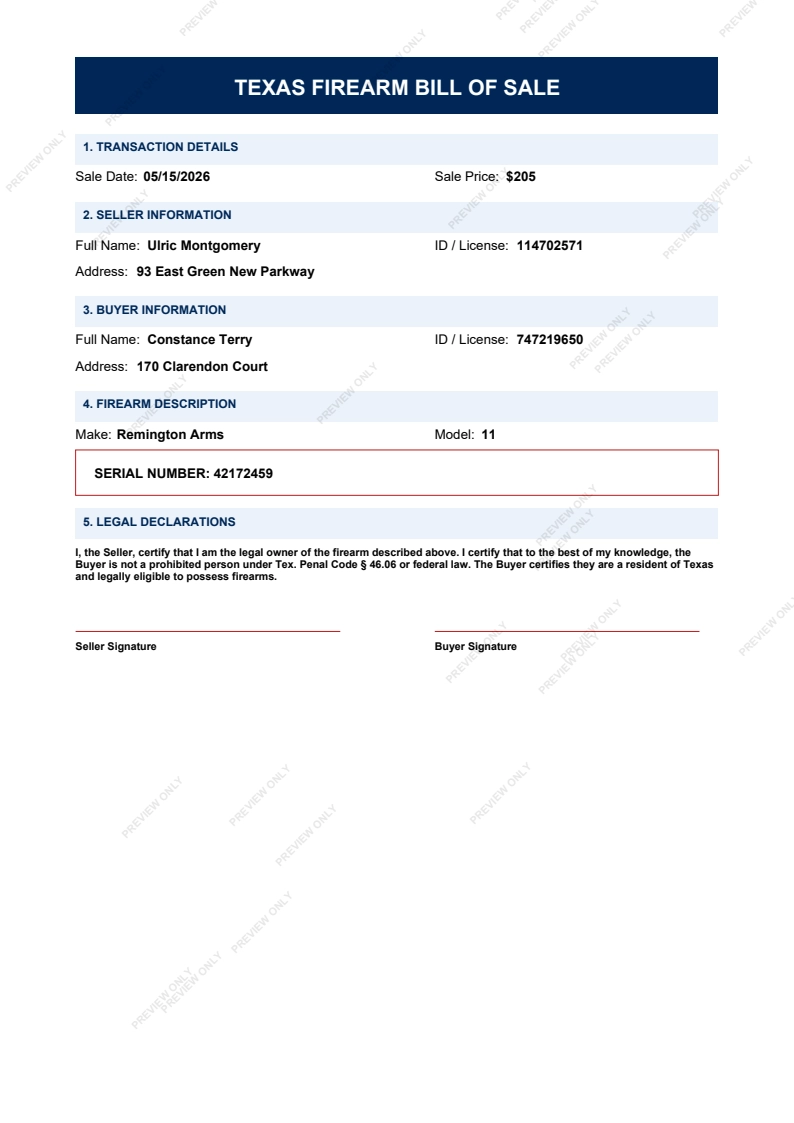
Texas is one of the most permissive states for private gun sales — transfers between individuals require no background check, waiting period, or state registration. That said, Tex. Penal Code § 46.06 makes it a criminal offense to knowingly sell, lease, loan, or give a firearm to certain prohibited people, including someone you know intends to use it unlawfully, an intoxicated buyer, or a convicted felon within five years of release. Most violations are a Class A misdemeanor, but selling a handgun to anyone under 18 is a state jail felony. Recording the buyer's Texas-issued photo ID alongside the firearm's exact serial number is what allows you to demonstrate that due diligence later, if the firearm is ever traced by law enforcement or the ATF.
Beyond Texas's Rules: Completing the Form
Everything above covers what makes a Texas sale legally sound. For the actual field-by-field process of filling out and finalizing the document — from verifying ID to keeping your copy — see our nationwide Step-by-Step Firearm Bill of Sale Guide.
📋 Texas Legal Essentials for Private Sellers
1. Selling to Minors Carries Real Felony Risk
Texas allows private handgun sales to adults 18 and older — younger than the 21-year floor that applies to licensed dealers. But selling, renting, or giving a handgun to anyone under 18 is a state jail felony under Tex. Penal Code § 46.06, not just a misdemeanor. Long guns to minors carry lower risk but are still restricted in specific circumstances.
⚠️ Don't assume the 18-and-older rule means age verification is optional — a buyer's Texas ID confirming their age and residency is still essential.
2. The 5-Year Rule for Prior Felons
Under § 46.06(a)(4), it's illegal to knowingly sell a firearm to someone convicted of a felony within five years of their release from confinement, parole, or community supervision — whichever is later. After that window, some individuals may legally regain firearm rights, but the rules for confirming this are complex.
⚠️ Don't try to personally verify a buyer's felony history or 'clock' — if you have any reason to believe they're prohibited, walk away from the sale rather than interpret the timeline yourself.
3. How ATF Trace Works in Texas
If a firearm you sold privately is later used in a crime, the ATF traces the serial number back to the last known seller — you. A detailed Bill of Sale showing the buyer's full name, Texas driver's license or LTC number, date of transfer, and exact serial number is your strongest defense if that happens.
⚠️ Recording the serial number from a box label or receipt instead of the firearm itself is not accepted as proof during an ATF trace.
4. Cities and Counties Can't Add Their Own Rules
Texas Local Government Code § 229.001 gives the state sole authority over firearm regulation — cities and counties cannot pass ordinances on the transfer, possession, storage, or licensing of firearms. A 2025 law (SB 2284) expanded this preemption to also cover air guns, archery equipment, knives, and ammunition. The Attorney General can sue any city that violates it.
⚠️ Don't assume Texas has any local exceptions similar to Miami-Dade's gun-show rule in Florida — Texas preemption leaves essentially no room for city or county add-ons.
5. A License to Carry (LTC) Strengthens Your Record
An LTC isn't required to buy or sell privately in Texas, but it's issued by the Texas Department of Public Safety only after a state and federal background check. Recording a buyer's LTC number alongside their driver's license gives you stronger documented evidence of their eligibility at the time of sale.
⚠️ Relying only on a buyer's verbal claim of holding an LTC provides no protection — ask to see the physical license and record the number.
Texas vs. Neighboring States: 2026 Legal Comparison
| Feature | Texas (TX) | Oklahoma (OK) | Louisiana (LA) | New Mexico (NM) |
|---|---|---|---|---|
| Private Sale Allowed | Yes | Yes | Yes | No (FFL Required) |
| Background Check | Optional | Optional | Optional | Mandatory |
| Waiting Period | None | None | None | None |
| Magazine Limits | None | None | None | None |
📄 Lone Star State Form Blueprint Preview:
Texas Firearm Transfer FAQ
Is a Bill of Sale legally required for private gun sales in Texas?
No, Texas law does not require a Bill of Sale for private firearm transfers. However, it is strongly recommended. Without proper documentation, you risk being the last known owner if the firearm is later used in a crime. A well-completed Texas Gun Bill of Sale serves as your best evidence that you performed due diligence and transferred the firearm lawfully. Source: Texas Penal Code § 46.06
Can I legally sell a handgun to an 18-year-old in Texas?
Yes. Texas allows private sales of handguns to individuals aged 18 and older. This differs from federal rules that apply only to licensed dealers (FFLs), who cannot sell handguns to anyone under 21. Selling or giving a handgun to someone under 18 is a state jail felony under Texas law. Always verify the buyer's Texas-issued ID to confirm they are at least 18 and a Texas resident. Selling to an out-of-state minor can violate federal law. Source: Texas Penal Code § 46.06
What if the buyer lies about their eligibility?
Texas law punishes sellers who 'knowingly' transfer a firearm to a prohibited person — most violations of this rule are a Class A misdemeanor. If you take reasonable steps, such as checking a valid Texas ID and having the buyer sign a Bill of Sale affirming their eligibility, you significantly strengthen your legal defense. Documentation helps prove you acted in good faith. Source: Texas Penal Code § 46.06
How does the 5-year rule for felons work in Texas?
Under § 46.06, it's illegal to knowingly sell a firearm to someone convicted of a felony within five years of their release from confinement, parole, or community supervision — whichever is later. Some individuals may regain firearm rights after that period. As a private seller, you should never try to interpret these rules yourself. If you have any reason to believe the buyer is prohibited, do not proceed with the sale. Source: Texas Penal Code § 46.06
Can my city or county pass its own gun sale rules in Texas?
No — Texas has one of the strongest firearm preemption laws in the country. Local Government Code § 229.001 bars cities and counties from adopting any regulation on the transfer, possession, storage, licensing, or registration of firearms. A 2025 law (SB 2284) expanded this further to cover air guns, archery equipment, knives, and ammunition as well. The Texas Attorney General can sue any municipality that violates this and recover its legal costs from the city. Source: Texas Local Government Code § 229.001
Does a Texas License to Carry (LTC) help in a private sale?
It's not required, but it's useful. An LTC is issued by the Texas Department of Public Safety only after the applicant passes a state and federal background check. Recording a buyer's LTC number on the Bill of Sale — alongside their driver's license — gives you stronger evidence that they weren't a prohibited person at the time of the sale, similar to how a CWL functions in other states. Source: Texas DPS – Handgun Licensing
Related Forms & Regional Compliance:
Unlike neighboring states like New Mexico, where background checks are mandatory for all private transfers, Texas continues to allow person-to-person sales without an FFL intermediary. If you are conducting a sale across state lines, for example into Oklahoma or Louisiana, you must follow federal law and use a licensed dealer.