New Mexico's Legal Situation Is Above — The Bill of Sale Isn't Part of the Litigation
The waiting period litigation, the background check requirement, and New Mexico's evolving 2026 legal landscape above are specific to this state. Filling out and signing the actual Bill of Sale — the fields, the description, the signatures — works the same basic way everywhere.
See our nationwide Step-by-Step Firearm Bill of Sale Guide for that walkthrough.
Last Updated: Sep 15, 2026
New Mexico's gun laws are in significant legal flux in 2026. Private sales have required FFL background checks since 2019 (SB 1). A 7-day waiting period was enacted in 2024 (HB 129), but on August 27, 2026, a federal judge issued a final ruling permanently blocking its enforcement as unconstitutional — though the governor's office has signaled it will likely appeal. New Mexico's existing Red Flag (Extreme Risk Protection Order) law has been in effect since 2020; a broader assault weapons and magazine ban was debated in the 2026 legislature but did not pass. This Bill of Sale documents the agreed price and firearm details before you visit the dealer — your private record in a state where the rules keep changing.
New Mexico vs. Southwestern Neighbors: 2026 Comparison
| Feature | New Mexico (NM) | Texas (TX) | Arizona (AZ) | Colorado (CO) |
|---|---|---|---|---|
| Private Sale Background Check | Yes | No | No | Yes |
| Mandatory Waiting Period | Struck Down (Aug 2026, Pending Appeal) | No | No | 3 Days |
| Minimum Age (Private Handgun) | 19 | 18 | 18 | 21 |
| Red Flag Law | Yes (ERPO, Since 2020) | No | No | Yes |
| State Firearm Registry | No | No | No | No |
| Family Transfer Exemption | Yes (Immediate Family) | N/A | N/A | Yes |
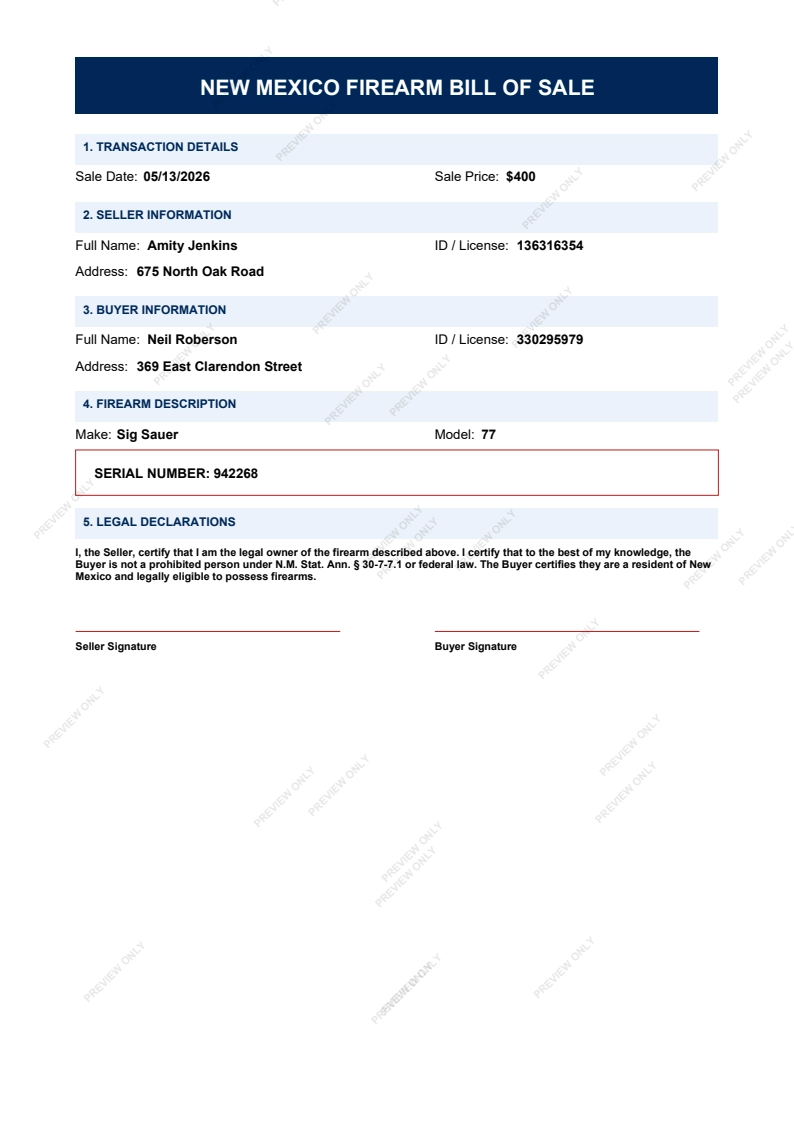
📄 Land of Enchantment Form Blueprint Preview:
📋 New Mexico Legal Essentials for Private Sellers
1. The Waiting Period Just Got Struck Down — But the Situation Is Genuinely Unsettled
New Mexico's 7-day waiting period (HB 129, 2024) has been through multiple rounds of litigation: a Tenth Circuit ruling in August 2025 found it likely unconstitutional, a preliminary injunction followed in February 2026, and a federal judge issued a final ruling permanently blocking enforcement on August 27, 2026. The order technically applies only to the two named plaintiffs, but legal commentators note it may function as broader precedent, and the state has signaled it will likely appeal.
⚠️ Don't assume this is fully resolved either way — verify current enforcement status directly with your FFL dealer, since the practical scope of this ruling is still being debated even among legal experts.
2. The Background Check Requirement Is Older and More Settled Than the Waiting Period
Unlike the waiting period, New Mexico's universal background check requirement has been law since 2019 and isn't currently subject to the same legal challenges. Almost every private transfer — handguns, rifles, and shotguns alike — must go through an FFL dealer for a NICS check, regardless of what happens with the waiting period litigation.
⚠️ Don't let the waiting period's uncertain status make you assume the background check requirement itself is also in doubt — these are two separate legal questions with very different levels of stability.
3. New Mexico's Red Flag Law Isn't New — Don't Let Outdated Sources Confuse You
New Mexico's Extreme Risk Protection Order law has been in effect since 2020, not a recent 2026 addition as some sources incorrectly suggest. A separate, broader gun control bill covering assault weapons and magazine limits was debated in the 2026 session but failed to pass.
⚠️ Don't confuse the long-standing 2020 Red Flag law with the 2026 assault weapons bill that didn't pass — conflating the two creates a inaccurate picture of what's actually current law.
4. The Private-Sale Age Floor Is Higher Than Most States
New Mexico sets 19 as the minimum age for private firearm transfers — both handguns and long guns — stricter than the 18-year federal baseline used in most permissive states. This is a state-specific floor that applies regardless of what an FFL's federal paperwork might otherwise allow.
⚠️ Don't apply the 18-year age floor common in neighboring states like Texas or Arizona — New Mexico's private-sale minimum is specifically 19, one year higher.
5. Sanctuary County Declarations Don't Change Your Legal Obligations
Several New Mexico counties have declared themselves Second Amendment Sanctuaries, suggesting they won't enforce certain state gun laws. These declarations carry little actual legal weight against state preemption and federal supremacy — the FFL background check and reporting requirements remain the only legally safe path regardless of local political statements.
⚠️ Don't assume selling in a 'sanctuary county' changes what's legally required of you — these declarations are political statements, not legal exemptions, and following through an FFL remains the only safe approach.
This information reflects publicly available New Mexico statutes and enforcement practices. New Mexico's firearm laws are subject to significant ongoing litigation — always verify the latest rules and consult a qualified attorney.
New Mexico Firearm Transfer FAQ
Is a background check required for private sales in New Mexico?
Yes. Since 2019, almost all private firearm transfers must be processed through an FFL dealer who conducts a NICS background check. This applies equally to handguns, rifles, and shotguns. Failure to comply is a misdemeanor for the first offense and a felony for subsequent offenses.
What is the current status of New Mexico's 7-day waiting period?
The situation is genuinely unsettled. HB 129 established a 7-day waiting period in 2024, and on August 27, 2026, a federal judge issued a final ruling permanently blocking its enforcement as unconstitutional. Technically, that order applies only to the two named plaintiffs in the case, but legal commentators note it may function as binding circuit precedent more broadly, and the governor's office has signaled a likely appeal. Given this active confusion, verify current enforcement directly with your FFL dealer before finalizing any transfer timeline.
Are there exceptions to the background check requirement?
Yes. Transfers between immediate family members — spouses, parents, children, siblings, and grandparents — are exempt. In-laws are specifically excluded from this exemption. Transfers to law enforcement and transactions involving federally defined antique firearms are also exempt.
Is a Bill of Sale still useful in New Mexico if the FFL handles the paperwork?
Yes. The dealer's paperwork protects the state's interests, but a Bill of Sale is your private contract documenting the agreed price, firearm condition, and serial number. It serves as your proof of transaction in a state with no government firearm registry.
Does New Mexico have a Red Flag law?
Yes — New Mexico's Extreme Risk Protection Order (ERPO) law has been in effect since 2020, allowing courts to temporarily remove firearms from individuals deemed a danger to themselves or others. Sellers should ensure buyers certify on the Bill of Sale that they are not currently subject to an active ERPO.
What is the minimum age for private gun sales in New Mexico?
New Mexico state law sets 19 as the minimum age for all private firearm transfers, handguns and long guns alike — stricter than the federal private-sale baseline. While an FFL will verify this during the background check, sellers should confirm the buyer's age beforehand.
Did a major gun control bill pass in New Mexico's 2026 session?
No. A bill intended to ban certain semi-automatic firearms and magazines holding more than 10 rounds was debated during the 2026 legislative session but did not pass before adjournment. It may be reintroduced in a future session.
Does New Mexico have Second Amendment Sanctuary counties?
Yes, some counties have made such declarations, indicating they may not enforce certain state gun laws. However, these declarations have limited legal weight against federal supremacy and state preemption; following state FFL requirements is the only legally safe course.
Who is prohibited from owning a gun in New Mexico?
Prohibited persons include convicted felons, those with domestic violence convictions, individuals subject to protection orders or active ERPOs, unlawful drug users, and those under age 19 for handgun possession. Selling to a prohibited person remains a criminal offense.
Can I sell to a resident of Texas, Arizona, or any neighboring state?
No. Federal law prohibits private transfers between residents of different states. Selling directly to a resident of Texas, Arizona, Colorado, Utah, or Oklahoma without FFL involvement is a federal felony.
Related Forms & Regional Compliance:
New Mexico is bordered by five states—Texas, Arizona, Colorado, Utah, and Oklahoma. Despite the FFL background check requirement for residents, federal law strictly prohibits hand-to-hand private firearm transfers across state lines to residents of any of these neighbors. Selling directly to a non-resident without FFL involvement is a federal felony. Furthermore, New Mexico sellers must be aware that the state's preemption laws do not apply to the 23 federally recognized tribes within the state, each of which may have its own distinct firearms policies.