Last Updated: Aug 06, 2026
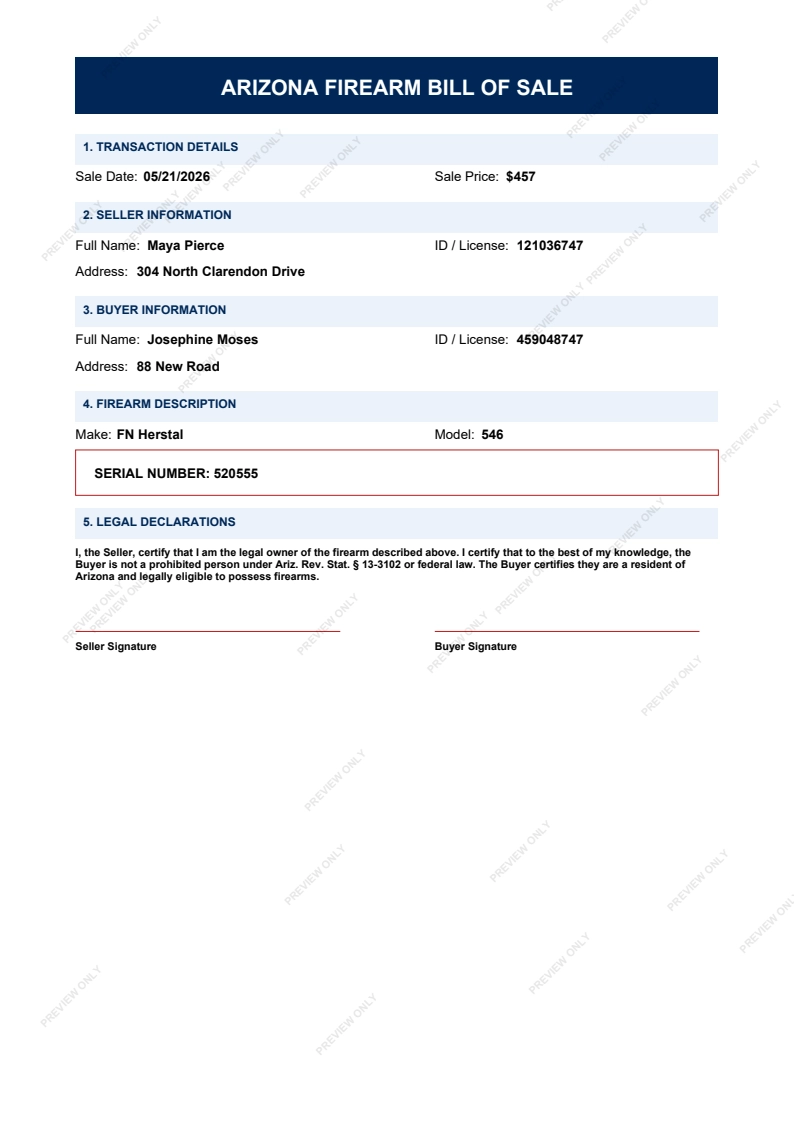
Arizona is widely considered one of the most firearms-friendly states in the U.S. — Constitutional Carry, no mandatory background checks for private transfers, no waiting periods, and no state-level registration. Arizona law strictly prohibits the creation of any firearm registry. That said, under A.R.S. § 13-3102, selling or transferring a firearm to a prohibited possessor is a felony, one of several distinct offenses covered under Arizona's broad 'misconduct involving weapons' statute. Recording the buyer's Arizona-issued ID alongside the firearm's exact serial number is what allows you to demonstrate that due diligence later, if the firearm is ever traced by law enforcement or the ATF — especially valuable in a state that keeps no government database of private sales.
📄 Arizona Transfer Form Blueprint:
How This Arizona Form Fits Into a Full Sale
This page covers what's specific to Arizona. The mechanics of filling out and executing the Bill of Sale itself — who signs where, what to do with each copy — are the same everywhere. See our nationwide Step-by-Step Firearm Bill of Sale Guide for that full walkthrough.
📋 Recent Legal Changes & ATF Practice in Arizona
1. Constitutional Carry & Stable Private Sale Framework
Arizona has maintained Constitutional Carry since 2010. As of 2026 there have been no major new restrictions on private firearm transfers. Private sales between Arizona residents continue to require no background check, no registration, and no waiting period. This long-standing stability makes proper documentation with a Bill of Sale especially valuable for long-term protection.
⚠️ Don't assume 'no background check' means 'no risk' — you can still face felony liability for knowingly selling to a prohibited possessor, even without a check to catch it.
2. How ATF Trace Works in Arizona
If a firearm you sold privately is later used in a crime, the ATF will trace the serial number back to you as the last known owner. Because Arizona has no state firearm registry, your detailed Bill of Sale with the buyer's full name, Arizona-issued ID details, date of transfer, and exact serial number copied from the frame becomes critical evidence during an investigation.
⚠️ Recording the serial number from a box label or receipt instead of the firearm itself is not accepted as proof during an ATF trace.
3. Strong Statewide Preemption & Local Enforcement
Arizona has very strong preemption under A.R.S. § 13-3108. No city or county — including Phoenix, Tucson, or Flagstaff — can enact firearm rules stricter than state law, and any local ordinance that conflicts with state law is null and void. The same statute also bars any local registry or record of firearm ownership.
⚠️ Don't assume a local ordinance you've heard about in a specific city changes your obligations as a private seller — under state preemption, it almost certainly doesn't and may already be legally void.
This information reflects publicly available Arizona statutes and enforcement practices. Firearm laws can change — always verify the latest rules and consult a qualified attorney.
Arizona Firearm Transfer FAQ
Why do I need a Bill of Sale in Arizona?
Arizona does not legally require a Bill of Sale for private firearm transfers. However, with no state registry and no background check requirement, this document is your only reliable proof of the transfer. Under A.R.S. § 13-3102, you must not sell to a prohibited person. A signed Bill of Sale creates a clear paper trail if the firearm is ever traced back to you.
What is the minimum age for private handgun sales in Arizona?
The minimum age for private handgun sales in Arizona is 18. This is lower than the federal dealer requirement of 21. For long guns the minimum age is also 18. Always verify the buyer’s Arizona-issued photo ID to confirm both age and residency.
Are background checks required for private sales in Arizona?
No. Arizona does not require background checks or FFL involvement for private sales between residents. However, under A.R.S. § 13-3102 it is illegal to knowingly sell to a prohibited person. Recording the buyer’s self-certification on the Bill of Sale provides important protection.
Can I sell to a buyer with an Arizona Concealed Weapons Permit (CWP)?
Yes — and it is worth recording on the Bill of Sale. An Arizona CWP means the buyer has already passed a background check. The permit is shall-issue, costs $60 for new applicants, and is valid for 5 years. It also offers reciprocity in many other states.
Is there a gun registry in Arizona?
No. A.R.S. § 13-3108 explicitly prohibits the state or any local government from creating or maintaining a firearm registry. Arizona has strong statewide preemption, so gun laws are uniform across all cities and counties.
Does Arizona have a Stand Your Ground or Castle Doctrine law?
Yes. Arizona has strong self-defense laws, including Stand Your Ground and Castle Doctrine protections for your home, vehicle, and place of business under A.R.S. § 13-411. There is no duty to retreat if you are lawfully present.
Does Arizona have a Red Flag law?
No. As of 2026, Arizona has not enacted an Extreme Risk Protection Order (Red Flag) law. Multiple attempts have failed in the legislature. The state also has no assault weapons ban or magazine capacity limits.
Can I sell a firearm to someone from out of state?
No. Federal law (18 U.S.C. § 922) prohibits private person-to-person transfers across state lines. Arizona borders California, Nevada, Utah, and New Mexico — sales to residents of any of these states must go through a licensed FFL dealer.
Is a Tribal ID acceptable for verification?
Yes. Any government-issued photo ID proving Arizona residency and age is generally acceptable, including Tribal IDs from federally recognized tribes. However, firearm rules on tribal land are set by the sovereign nation itself.
How long should I keep the Bill of Sale?
Indefinitely. ATF traces can occur many years later. Since Arizona has no state registry, your Bill of Sale is often the only document proving you no longer own the firearm. Keep both a physical copy and a digital backup.