Last Updated: Aug 07, 2026
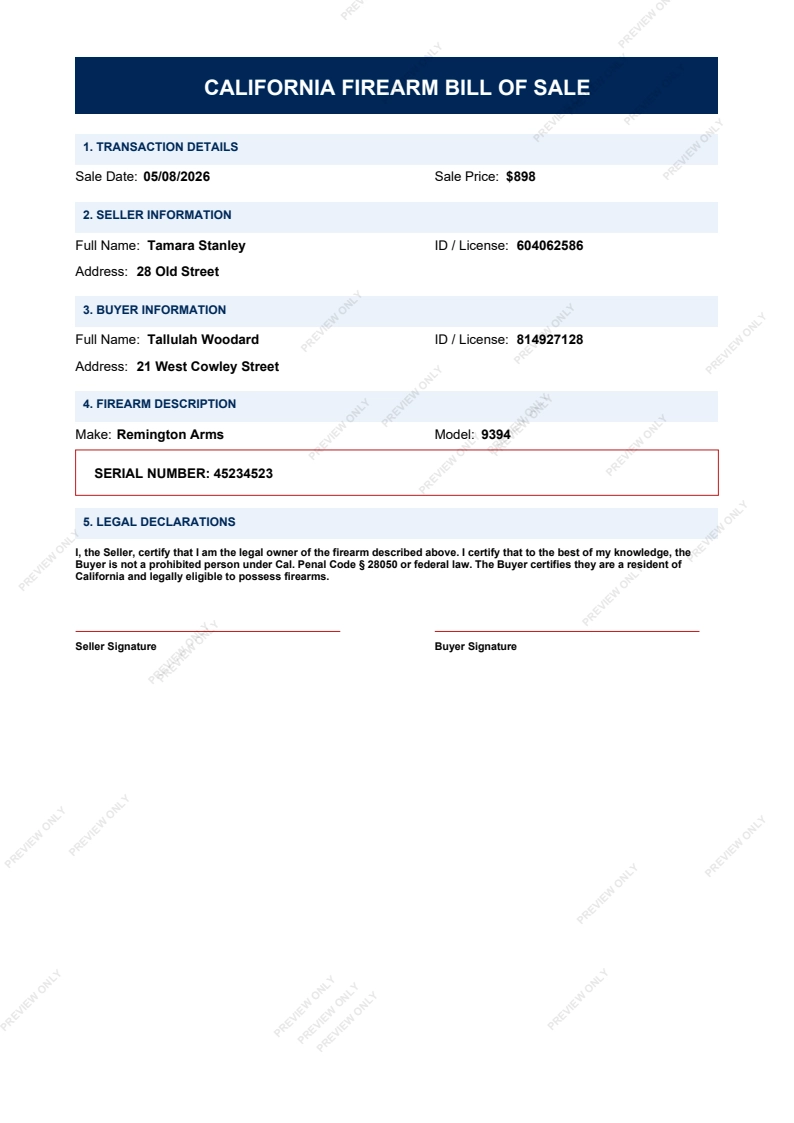
California is the most regulated state in the country for private firearm sales. Under Cal. Penal Code §§ 27545 and 28050, nearly every private transaction must be completed as a Private Party Transfer (PPT) through a licensed FFL dealer, triggering a mandatory background check and a 10-day waiting period — even between two private individuals who already know each other. The buyer must also present a valid Firearm Safety Certificate (FSC) unless exempt. This Bill of Sale documents the agreed price, the firearm's condition, and the transaction details before both parties appear at the dealer to complete the legally required transfer.
📄 CA Firearm Form Draft Preview:
One More Resource Before You Sign
California law is covered in the sections above. The signing and documentation process itself — identical whether you're in California or elsewhere — is explained separately. Check our nationwide Step-by-Step Firearm Bill of Sale Guide if you want that walkthrough.
📋 California Legal Essentials for Private Sellers
1. Nearly Every Sale Must Go Through an FFL
Under Cal. Penal Code §§ 27545 and 28050, almost all private-party transfers must be completed at a licensed FFL dealer, who runs a background check and files a DROS (Dealer Record of Sale). Bypassing this requirement — a true hand-to-hand transfer — is a criminal offense, generally a misdemeanor but a felony in certain circumstances, particularly involving a handgun.
⚠️ Don't assume an exemption applies just because you and the buyer already know each other, are longtime friends, or have done business before — California's PPT requirement applies almost universally, with only narrow statutory exceptions.
2. The 10-Day Wait Applies to Everyone
California mandates a 10-day wait — ten full 24-hour periods — from the moment the dealer files the DROS until the buyer can take possession. This applies even if the buyer already owns firearms or holds a valid CCW permit; there is no 'frequent buyer' exemption for private-party transfers.
⚠️ Don't tell the buyer they can pick up the firearm early because they're 'already a gun owner' — the 10-day clock resets for every DROS transaction, with no exceptions for existing ownership.
3. A New Purchase-Frequency Limit Replaced the Old One
California's old 'one handgun per 30 days' rule was struck down as unconstitutional by the Ninth Circuit in June 2025 (Nguyen v. Bonta). The state responded with AB 1078, effective April 1, 2026, which caps buyers at three handguns or semiautomatic centerfire rifles within any 30-day period — not just one. A few cities, including Los Angeles, still have older local ordinances being separately challenged.
⚠️ Don't assume the old 'one gun per month' limit is still the law — it's been replaced by the broader '3-in-30' rule, and the local-ordinance situation in some cities remains unsettled.
4. New Pistol Design Restrictions Don't Reach Existing Owners
Effective July 1, 2026, AB 1127 (Cal. Penal Code § 27595) bars dealers from selling new semiautomatic pistols with a 'cruciform trigger bar' design — the feature common to Glock and similar striker-fired pistols that makes them compatible with illegal auto-sear conversion devices. A private-party transfer of an already-owned pistol through an FFL remains legal; the restriction targets new retail sales, not existing ownership.
⚠️ Don't assume a pistol you already legally own becomes unsellable under AB 1127 — the PPT process for existing firearms is unaffected, only new dealer sales of the restricted design are barred.
5. Assault Weapons Need Registration, Not Just Legality
Under Cal. Penal Code § 30515, transferring any firearm defined as an assault weapon is a felony unless that specific firearm is properly registered with the California DOJ. Owning a legal firearm is not the same as being cleared to sell it — registration status must be verified before any PPT is initiated.
⚠️ Don't assume a firearm is transferable just because it was legally purchased — confirm its registration status with the DOJ before scheduling the FFL appointment, since an unregistered assault weapon can't be legally transferred at all.
This information reflects publicly available California statutes and enforcement practices. Firearm laws in California change frequently and litigation status can shift — always verify the latest rules and consult a qualified attorney.
California Firearm Transfer FAQ
Can I sell a gun hand-to-hand in California?
No. California is one of the strictest states in the country for private sales. Almost all Private Party Transfers (PPT) must be processed through a licensed FFL dealer. Both the seller and buyer must physically go to the dealer together, where the dealer files a DROS (Dealer Record of Sale), runs a background check, and starts the mandatory 10-day waiting period. Bypassing this requirement is a criminal offense — generally a misdemeanor, though it can escalate to a felony in certain circumstances, particularly involving a handgun. Source: Cal. Penal Code § 27545
Why do I need a Bill of Sale if the dealer handles the paperwork?
The dealer's DROS form records the transfer for the state — but it does not protect you as the seller. This Bill of Sale is your private contract that documents the agreed sale price, the firearm's condition at the time of transfer, and the buyer's FSC number before you hand anything over to the dealer. If the buyer fails the background check or backs out, this document proves what was agreed and when. It also protects you if a price dispute arises after the DROS is filed.
What is a Firearm Safety Certificate (FSC) and why does it matter?
A Firearm Safety Certificate is a California-specific requirement — buyers must pass a written safety test and hold a valid FSC before they can take possession of any firearm. As the seller, you should verify and record the buyer's FSC number on this Bill of Sale before visiting the dealer. Source: California DOJ – Firearm Safety Certificate
What exactly is the 10-day waiting period in California?
California law mandates a 10-day wait — ten full 24-hour periods — from the moment the dealer files the DROS until the buyer can take possession of the firearm. This applies to every transaction, regardless of how well the parties know each other or whether the buyer already owns firearms or holds a valid CCW permit. Source: California DOJ – Firearms
How much does a California PPT cost?
The total state-mandated fee for a Private Party Transfer is $47.19 — this breaks down to a $37.19 DROS fee plus a $10.00 processing fee the dealer may charge. Dealers are legally required to process PPT requests and cannot refuse, but they cannot charge more than these maximum amounts. Source: CA DOJ Firearms Fee Schedule
Can I bring a gun I bought in another state into California?
Yes, but not without paperwork. If you move to California, you must report it within 60 days using a New Resident Firearm Ownership Report. Bringing in a firearm classified as an assault weapon under California law is illegal regardless of where it was purchased. Source: New Resident Firearm Ownership Report
Are there assault weapon restrictions in California?
Yes, and they are among the strictest in the country. You cannot sell or transfer any firearm defined as an assault weapon unless it is properly registered under state law. Selling an unregistered assault weapon — even privately — is a felony. Source: Cal. Penal Code § 30515
What ID is required in California for a private sale?
A valid California Driver's License or ID card is required. Pay attention to IDs marked 'Federal Limits Apply' — these require additional documentation, like a U.S. passport or birth certificate, to prove lawful presence. Source: California DMV – REAL ID
Can I sell an off-roster handgun privately in California?
Yes — this is one of the few advantages of a PPT. While dealers cannot sell new handguns that aren't on the Roster of Certified Handguns, a private transfer of an off-roster handgun between two California residents remains legal through an FFL. Source: CA DOJ – Roster of Certified Handguns
Is there still a one-gun-per-30-days limit for private sales in California?
No, not in its original form — but the rules changed again recently, so check current status before relying on this. In June 2025, the Ninth Circuit ruled California's original 'one handgun per 30 days' law unconstitutional (Nguyen v. Bonta), and that ruling has since taken effect statewide. California responded with a new law, AB 1078, effective April 1, 2026, which replaced the old rule with a '3-in-30' limit — no more than three handguns or semiautomatic centerfire rifles within any 30-day period. A few cities, including Los Angeles and Inglewood, still have older local one-per-30-days ordinances that are separately being challenged in court.
Are Glocks still legal to sell privately in California in 2026?
Yes, if you already own one. As of July 1, 2026, Assembly Bill 1127 (Cal. Penal Code § 27595) bars licensed dealers from selling new semiautomatic pistols with a 'cruciform trigger bar' — the design feature common to Glock and similar striker-fired pistols that makes them compatible with illegal auto-sear conversion devices. The law does not require existing owners to give up their pistols, and it does not affect private-party transfers of an already-owned pistol conducted through an FFL. Source: Assembly Bill 1127
Related Forms & Regional Compliance:
California stands as the most regulated firearm market in the West. Unlike neighboring Arizona, where private sales require no FFL involvement at all, California requires almost all transfers to be facilitated by an FFL dealer with a 10-day waiting period. Nevada also requires an FFL for private transfers, but without California's waiting period or registration requirement. If you are moving or selling across state lines into Oregon, be aware that you must comply with federal law and use a licensed dealer, as person-to-person transfers between residents of different states are strictly prohibited without an FFL intermediary.