Legal Protocol for Oregon Private Firearm Transfers
The FICS background check, the SB 941 process, and Measure 114's ongoing legal saga above are specific to Oregon. Filling out and signing the actual Bill of Sale — the fields, the description, the signatures — works the same basic way everywhere.
See our nationwide Step-by-Step Firearm Bill of Sale Guide for that walkthrough.
Last Updated: Sep 20, 2026
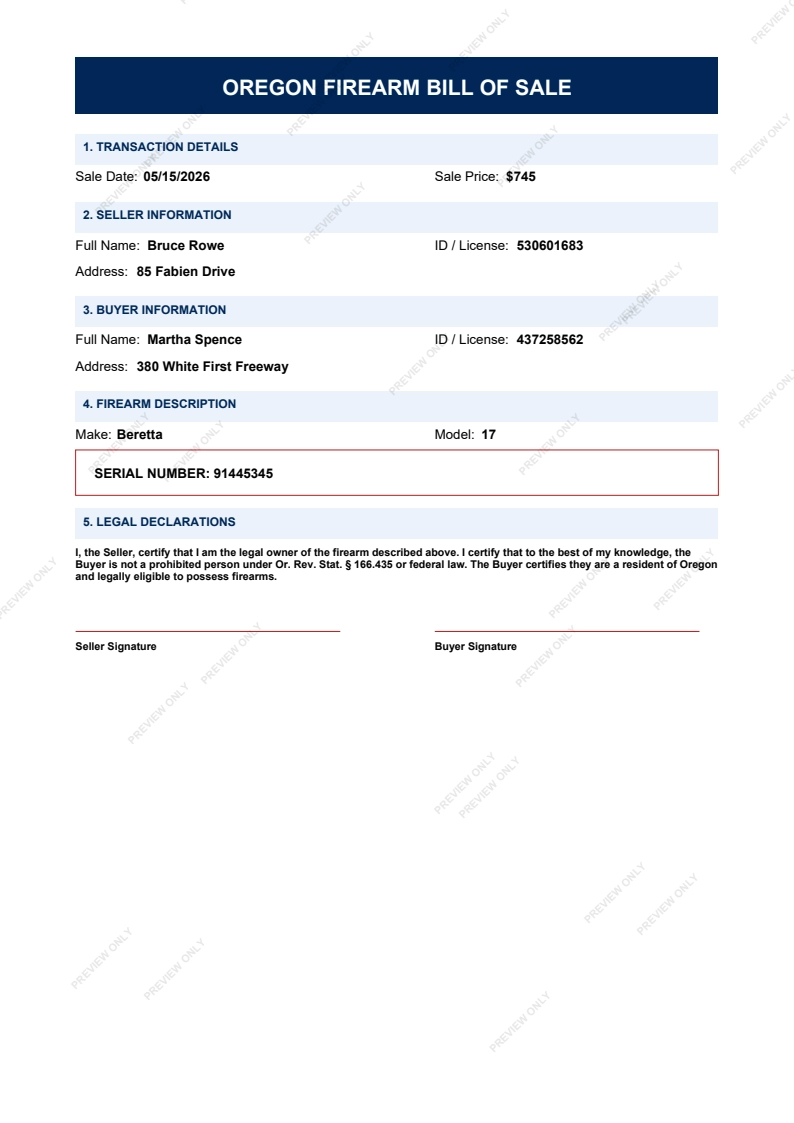
Oregon requires a background check through a licensed FFL dealer for almost every private firearm sale — a rule in effect since 2015 under Senate Bill 941 (the Oregon Firearms Safety Act), which closed the state's earlier 'internet loophole.' Both seller and buyer generally appear together at a dealer who contacts Oregon's own Firearms Instant Check System (FICS), separate from the federal NICS. Measure 114's permit-to-purchase system and 10-round magazine ban, approved by voters in 2022, remain in legal limbo: the Oregon Court of Appeals ruled the law constitutional in March 2025, the Oregon Supreme Court is still reviewing the case, and in 2026 the legislature itself passed House Bill 4145, pushing the law's effective date to January 1, 2028. As of today, you do not need a Measure 114 purchase permit, and the 10-round magazine restriction is not in effect. This Bill of Sale documents the agreed price and firearm condition before you visit the dealer — your private contract that the state's paperwork does not replace.
📄 Beaver State Form Blueprint Preview:
Oregon Firearm Transfer FAQ
Are background checks required for private sales in Oregon?
Yes — Oregon has required background checks for all private firearm transfers since 2015 under the Oregon Firearms Safety Act. Under ORS § 166.435, both seller and buyer must appear together in person at a licensed FFL dealer who contacts the Oregon Firearms Instant Check System (FICS) — Oregon's own background check system separate from the federal NICS. A direct hand-to-hand private transfer is a Class A misdemeanor for a first offense and a Class B felony for repeat violations.
What is Oregon's FICS system and how is it different from NICS?
Oregon's Firearms Instant Check System (FICS), operated by the Oregon State Police, is a state-level background check system that searches both Oregon and federal databases simultaneously. Unlike states that contact the FBI's NICS directly, Oregon routes all checks through OSP's FICS unit. The system provides three responses: Approved (approximately 96% of checks, typically within minutes), Denied, or Pended/Delayed. If FICS cannot complete the check within 30 minutes, OSP must notify the dealer with an estimated completion time. Records of transactions are kept for five years and are exempt from public inspection.
Is a Bill of Sale still useful if the FFL handles the paperwork?
Yes — the FFL's records and the FICS approval protect the state's interests, not yours personally. The Bill of Sale is your private contract that documents the agreed price, the firearm's condition at the time of transfer, and the serial number before you hand anything to the dealer. Under ORS § 166.470, Oregon prohibits knowingly transferring a firearm to a prohibited person — a signed Bill of Sale with the buyer's self-certification is your good-faith defense against this standard.
What are the exceptions to Oregon's background check requirement?
Under ORS § 166.435, limited exceptions apply. Family transfers are exempt — covering spouses, domestic partners, parents, children, siblings, grandparents, grandchildren, aunts, uncles, nieces, and nephews. Transfers to law enforcement officers acting in official capacity are exempt. Temporary transfers at shooting ranges, organized competitions, while hunting, or in genuine emergencies are also exempt. All other private transfers — including sales to friends, acquaintances, and coworkers — require FFL involvement.
What is Oregon's safe storage law?
Oregon's SB 554, signed by Governor Brown in September 2021, requires all gun owners to store firearms in a gun room, locked safe, or with a trigger lock when the firearm is not being physically carried or otherwise under the owner's immediate control. As a seller, you should inform buyers of this obligation at the time of transfer. Additionally, under SB 554, stolen firearms must be reported to local law enforcement within 72 hours of discovering the theft. Failure to report is a violation.
What is the current status of Oregon's Measure 114?
Measure 114, passed by Oregon voters in November 2022, would have required a permit-to-purchase for all firearm acquisitions and banned magazines capable of holding more than 10 rounds. The law has been blocked by ongoing court challenges since December 2022. As of 2026, Measure 114's permit-to-purchase requirement and magazine ban are NOT currently in effect due to court injunctions. Monitor the legal status closely — if the courts ultimately uphold Measure 114, both requirements would take effect. The background check requirement under ORS § 166.435 is separate from Measure 114 and remains fully in effect.
What is the minimum age for private gun sales in Oregon?
The minimum age to purchase any firearm in Oregon — including private sales through an FFL — is 18 for long guns and 21 for handguns. Always verify the buyer's Oregon Driver's License or State ID to confirm both age and state residency before visiting the dealer. Note that if Measure 114 is ever upheld, permit-to-purchase requirements could add additional age-related steps to the process.
Does Oregon have a waiting period?
Oregon does not impose a fixed waiting period. Under ORS § 166.412, once FICS approves the background check, the transfer can proceed immediately. However, if the check is pended or delayed beyond 30 minutes, OSP must provide an estimated completion time — creating a de facto wait. If OSP does not provide notice within three business days, the dealer may release the firearm under the default proceed rule.
Does Oregon require a concealed carry permit?
Yes. Oregon requires a Concealed Handgun License (CHL) to carry a concealed handgun in public — Oregon has not adopted Constitutional Carry. The CHL is shall-issue, valid for 4 years, and costs vary by county. The application requires a background check, fingerprinting, and firearms safety training. Non-residents may also apply for an Oregon CHL if they meet the same requirements. Oregon's CHL is not reciprocal with most other states. Open carry of a loaded firearm in public is generally legal in Oregon without a permit in unincorporated areas, but many cities including Portland prohibit it by ordinance.
Can I sell to a resident of California, Washington, or any neighboring state?
No. Federal law under 18 U.S.C. § 922 prohibits private person-to-person firearm transfers across state lines. Oregon borders four states — California, Nevada, Idaho, and Washington — and selling directly to a resident of any of them without FFL involvement is a federal felony. Note that Oregon's 40-mile rule provides one accommodation: if buyer and seller live more than 40 miles apart, the seller may ship the firearm to an FFL near the buyer rather than requiring both to travel to the same dealer.
Related Forms & Regional Compliance:
Oregon is bordered by Washington, Idaho, Nevada, and California. Crossing state lines for a private sale is strictly prohibited by federal law without an FFL. Residents should note that Washington and California have similarly strict background check requirements, while Idaho remains significantly more permissive.