Last Updated: Aug 09, 2026
Idaho gives private sellers more legal room than almost any other state — no background check, no waiting period, no registration, and no paperwork required by state law. Idaho even has a statute (Idaho Code § 18-3326A) that explicitly prohibits any government agency from maintaining a registry of privately owned firearms. But federal law still holds: under 18 U.S.C. § 922(d), selling to a prohibited person is a federal felony punishable by up to 10 years. Without a signed Bill of Sale, you are the last documented owner of that firearm — forever. This 2026 form gives you a dated, signed paper trail that proves the gun left your hands legally.
📄 Idaho Firearm Receipt Blueprint Preview:
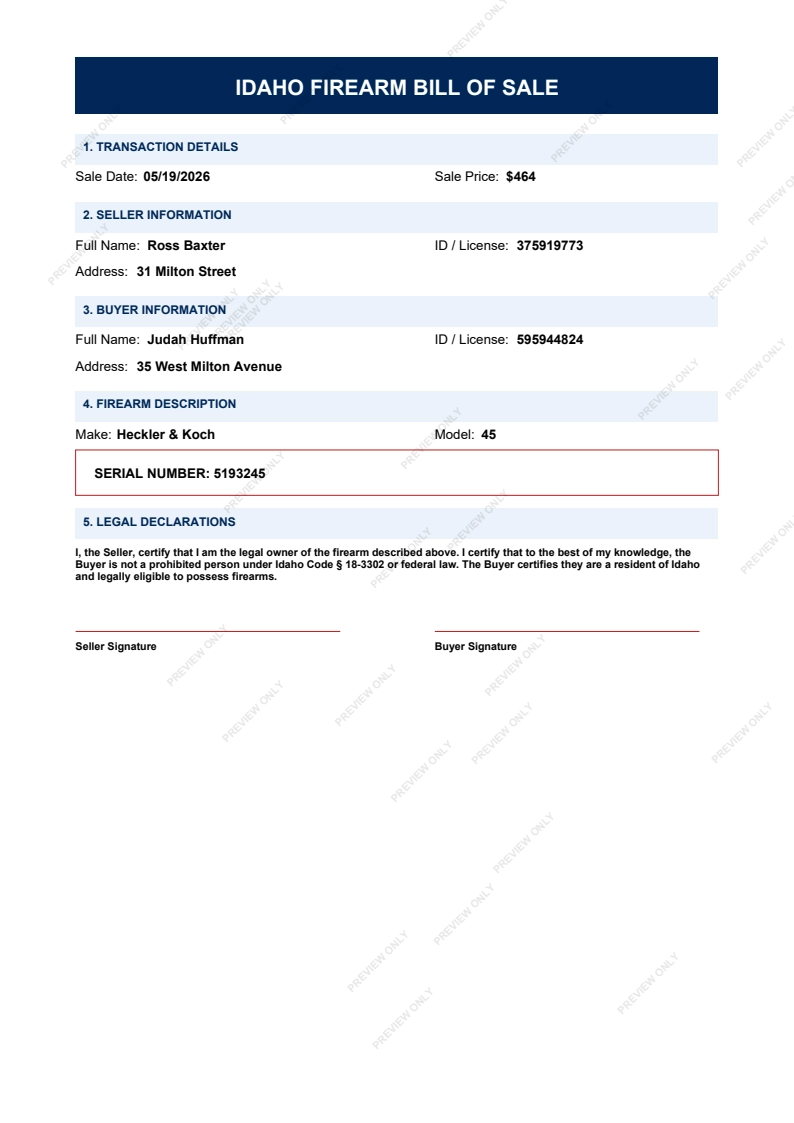
Idaho's Rules vs. the Universal Paperwork Steps
The background check exemption, registry ban, and preemption rules above are specific to Idaho. Actually completing the Bill of Sale — the fields, the signatures, keeping your copy — is the same process no matter which state you're in.
See our nationwide Step-by-Step Firearm Bill of Sale Guide for that walkthrough.
📋 Idaho Legal Essentials for Private Sellers
1. No State Requirement, But Federal Liability Still Applies
Idaho imposes no background check, waiting period, or documentation requirement on private firearm transfers. But federal law (18 U.S.C. § 922(d)) still makes it a crime — punishable by up to 10 years — to sell to someone you know, or have reasonable cause to believe, is prohibited from possessing a firearm. Idaho's hands-off approach doesn't erase that federal exposure.
⚠️ Don't treat the absence of a state requirement as the absence of risk — federal law still holds you personally responsible if you had reasonable cause to suspect the buyer was prohibited.
2. Idaho's Registry Ban Started as a Financial Privacy Law
Idaho Code § 18-3326A is officially the 'Second Amendment Financial Privacy Act,' originally aimed at stopping payment processors from creating special tracking codes for firearm purchases. Its protections extend further: the statute bars any government agency from maintaining a registry of privately owned firearms or their owners at all.
⚠️ Don't assume this statute only covers credit card transactions — its registry ban applies broadly, which is exactly why your Bill of Sale, not any government record, is your only proof of a completed sale.
3. A Concealed Weapons License Isn't a Reliable Eligibility Signal
Idaho has been a Constitutional Carry state since 2020, meaning most eligible adults 18 and older can carry concealed without any license. A buyer without a CWL isn't unusual or suspicious — but a buyer who does hold an Enhanced CWL (which requires an 8-hour live-fire course) has undergone more vetting than the state's baseline requires.
⚠️ Don't assume a buyer without a CWL is less trustworthy — permitless carry means most legally eligible Idahoans simply never bother getting one.
4. The Under-18 Rules Are Sharper Than They First Appear
It's a separate crime for anyone under 18 to possess a handgun, a sawed-off rifle or shotgun, or a fully automatic weapon in Idaho — meaning a private seller who hands over a covered firearm to a minor risks criminal exposure even if no money changed hands. Long guns follow a different track, where a minor can possess one with parental permission or supervision.
⚠️ Don't treat 18 as a flexible guideline — verify age with a valid ID before any handgun transfer, regardless of how mature or responsible a younger buyer seems.
5. Local Governments Can't Add Rules — Idaho's Preemption Is Broad
Idaho Code § 18-3302J bars counties, cities, and any other political subdivision from adopting rules that regulate the sale, transfer, ownership, possession, or storage of firearms or ammunition beyond state law. The one narrow carve-out: local governments can still regulate the discharge of firearms within their boundaries.
⚠️ Don't assume a city ordinance you've heard about — like a local waiting period or extra paperwork — actually applies to you; Idaho's preemption law almost certainly blocks it, aside from discharge rules.
This information reflects publicly available Idaho statutes and enforcement practices. Firearm laws can change — always verify the latest rules and consult a qualified attorney.
Idaho Firearm Transfer FAQ
Is a Bill of Sale required for private sales in Idaho?
No — Idaho requires zero documentation for private firearm transfers. But the ATF trace follows the paper trail to the last documented owner, and that is you until you can prove otherwise. A Bill of Sale with the buyer's ID and the serial number is your only defense if the firearm is later used in a crime.
Does Idaho require a background check for private sales?
No. Idaho has no state law requiring a background check for a private transfer between two residents. Federal law under 18 U.S.C. § 922(d) still prohibits selling to a prohibited person. The Bill of Sale records the buyer's self-certification of eligibility, providing your good-faith defense. Source: 18 U.S.C. § 922(d)
What are the rules for Constitutional Carry in Idaho?
Idaho is a Constitutional Carry state for any U.S. citizen 18 or older, expanded to non-residents and members of the armed forces under a 2020 law. Since permitless carry is the norm, the absence of a license tells you nothing about eligibility. Always verify the buyer's ID to confirm residency and age. Source: Idaho Code § 18-3302
What is the difference between Idaho's Standard and Enhanced CWL?
The Standard CWL requires minimal training, while the Enhanced CWL requires an 8-hour course with live fire. If your buyer holds an Enhanced CWL, it signals a higher level of vetting. Source: Idaho State Police
What is the minimum age for a private sale in Idaho?
The minimum age for a private purchase in Idaho is 18 for all firearms, including handguns. It is a separate crime for anyone under 18 to possess a handgun, a sawed-off rifle or shotgun, or a fully automatic weapon. Never sell to anyone under 18. Source: Idaho Code § 18-3302F
Does Idaho have a gun registry?
No. Idaho Code § 18-3326A explicitly prohibits any government agency from maintaining a registry of privately owned firearms. Your Bill of Sale is a private document and is never filed with any agency. Source: Idaho Code § 18-3326A
Can I sell to a buyer from a neighboring state like Montana or Oregon?
No. Federal law prohibits private transfers across state lines. If the buyer is not an Idaho resident, the transaction must go through an FFL dealer in the buyer's home state to avoid a federal felony.
Are NFA items legal to sell privately in Idaho?
Yes, all NFA items are legal with federal compliance. The ATF Form 4 approval process remains mandatory for all transfers of suppressors or SBRs.
Does Idaho have a Red Flag law?
No. Idaho has no Extreme Risk Protection Order (ERPO) mechanism and has actively resisted such legislation. There is no state-level 'Red Flag' law in Idaho as of 2026.
Is there a waiting period in Idaho?
No. Under Idaho's firearm preemption law, no city or county can impose local waiting periods or other firearm restrictions beyond state law. The rules are uniform statewide: once the Bill of Sale is signed and payment exchanged, the deal is done. Source: Idaho Code § 18-3302J
Related Forms & Regional Compliance:
Idaho remains an island of firearm freedom in the Northwest. Neighboring Montana and Wyoming share Idaho's permissive approach — neither requires a background check, waiting period, or registration for private sales. By contrast, Washington has required universal background checks for private transfers since 2014, and Oregon has required them since 2000, with a 2022 law adding a permit-to-purchase system and magazine limit that remains tied up in litigation. If you are selling to someone from these states, federal law prohibits a direct hand-to-hand transfer; the firearm must be sent to an FFL in the buyer's home state.