Nevada's FFL Process Is Above — The Bill of Sale Isn't Unique
The DPS Point of Contact system, the family exemption list, and Nevada's background check history above are specific to this state. Filling out and signing the actual Bill of Sale — the fields, the description, the signatures — works the same basic way everywhere.
See our nationwide Step-by-Step Firearm Bill of Sale Guide for that walkthrough.
Nevada vs. Southwest Neighbors: 2026 Comparison
| Feature | Nevada (NV) | California (CA) | Arizona (AZ) | Utah (UT) |
|---|---|---|---|---|
| Private Sale Background Check | Yes | Yes | No | No |
| Point of Contact State | Yes | Yes | No | No |
| Handgun Roster | No | Yes | No | No |
| Magazine Capacity Limit | No | Yes | No | No |
| Red Flag Law | Yes | Yes | No | No |
| Minimum Age (Private Handgun) | 18 (21 for Semi-Auto Rifles/Shotguns per AB 245) | 21 | 18 | 18 |
Last Updated: Sep 13, 2026
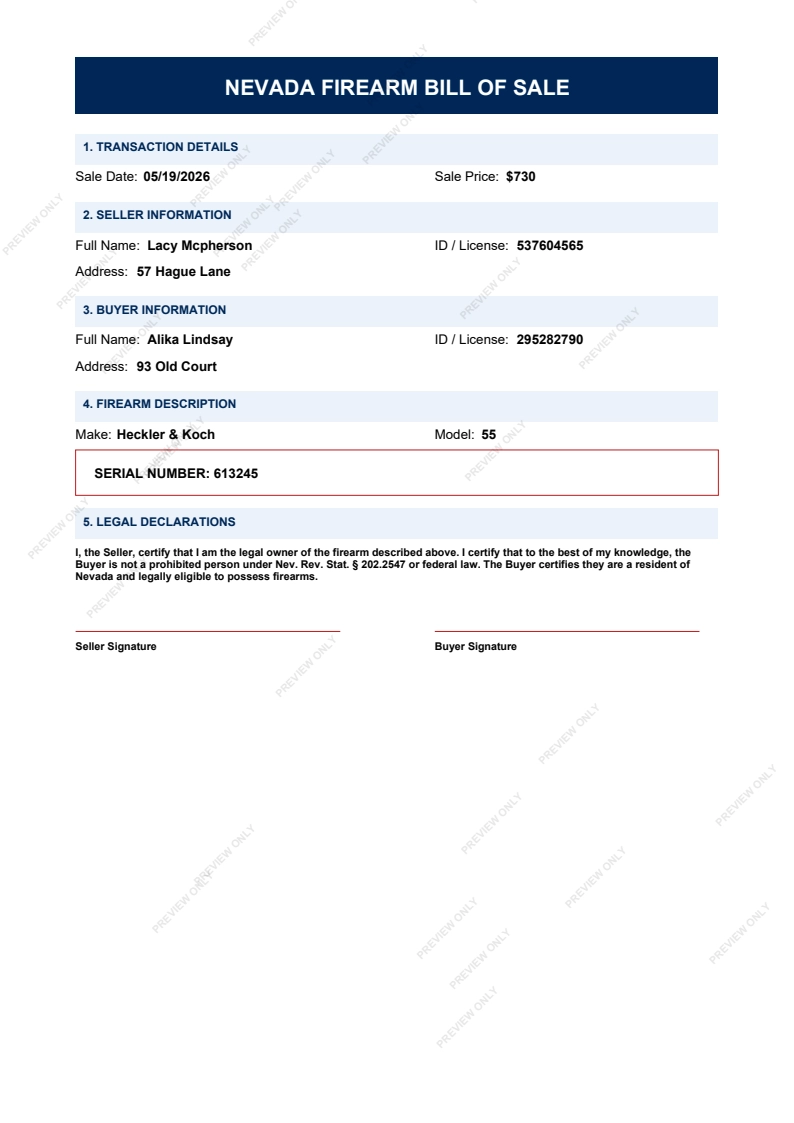
Nevada requires a background check through a licensed FFL dealer for almost every private firearm sale — one of the strictest universal background check systems in the country. This traces back to Question 1, approved by voters in 2016, which was initially ruled unenforceable when the FBI refused to run the required checks. Senate Bill 143 (2019) fixed this by routing background checks through Nevada's own Department of Public Safety instead, finally taking effect on January 2, 2020. Both the seller and buyer must appear together at an FFL dealer, who processes the transfer through this state Point of Contact system. The family exemption covers spouses, domestic partners, and blood relatives including step and adoptive relations — but in-laws are excluded. This Bill of Sale documents the agreed price and firearm condition before you visit the dealer — your private contract that the state's paperwork does not replace.
📄 Silver State Form Blueprint Preview:
Nevada Firearm Transfer FAQ
Are background checks required for private sales in Nevada?
Yes. Under NRS 202.2547, almost all private firearm transfers must be processed through a licensed FFL dealer. The dealer runs the check through Nevada's Department of Public Safety (DPS) Point of Contact system rather than directly through NICS. Both the seller and buyer must appear together at the dealer's place of business. Source: NRS 202.2547
Is a Bill of Sale still useful if the FFL handles the paperwork?
Yes. While the dealer processes the background check, the Bill of Sale acts as your private contract to document the price, the firearm's condition, and the serial number. Since Nevada has no state-level firearm registry, this document is your personal proof of the transaction.
What are the exceptions to Nevada's background check requirement?
Exemptions under NRS 202.2548 include transfers between certain family members (spouses, domestic partners, and blood/step/adoptive relatives), transfers to peace officers or military members in an official capacity, and sales of antique firearms as defined by federal law. Notably, in-laws are not included in the family exemption. Source: NRS 202.2548
Does a Nevada CCW permit skip the FFL requirement for private sales?
No. A valid Nevada CCW permit allows a buyer to skip the NICS background check when buying directly from a dealer's own inventory, but it does not eliminate the requirement for private parties to use an FFL dealer for the transfer itself. Both parties must still visit a dealer to complete the sale.
Is there a waiting period in Nevada?
No. Nevada has no mandatory waiting period. Once the DPS background check is approved, the buyer can take possession immediately. However, if a check is delayed, the dealer may legally proceed with the transfer if three business days pass without a denial.
What is the minimum age for private gun sales in Nevada?
Under NRS 202.310, the minimum age for a private handgun sale in Nevada is 18 — the 21-year floor most people associate with handguns only applies to purchases from a licensed FFL dealer under federal law. Since 2025, however, Assembly Bill 245 sets the age at 21 specifically for semi-automatic centerfire rifles and shotguns, regardless of whether the sale is private or through a dealer. Long guns outside that category remain at 18. Source: NRS 202.310
Are there magazine limits or assault weapons restrictions in Nevada?
No. Nevada has no magazine capacity limits and no assault weapons ban. Additionally, there is no handgun roster, and NFA items like suppressors are legal with federal compliance. As of January 1, 2026, the federal $200 NFA tax stamp was reduced to $0 for suppressors, SBRs, SBSs, and AOWs, though machine guns and destructive devices still carry the full $200 tax.
Who is a prohibited person in Nevada?
Prohibited persons include convicted felons, fugitives, and those with domestic violence convictions. Nevada also utilizes a Red Flag law (Extreme Risk Protection Order), which allows courts to temporarily remove firearms from individuals deemed a risk to themselves or others.
Can I sell to a resident of California, Arizona, or any neighboring state?
No. Federal law prohibits hand-to-hand private firearm transfers across state lines. This includes residents of California, Arizona, Utah, Idaho, and Oregon. The buyer must be a Nevada resident to use the FFL-assisted private party transfer process in the state.
Related Forms & Regional Compliance:
Nevada is bordered by California, Arizona, Utah, Idaho, and Oregon. Despite the FFL-assisted process for residents, federal law strictly prohibits hand-to-hand private transfers to residents of any other state. Nevada’s FFL-assisted private sale path is reserved exclusively for Nevada residents; any interstate transaction must be treated as a standard dealer transfer to the buyer's home state. Sellers should be particularly mindful of the stark legal contrast when dealing with buyers near the California border, where regulations are significantly more restrictive.