Last Updated: Sep 28, 2026
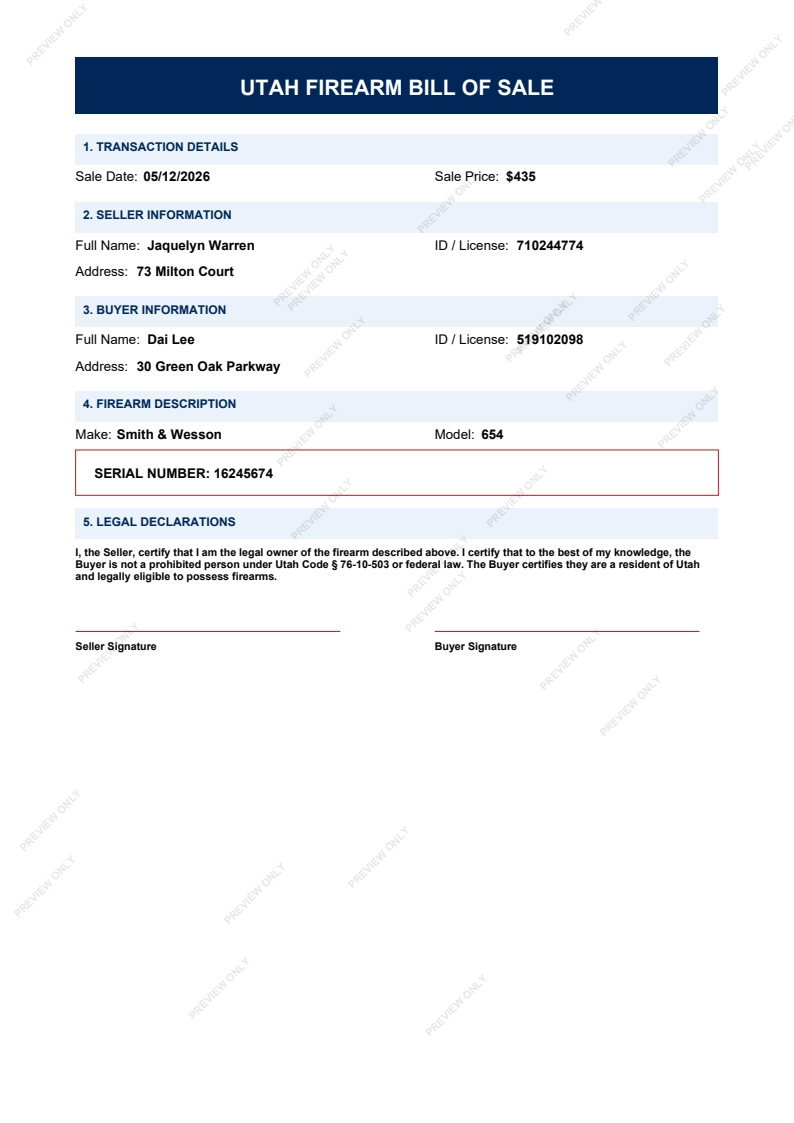
Utah was the 17th state to adopt Constitutional Carry, effective May 5, 2021 under House Bill 60 — and March 2026 brought three additional pro-gun bills signed by Governor Cox: House Bill 84 (campus carry expansion), House Bill 214 (firearm industry liability protections extending PLCAA-like coverage to accessories like suppressors), and House Bill 314 (eliminating a duplicative state-specific FFL form not required under federal law). Private sales require no background check, no permit, no waiting period, and no registration. Utah offers a unique voluntary tool: the Bureau of Criminal Identification (BCI) online portal (serialandcfp.ps.utah.gov) lets sellers verify a buyer's Concealed Firearm Permit validity and check whether a serial number has been reported stolen — without recording any personal data or search history. This Bill of Sale documents the buyer's ID, the serial number, and the transfer date — your only paper trail in a state that prohibits any government registry.
Utah's BCI Portal Is Above — The Bill of Sale Itself Is Standard
The BCI verification portal, the CFP system, and Utah's 2026 legislative changes above are specific to this state. Filling out and signing the actual Bill of Sale — the fields, the description, the signatures — works the same basic way everywhere.
See our nationwide Step-by-Step Firearm Bill of Sale Guide for that walkthrough.
📄 Beehive State Form Blueprint Preview:
📋 Utah Legal Essentials for Private Sellers
1. The BCI Portal Is a Rare, Genuinely Useful Voluntary Tool
Authorized under UCA § 76-10-526.1, Utah's BCI portal (serialandcfp.ps.utah.gov) lets a private seller verify a buyer's CFP validity and check whether a serial number has been reported stolen — without recording any personal data or search history. Few other permissive states offer anything comparable for private sellers.
⚠️ Don't skip this free, anonymous check just because it's optional — it takes minutes and gives you documented good-faith evidence that no other permissive state's private sellers typically have access to.
2. 'Unloaded' Has a Very Specific, Counterintuitive Legal Meaning
For open carry without a permit, Utah's legal definition of 'unloaded' means no round in the chamber and at least two mechanical actions away from firing — a handgun with a fully loaded magazine but an empty chamber legally qualifies as 'unloaded' under this standard. This surprises many buyers and out-of-state visitors.
⚠️ Don't assume 'unloaded' means what it sounds like — under Utah's specific legal definition, a magazine can be fully loaded and the firearm still counts as unloaded, as long as the chamber itself is empty.
3. A CFP Signals Real Vetting — And Broad Reciprocity
Utah's optional Concealed Firearm Permit requires a background check and safety course, and a valid CFP exempts the holder from the point-of-sale NICS check at licensed dealers. A buyer's CFP is strong evidence of eligibility precisely because it means they already passed a background check to get it.
⚠️ Don't treat a buyer's lack of a CFP as unusual — Constitutional Carry means most eligible Utahns 21 and older don't need one, so its absence tells you nothing on its own.
4. March 2026 Brought Three Distinct Legal Changes — Know Which Is Which
House Bill 84 expanded campus carry while banning open carry on campuses, House Bill 214 extended liability protections to firearm manufacturers and sellers (including accessories like suppressors), and House Bill 314 eliminated a duplicative state-specific form FFL dealers previously had to use. These are three separate laws addressing different parts of Utah's firearm framework.
⚠️ Don't conflate these three 2026 bills — each addresses a different issue (campus carry, industry liability, and paperwork simplification), and mixing them up can lead to confusion about what actually changed.
5. Long-Standing Self-Defense Law Doesn't Change Sale Requirements
Utah has had Stand Your Ground protections since 1994, among the earliest in the country, plus Castle Doctrine covering home, vehicle, and business. While this reflects Utah's broader pro-gun legal culture, it has no direct bearing on private sale requirements — those remain governed by separate statutes.
⚠️ Don't assume Utah's robust self-defense laws mean anything about sale requirements specifically — self-defense law and private-sale law are separate legal areas that happen to both be permissive in Utah.
This information reflects publicly available Utah statutes and enforcement practices. Firearm laws can change — always verify the latest rules and consult a qualified attorney.
Utah Firearm Transfer FAQ
Is a Bill of Sale required for private gun sales in Utah?
No — Utah prohibits any state or local government from maintaining a registry of firearm transfers or ownership, and there is no documentation requirement for private sales. But the BCI portal and a signed Bill of Sale together provide the strongest good-faith defense available for Utah private sellers. Without some form of documentation, the ATF trace ends at you as the last recorded owner if the firearm ever surfaces in a criminal investigation.
What is Utah's BCI online portal and how does it help private sellers?
Authorized under UCA § 76-10-526.1 (HB226, 2023), Utah's Bureau of Criminal Identification online system lets you verify whether a buyer's Utah concealed firearm permit is valid and check whether the firearm's serial number has been reported stolen. The direct tool is available at serialandcfp.ps.utah.gov, linked from bci.utah.gov. No search is recorded, no personal data is revealed, and no paperwork is generated. Using it is not required but provides documented good-faith evidence that you checked the buyer's eligibility before completing the transfer. Source: Utah BCI Serial & CFP Check
Are background checks required for private sales in Utah?
No. Utah does not require a background check or any other state-specific requirements for private party sales of firearms. However, federal law under 18 U.S.C. § 922 still prohibits selling to a prohibited person. If you want extra protection beyond the Bill of Sale and BCI portal, you can voluntarily use an FFL to run a background check.
What is the minimum age for private gun sales in Utah?
Federal age requirements still apply: 18 for rifles and shotguns, and 21 for handguns. Utah state law mirrors these minimums for private sales. Additionally, Utah prohibits transfers to anyone adjudicated as a juvenile delinquent for a felony-equivalent act within the past 10 years — meaning a 22-year-old with a recent juvenile felony adjudication is still prohibited. Always verify the buyer's Utah Driver's License or State ID.
What is Utah's Concealed Firearm Permit and why does it matter for private sellers?
Utah's optional CFP costs $53.25, is valid for 5 years, and requires a firearms safety course and background check. Under Utah Code § 76-10-526, a valid CFP exempts the holder from the point-of-sale NICS background check at licensed dealers. For private sellers, a buyer's valid CFP is the strongest evidence of eligibility — it means they passed a background check. Record the CFP number on the Bill of Sale. Utah's CFP is recognized in 36+ other states — one of the broadest reciprocity postures in the country.
What is Utah's unique 'unloaded' open carry rule?
Utah allows open carry of unloaded firearms without a concealed firearm permit. 'Unloaded' as it applies here means that there is no round in the firing position (or chamber), and the firearm is at least two 'mechanical actions' from firing. This means a handgun with a loaded magazine but no round chambered qualifies as 'unloaded' in Utah. Loaded open carry or concealed carry requires either a CFP or being 21 or older under Constitutional Carry. This unusual definition surprises many out-of-state visitors.
What did Utah's 2026 legislative session change for gun owners?
The 2026 Utah legislative session produced three notable firearms bills, all signed into law by Governor Cox. HB 84 expanded permitless concealed carry on public college and university campuses for adults 21+ and provisional CFP holders aged 18-20, while simultaneously banning open carry on campuses. A second bill strengthened firearm industry liability protections and added preemption preventing local ordinances that expose the industry to litigation. A third bill eliminated a redundant state-specific form that FFL dealers required at point of sale, streamlining dealer purchases.
Does Utah have a Red Flag law?
No. Utah has not enacted an Extreme Risk Protection Order law as of 2026. Utah also has no assault weapons ban, no magazine capacity limits, and no safe storage mandate. Utah's statewide preemption statute prevents any county, city, or municipality from enacting firearms regulations stricter than state law. NFA items including suppressors are legal in Utah and may be used for hunting — one of the more permissive states for hunting with a suppressor.
What are Utah's self-defense protections?
Utah has had Stand Your Ground protections since 1994 — among the earliest in the country. Under Utah Code § 76-2-405, there is no duty to retreat from any place you have a legal right to be if you reasonably believe deadly force is necessary to prevent death or serious bodily injury. Utah also has Castle Doctrine covering home, vehicle, and business. Utah's self-defense laws are considered among the most robust in the country.
Can I sell to a resident of Nevada, Arizona, or any neighboring state?
No. Federal law under 18 U.S.C. § 922 prohibits private person-to-person firearm transfers across state lines. Utah borders five states — Nevada, Arizona, Colorado, Wyoming, and Idaho — and selling directly to a resident of any of them without FFL involvement is a federal felony. Always verify the buyer holds a current Utah Driver's License or State ID before completing any private transfer.
Related Forms & Regional Compliance:
Utah is bordered by Idaho, Wyoming, Colorado, New Mexico, Arizona, and Nevada. While Utah's internal laws are permissive, federal law strictly prohibits the private, hand-to-hand transfer of firearms across state lines to residents of these neighboring states without a licensed FFL dealer. Additionally, while Utah recognizes broad carry rights, residents should be aware of varying restrictions in neighboring states like Colorado, which maintains stricter requirements for background checks and magazine limits.