Last Updated: Sep 13, 2026
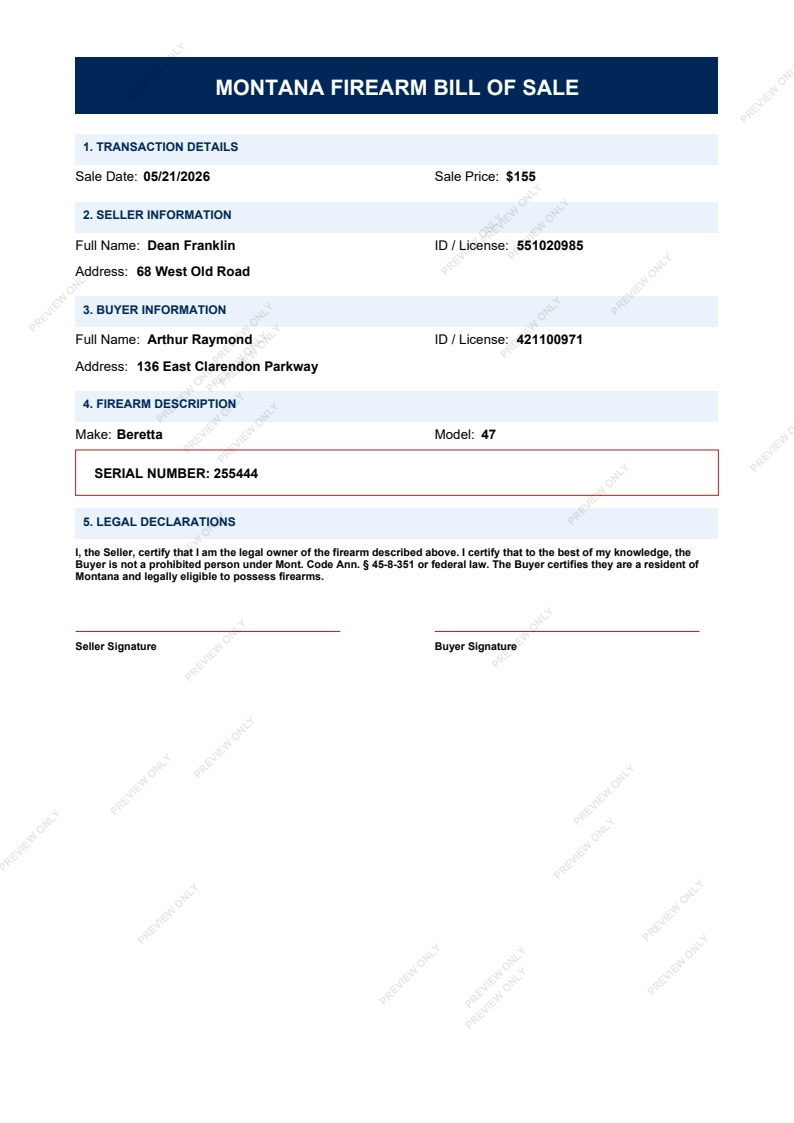
Montana is one of the most firearms-friendly states in the country. Private sales require no background check, no permit, no waiting period, and no paperwork. Montana adopted Constitutional Carry statewide in 2021 with HB 102, eliminating the former rural-area exemption — which previously covered about 99.6% of the state's land but excluded incorporated cities — and allowing anyone 18 or older to carry concealed anywhere in the state. The minimum age for private handgun sales is 18 — lower than the federal dealer requirement of 21. Montana's strong preemption law also bars any city or county from imposing its own firearm registration or licensing requirements. This Bill of Sale documents the buyer's ID, the firearm's serial number, and the transfer date — your only paper trail in a state that keeps no records.
Montana vs. Neighboring States: 2026 Comparison
| Feature | Montana (MT) | Idaho (ID) | Wyoming (WY) | North Dakota (ND) |
|---|---|---|---|---|
| Private Sale Background Check | No | No | No | No |
| Constitutional Carry | Yes | Yes | Yes | Yes |
| State Firearm Registry | None | None | None | None |
| Red Flag Law | Prohibited (Local Level, HB 809) | No | No | No |
| Minimum Age (Private Handgun) | 18 | 18 | 18 | 18 |
Montana's Freedoms Are Above — The Form Itself Is Standard
HB 102, the MCWP background-check exemption, and Montana's preemption rules above are specific to this state. Filling out and signing the actual Bill of Sale — the fields, the description, the signatures — works the same basic way everywhere.
See our nationwide Step-by-Step Firearm Bill of Sale Guide for that walkthrough.
📄 Treasure State Form Blueprint Preview:
📋 Montana Legal Essentials for Private Sellers
1. HB 102 Closed a Gap Most People Didn't Know Existed
Before 2021, Montana's permitless carry only covered roughly 99.6% of the state's land — the exemption specifically excluded incorporated cities and towns, where a permit was still required. HB 102 eliminated that gap, extending Constitutional Carry statewide so that any resident 18 or older who can legally possess a firearm can now carry openly or concealed anywhere in Montana without a permit.
⚠️ Don't assume a buyer's lack of a Montana Concealed Weapons Permit (MCWP) means anything about their eligibility — since 2021, most legally eligible Montanans in cities and towns no longer need one either.
2. An MCWP Is More Than Just a Carry Credential
Montana Code § 45-8-330 makes MCWP holders exempt from the federal NICS background check when buying a handgun from a licensed dealer — Montana is what's known as a 'Brady permanent exemption' state for this purpose. If your private buyer holds a valid MCWP, that's meaningful evidence they already passed a background check when the permit was issued.
⚠️ Don't treat an MCWP as just a carry permit — it also functions as proof of a completed federal background check, which is useful documentation for a private seller even though Montana itself doesn't require one.
3. Preemption Has Real Carve-Outs for Public Buildings
Montana's preemption law (§ 45-8-351) generally bars cities and counties from regulating firearm sales, ownership, or carrying — but it specifically allows local governments to restrict carrying weapons in publicly owned buildings, parks under their jurisdiction, and schools. This means carry restrictions can genuinely vary by location even in a strongly preemptive state.
⚠️ Don't assume Montana's strong preemption law means zero local variation exists — public buildings and schools are a specific, lawful exception where local restrictions can still apply.
4. Red Flag Laws Are Blocked at Every Level of Government
Montana has no state Red Flag law, and HB 809 (2025) goes further by explicitly barring cities and counties from enacting their own Extreme Risk Protection Order ordinances, backed by civil penalties for violations. This makes Montana one of the few states with an affirmative, multi-level prohibition on this type of law, not just an absence of one.
⚠️ Don't assume a local Montana ordinance could someday create a Red Flag mechanism where the state hasn't — HB 809 specifically closes that door at the local level too.
5. The 2026 NFA Tax Change Has Limits Worth Knowing
The federal $200 NFA tax stamp dropped to $0 on January 1, 2026, but only for suppressors, short-barreled rifles, short-barreled shotguns, and AOWs — machine guns and destructive devices still carry the full $200 tax. The registration, fingerprinting, and background check process through ATF Form 4 remains required either way.
⚠️ Don't assume every NFA item got cheaper — the $0 change applies to a specific list of item types, and a fully automatic firearm still carries the original $200 transfer tax.
This information reflects publicly available Montana statutes and enforcement practices. Firearm laws can change — always verify the latest rules and consult a qualified attorney.
Montana Firearm Transfer FAQ
Is a Bill of Sale required in Montana?
Montana requires zero documentation for private firearm transfers. However, because state law prohibits any government registry, a signed Bill of Sale is your only proof that the firearm was transferred. Without it, an ATF trace will point to you as the last documented owner. A signed document recording the buyer's ID, serial number, and transfer date is your primary defense in a criminal investigation.
What changed with Montana's Constitutional Carry in 2021?
Signed in 2021, HB 102 eliminated restrictions that previously made permitless concealed carry illegal within city and town limits. Now, Constitutional Carry applies statewide; any Montana resident 18 or older who can legally possess a firearm can carry openly or concealed anywhere in the state without a permit. For private sellers, the absence of a permit is now standard.
Are background checks required for private sales in Montana?
No. Montana does not require background checks or FFL involvement for private sales between residents. Notably, Montana is a Brady permanent exemption state under Mont. Code Ann. § 45-8-330; holders of a Montana Concealed Weapons Permit (MCWP) are exempt from NICS checks at dealers. If your buyer has an MCWP, recording it on the Bill of Sale confirms they passed a background check upon issuance.
What is the minimum age for private gun sales in Montana?
The minimum age for private sales of both handguns and long guns in Montana is 18. While federal law requires age 21 for dealer handgun sales, Montana defers to the federal minimum of 18 for private transfers. Always verify the buyer's Montana ID to confirm age and residency.
Does Montana have a Red Flag law?
No. Furthermore, HB 809 (passed in 2025) explicitly prohibits local cities and counties from enacting their own Red Flag or Extreme Risk Protection Order laws. As of 2026, Montana has no ERPO mechanism, no safe storage mandates, and no assault weapons bans.
Can I sell a high-capacity magazine or NFA item in Montana?
Yes. Montana has no restrictions on magazine capacity. For NFA items, Montana imposes no additional state-level restrictions. As of January 1, 2026, the federal $200 NFA tax stamp was reduced to $0 for suppressors, short-barreled rifles, short-barreled shotguns, and AOWs — though machine guns and destructive devices still carry the $200 tax. The ATF Form 4 approval process, registration, and background check remain mandatory regardless of the tax amount.
What are the carry restrictions in Montana?
Carry is prohibited in government offices, K-12 schools, and federal facilities. Under Mont. Code Ann. § 45-8-351, local governments may also prohibit carry in certain public buildings. Tribal reservations, such as the Crow or Blackfeet reservations, are sovereign and have their own specific carry policies; contact tribal authorities before carrying on reservation land.
Who is a prohibited person in Montana?
Prohibited persons include convicted felons, those with domestic violence convictions, and individuals adjudicated as mentally incompetent under 18 U.S.C. § 922(g). Selling to a prohibited person is a federal felony punishable by up to 10 years in prison.