South Dakota's Freedoms Are Above — The Form Itself Is Standard
The 2025 campus carry expansion, the preemption strengthening, and South Dakota's Constitutional Carry history above are specific to this state. Filling out and signing the actual Bill of Sale — the fields, the description, the signatures — works the same basic way everywhere.
See our nationwide Step-by-Step Firearm Bill of Sale Guide for that walkthrough.
Last Updated: Sep 26, 2026
South Dakota is one of the least restrictive states in the country for private gun sales — no background check, no permit, no waiting period, no registration, and no magazine limits. Constitutional Carry has been in effect since July 1, 2019, when Governor Kristi Noem signed SB 47, sweeping away 155 years of concealed-carry licensing requirements. Private sales require no dealer involvement for same-state residents. But under SDCL § 22-14-16, selling to a prohibited person is still a serious offense — and in 2025, South Dakota lawmakers strengthened preemption under HB 1218 and expanded campus carry for enhanced permit holders under SB 100. This Bill of Sale documents the buyer's ID and the transfer date — your only paper trail in a state that explicitly prohibits any government registry.
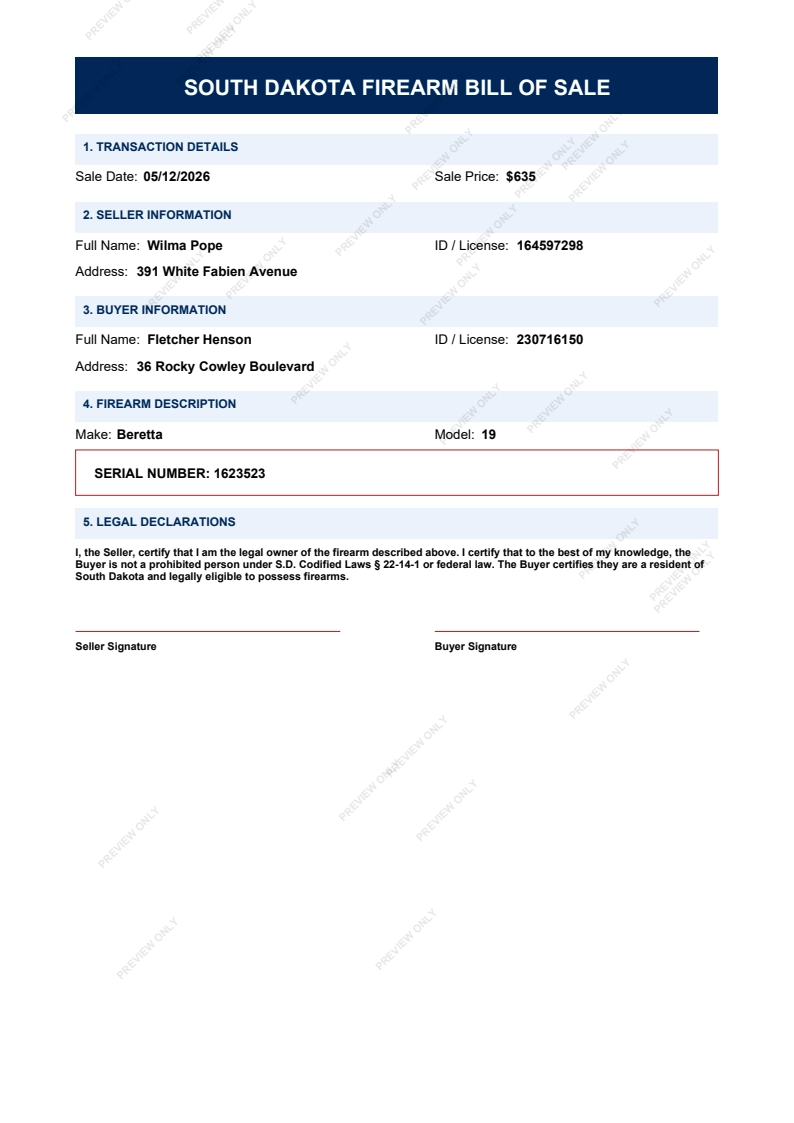
📄 Mount Rushmore State Form Blueprint Preview:
📋 South Dakota Legal Essentials for Private Sellers
1. The Prohibited-Person Rule Uses Time Windows, Not a Lifetime Ban
Unlike the federal lifetime ban for felony convictions, SDCL § 22-14-16 uses specific time windows: a violent crime or certain felony drug conviction within 15 years, a felony drug conviction within 5 years, or a domestic violence misdemeanor within 1 year. Someone could be prohibited under South Dakota law in situations where federal law alone wouldn't disqualify them.
⚠️ Don't assume a buyer's older conviction is automatically irrelevant just because federal law's lifetime ban might not apply the same way — South Dakota's own time-limited categories can still make a sale illegal.
2. Not All CPPs Signal the Same Level of Vetting
South Dakota's Regular CPP requires no training and doesn't exempt holders from a dealer background check, while the Gold Card and Enhanced CPP both confirm the holder already passed a NICS check. If you're looking for the strongest evidence of buyer eligibility, a Gold Card or Enhanced CPP carries far more weight than a Regular CPP.
⚠️ Don't treat every South Dakota CPP as equal proof of vetting — the cheap, training-free Regular CPP tells you much less about a buyer's background than the Gold Card or Enhanced tiers.
3. 2025 Brought Two Separate Laws — Don't Mix Up Which Did What
South Dakota's 2025 session produced SB 100, which expanded campus carry for Enhanced CPP holders at public universities and technical colleges, and separately HB 1218, which strengthened the state's firearm preemption law and added new places-off-limits provisions. These are two distinct bills addressing different topics.
⚠️ Don't conflate SB 100 (campus carry) with HB 1218 (preemption) — they passed in the same session but cover entirely separate ground, and mixing them up leads to confusion about what actually changed.
4. Suppressors Are a Genuine South Dakota Advantage for Hunters
South Dakota allows suppressor use for hunting, a notable exception compared to many other states. Combined with the federal NFA transfer tax dropping to $0 for suppressors as of January 1, 2026, this makes South Dakota an increasingly attractive market for suppressor-equipped hunting rifles.
⚠️ Don't assume suppressor hunting is illegal just because it's restricted in many other states — South Dakota specifically permits it, which is worth mentioning if you're selling a suppressor-ready firearm.
5. Reciprocity for Carry Doesn't Extend to Private Sales
South Dakota recognizes concealed carry permits from every other state, one of the broadest reciprocity postures in the country. But this recognition is strictly about carrying — it doesn't change the residency requirement for a private, intrastate firearm sale.
⚠️ Don't assume a visiting permit holder from another state can participate in a private sale just because their carry permit is recognized here — the buyer still needs to be a South Dakota resident for the transfer to be legal.
This information reflects publicly available South Dakota statutes and enforcement practices. Firearm laws can change — always verify the latest rules and consult a qualified attorney.
South Dakota Firearm Transfer FAQ
Is a Bill of Sale required in South Dakota?
No — South Dakota law explicitly prohibits any state or local government from maintaining a registry of firearm transfers or ownership. This means without a signed Bill of Sale, you have no proof the gun ever left your hands. The ATF trace follows the paper trail to the last documented owner, and that is you until you can prove otherwise. A document with the buyer's ID, serial number, and transfer date is your only defense if the firearm surfaces in a criminal investigation.
Are background checks required for private sales in South Dakota?
No. Private sales between South Dakota residents require no background check, no FFL dealer involvement, no state paperwork, and no waiting period. However, SDCL § 22-14-16 prohibits selling to prohibited persons — including those with violent crime convictions within 15 years, felony drug convictions within 5 years, and domestic violence misdemeanors within 1 year. The Bill of Sale records the buyer's self-certification of eligibility as your good-faith defense. Source: SDCL § 22-14-16
What are South Dakota's three CPP tiers and why do they matter for sellers?
South Dakota offers three optional Concealed Pistol Permit tiers. The Regular CPP costs just $10, requires no training, and is one of the cheapest permits in the country — but it does not exempt holders from background checks at dealers. The Gold Card CPP proves NICS passage and allows holders to skip the dealer background check. The Enhanced CPP requires additional live-fire training, provides the NICS exemption, is recognized in more states for reciprocity, and since 2025 authorizes campus carry at public universities. As a private seller, a Gold Card or Enhanced CPP is the strongest evidence of a buyer's eligibility — but even a Regular CPP should be recorded on the Bill of Sale.
What changed with South Dakota gun laws in 2025?
The 2025 South Dakota legislative session brought several notable changes. SB 100 expanded campus carry — Enhanced CPP holders can now legally carry at public universities and technical colleges statewide, effective July 1, 2025. Separately, HB 1218 strengthened the state's firearm preemption law and added new places-off-limits provisions. The legislature also repealed the longstanding ban on carry in establishments deriving more than half their income from alcohol sales. South Dakota also passed a law prohibiting financial institutions from using specific merchant codes to track firearm and ammunition purchases — part of a national trend of Second Amendment financial privacy legislation.
What is the minimum age for private gun sales in South Dakota?
The minimum age to possess a handgun in South Dakota is 18. For private sales, there is technically no state minimum age for purchase — but possession of a handgun by anyone under 18 requires the presence of a parent, guardian, or licensed firearms safety instructor. For long guns, there is no minimum possession age under state law. Federal law sets the floor at 18 for long gun purchases and 21 for handgun purchases from dealers. In practice, always verify the buyer's South Dakota Driver's License to confirm they are at least 18 before any private transfer.
Are suppressors legal for hunting in South Dakota?
Yes — and this is one of South Dakota's most notable firearm advantages. Suppressors are legal to own in South Dakota with proper federal ATF compliance, and uniquely, they may be used for hunting. As of January 1, 2026, the federal NFA transfer tax for suppressors was reduced to $0, making them significantly more accessible for South Dakota hunters. Fully automatic firearms are prohibited for hunting under state law, but suppressors on legal semi-automatic firearms are permitted for all legal hunting activities.
What are South Dakota's unique time-limited prohibited person rules?
South Dakota's prohibited person statute under SDCL § 22-14-16 is unusually specific with time limits. A person is prohibited if they have a prior conviction for a violent crime or certain felony drug crimes within the previous 15 years, a felony drug conviction within 5 years, or a domestic violence misdemeanor conviction within 1 year. These time-based windows are stricter and more specific than the federal lifetime ban for felonies — meaning someone could be prohibited under South Dakota law even if they would not be prohibited under federal law. Always ask the buyer to certify compliance with all these specific time limits. Source: SDCL § 22-14-16
Does South Dakota have a gun registry?
No — and South Dakota law actively prohibits one. State law explicitly bars any state or local governmental unit from maintaining a registry of firearm transfers or ownership. South Dakota's preemption statute also prevents any county, city, or municipality from enacting firearms regulations stricter than state law — the attorney general is required to seek injunctive relief against any locality that violates preemption. Your Bill of Sale is a private document and is never filed with any government agency.
Does South Dakota recognize out-of-state carry permits?
Yes — South Dakota has near-universal reciprocity and recognizes valid concealed carry permits from all other states. This is one of the broadest reciprocity postures in the country. Combined with Constitutional Carry for residents and non-residents alike since 2019, South Dakota is among the most accessible states for lawful carriers. However, recognizing a permit for carry does not mean the permit holder can participate in a private sale — the buyer must still be a South Dakota resident for a private sale to be legal.
Can I sell to a resident of Minnesota, Nebraska, or any neighboring state?
No. Federal law under 18 U.S.C. § 922 prohibits private person-to-person firearm transfers across state lines. South Dakota borders six states — North Dakota, Minnesota, Iowa, Nebraska, Wyoming, and Montana — and selling directly to a resident of any of them without FFL involvement is a federal felony. Always verify the buyer holds a current South Dakota Driver's License or State ID before completing any private transfer.
Related Forms & Regional Compliance:
South Dakota is bordered by North Dakota, Minnesota, Iowa, Nebraska, Wyoming, and Montana. While South Dakota's internal laws are permissive, federal law strictly prohibits the private transfer of firearms across state lines to residents of these neighboring states without a licensed FFL dealer. Sellers should note that Minnesota and Nebraska have significantly more restrictive regulations regarding permits and background checks compared to South Dakota.