Last Updated: Aug 24, 2026
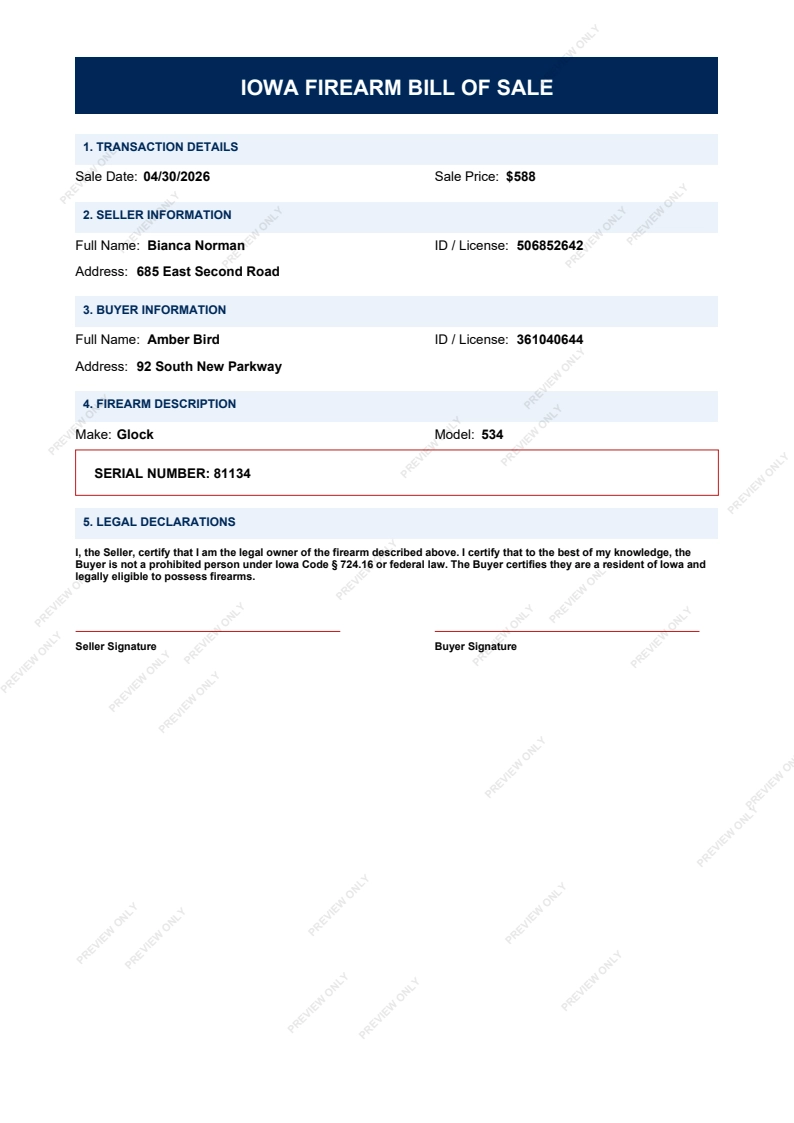
Iowa has been on a rapid pro-gun trajectory — Constitutional Carry since July 2021, a strict scrutiny constitutional amendment passed in 2022, and no Red Flag law. True private sales — between two individuals, not through a licensed dealer — require no permit, no background check, and no paperwork for either handguns or long guns. The Permit to Acquire Pistols and Revolvers or Permit to Carry Weapons requirement only applies when buying from a federally licensed firearms dealer (FFL), under Iowa Code § 724.15. Because Iowa keeps no registry and requires no state involvement in genuine private transfers, this Bill of Sale is your only private record of the agreed price, the firearm's details, and the transfer date — proof the gun left your hands legally.
Iowa vs. Neighboring States: 2026 Legal Overview
| Feature | Iowa (IA) | Missouri (MO) | Illinois (IL) | Nebraska (NE) |
|---|---|---|---|---|
| Private Sale Permit Required | No | No | Yes (FOID) | No |
| Constitutional Carry | Yes | Yes | No | Yes |
| Strict Scrutiny Clause | Yes | Yes | No | No |
| Magazine Limits | None | None | Yes | None |
| Waiting Period | None | None | 72 Hours | None |
📄 Hawkeye State Form Blueprint Preview:
Iowa's Details, Then the Standard Paperwork
The permit rules, constitutional amendment, and age nuances above are specific to Iowa. Actually filling out and signing the Bill of Sale follows the same basic format everywhere.
See our nationwide Step-by-Step Firearm Bill of Sale Guide for that walkthrough.
📋 Iowa Legal Essentials for Private Sellers
1. The Permit Requirement Is About the Dealer, Not the Buyer
Iowa Code § 724.15 requires a buyer to hold a Permit to Acquire Pistols and Revolvers, a Permit to Carry Weapons, or complete a NICS check — but only when buying from a federally licensed firearms dealer (FFL). A true private sale between two individuals triggers none of these requirements, for either handguns or long guns.
⚠️ Don't tell a buyer they need a permit for your private sale — that requirement is specific to dealer transactions, and repeating it as if it applies to you creates confusion about a process you're not actually part of.
2. The 2022 Constitutional Amendment Locks In Iowa's Permissive Approach
Iowa voters added a 'strict scrutiny' standard for the right to keep and bear arms to the state constitution in 2022. Any future gun control law now has to survive the highest level of judicial review, presumed unconstitutional unless the state proves a compelling interest — making it much harder for lawmakers to add new restrictions on private sales going forward.
⚠️ Don't assume Iowa's current permissive rules could easily change with a new legislature — the 2022 amendment raises the bar significantly for any future restriction to survive a court challenge.
3. Federal Law Still Sets a Practical Age Floor for Handguns
Iowa Code § 724.22 restricts handgun possession for most people under 21, separate from any dealer permit process. While a private long-gun sale can go to an 18-year-old, treating 21 as your personal floor for a private handgun sale is the safer, federally-aligned practice, even though Iowa itself doesn't require you to check a permit.
⚠️ Don't assume 18 is a safe age floor for every firearm — long guns and handguns follow different practical age standards, and confusing the two creates real legal risk.
4. Family Transfers Have Their Own Carve-Out, But It's Narrow
Iowa Code § 724.15 exempts transfers between people related within the second degree of consanguinity or affinity (like parents, children, siblings, and grandparents) from the FFL-dealer permit requirement — though this exemption is really only relevant if you were otherwise dealing through a dealer, since true private sales already require no permit regardless of relationship.
⚠️ Don't assume this family exemption is doing extra work for a private sale — since private transfers already require no permit, the family carve-out mainly matters in dealer-facilitated contexts.
5. No Registry, No Red Flag Law — But Federal Liability Still Applies
Iowa keeps no firearm registry, and the 2022 constitutional amendment makes a state Red Flag law unlikely to survive legal challenge. None of that changes federal law: knowingly selling to someone you have reasonable cause to believe is prohibited remains a federal felony, regardless of how permissive Iowa's own rules are.
⚠️ Don't treat Iowa's hands-off state law as the full picture — federal prohibited-person rules apply on top of Iowa law no matter how few state-level hoops you have to jump through.
This information reflects publicly available Iowa statutes and enforcement practices. Firearm laws can change — always verify the latest rules and consult a qualified attorney.
Iowa Firearm Transfer FAQ
Is a Bill of Sale required in Iowa?
Iowa law does not mandate a Bill of Sale for a genuine private transfer, but it is your only proof the sale happened. Iowa keeps no firearm registry and requires no state involvement in private sales, so without a signed document recording the buyer's ID, the serial number, and the date, you have no defense if the ATF traces a crime gun back to you as the last known owner.
Do I need to see a permit for a private handgun sale in Iowa?
No. Iowa Code § 724.15 only requires a Permit to Acquire Pistols and Revolvers, a Permit to Carry Weapons, or a NICS check when buying a handgun from a federally licensed firearms dealer (FFL). A true private sale — between two individuals, not through a dealer — requires none of these. It's still good practice to verify the buyer's ID and note it on your Bill of Sale, but no permit is legally required. Source: Iowa Code § 724.15
What is Iowa's 'Strict Scrutiny' amendment?
In 2022, Iowa voters passed a constitutional amendment adding the right to keep and bear arms to the state constitution with a 'strict scrutiny' standard. This means any new state gun laws are presumed unconstitutional unless the state can prove a compelling interest. For sellers, this helps ensure that Iowa's permissive private sale environment stays legally protected against future restrictions.
What is the minimum age for a private gun sale in Iowa?
18 for long guns. For handguns, federal law generally sets the floor at 18 for a private transfer (21 applies specifically to purchases from a licensed dealer). Iowa Code § 724.22 separately restricts anyone under 21 from receiving a handgun in most circumstances, so treating 21 as your personal minimum for a handgun sale is the safer practice. Source: Iowa Code § 724.22
Does Iowa have a Red Flag law?
No. Iowa does not have an Extreme Risk Protection Order (ERPO) law. The 2022 constitutional amendment's strict scrutiny standard also makes it significantly harder for such a law to be enacted and survive a legal challenge in the future.
Can I sell to a resident of Illinois or Nebraska?
No. Federal law prohibits private person-to-person transfers across state lines. Even though Nebraska is also a Constitutional Carry state, the transfer must go through a licensed FFL dealer in the buyer's home state. Selling directly to an out-of-state resident without an FFL is a federal felony.
Related Forms & Regional Compliance:
Iowa sits in a region of high firearm reciprocity. Neighbors like South Dakota, Missouri, and Nebraska all share Iowa's Constitutional Carry status. However, Illinois to the east remains a strict FOID-required state. If you are selling to someone from a neighboring state, federal law mandates that the transfer must go through a licensed FFL dealer in the buyer’s home state — hand-to-hand private sales across the Mississippi or Missouri rivers are federal felonies.