Last Updated: Sep 13, 2026
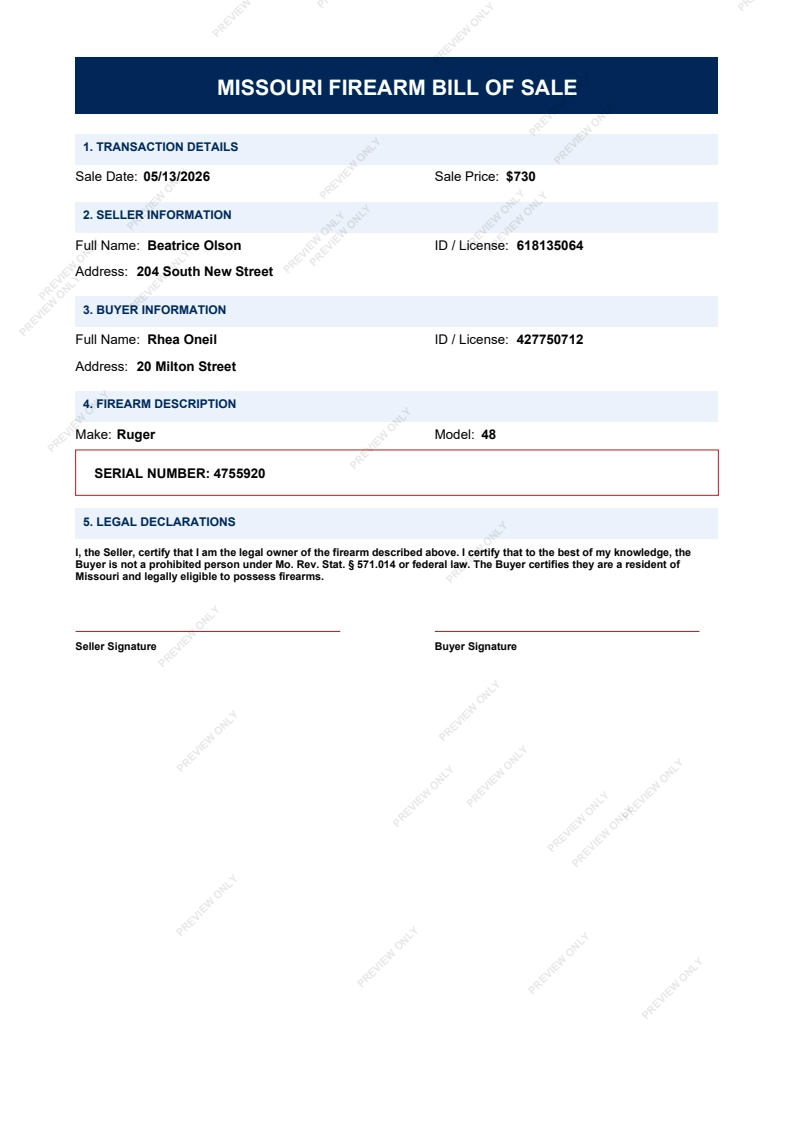
Missouri is one of the most firearms-friendly states in the country. Private sales require no background check, no permit, no waiting period, and no paperwork. Missouri repealed its permit-to-purchase requirement in 2007, making it one of the few states to actually roll back a firearms regulation. The state constitution's Article I, Section 23 requires strict scrutiny for any restriction on the right to keep and bear arms — one of the strongest state-level protections in the country. But federal law still applies: in August 2024, the 8th Circuit Court of Appeals struck down Missouri's Second Amendment Preservation Act (SAPA), which had attempted to bar state and local officials from helping enforce federal gun laws — meaning federal agents continue to enforce federal firearm laws in Missouri without state interference. This Bill of Sale documents the buyer's ID, the serial number, and the transfer date — your only paper trail in a state that keeps no records.
Missouri's Freedoms Are Above — The Form Itself Isn't One of Them
The registry ban, Constitutional Carry age, and Missouri's 2024-2026 legal changes above are specific to this state. Filling out and signing the actual Bill of Sale — the fields, the description, the signatures — works the same basic way everywhere.
See our nationwide Step-by-Step Firearm Bill of Sale Guide for that walkthrough.
Missouri vs. Neighboring States: 2026 Comparison
| Feature | Missouri (MO) | Illinois (IL) | Kansas (KS) | Iowa (IA) |
|---|---|---|---|---|
| Private Sale Background Check | No | Yes | No | No |
| Constitutional Carry | Yes | No | Yes | Yes |
| State Registry Prohibited | Yes | No | Yes | Yes |
| Minimum Age (Private Handgun) | 18 | 21 | 18 | 18 |
| Red Flag Law | No | Yes | No | No |
| Strict Scrutiny Protection | Yes | No | No | No |
📄 Show-Me State Form Blueprint Preview:
📋 Missouri Legal Essentials for Private Sellers
1. No Registry Isn't Just Practice — It's Explicitly Illegal
Under RSMo § 571.500, no state agency or department can compile, maintain, or participate in a database or record of the firearms an individual possesses. Combined with strong preemption under § 21.750, this makes Missouri's hands-off approach to private sales a matter of statute, not just informal practice.
⚠️ Don't assume 'no registry' just means the state hasn't gotten around to building one — Missouri law affirmatively prohibits state agencies from creating this kind of database at all.
2. Two Different Ages Matter for Two Different Things
A buyer can legally purchase a handgun privately in Missouri at 18, but Constitutional Carry doesn't kick in until 19 (or 18 for active military and honorably discharged veterans). This means an 18-year-old can legally own a handgun you sold them but not yet carry it without a permit.
⚠️ Don't confuse the purchase age (18) with the carry age (19) — a buyer being legally able to own the firearm you're selling doesn't automatically mean they can carry it yet.
3. SAPA's Collapse Means Full Federal Enforcement Continues
Missouri's Second Amendment Preservation Act attempted to bar state and local police from helping enforce federal gun laws, but the 8th Circuit struck it down in August 2024 for violating the Supremacy Clause. Federal ATF agents enforce federal firearm law in Missouri exactly as they would anywhere else — SAPA's collapse didn't create a loophole, it just failed to create one.
⚠️ Don't assume SAPA's history means Missouri offers some kind of shield from federal firearms law — that was always the theory, and the courts firmly rejected it.
4. New 2026 Rules Target Ammunition, Not Firearms Themselves
Starting January 1, 2026, Missouri's HB 261 requires ammunition sellers to be licensed by the Secretary of State, and ammunition bought online by Missouri residents must be delivered to a licensed vendor for verification rather than shipped straight to a home address. If your private sale includes ammunition, this new layer of regulation is worth understanding.
⚠️ Don't assume Missouri's permissive firearm-sale environment extends automatically to ammunition — this new 2026 requirement adds a step specifically for ammo that doesn't apply to the firearm itself.
5. Celebratory Gunfire Carries Real, Escalating Penalties
Since Blair's Law took effect in August 2024, recklessly discharging a firearm within or into any Missouri municipality is a crime — a Class A misdemeanor for a first offense, escalating to felonies for repeat violations, regardless of whether anyone is actually hurt. This isn't directly about sales, but it's relevant context if you know a buyer's intended use raises this kind of concern.
⚠️ Don't assume celebratory gunfire is a minor, rarely-enforced issue — Missouri prosecutors have actively pursued charges under this law since it took effect, including multiple cases each holiday season.
This information reflects publicly available Missouri statutes and enforcement practices. Firearm laws can change — always verify the latest rules and consult a qualified attorney.
Missouri Firearm Transfer FAQ
Is a Bill of Sale required in Missouri?
Missouri requires zero documentation for private firearm transfers, and state law under RSMo § 571.500 prohibits any state agency or department from maintaining a database or registry of the firearms an individual possesses. However, without a Bill of Sale, you have no proof the gun left your possession. An ATF trace will lead to the last documented owner, making a private record of the buyer's ID and the serial number your only defense in a future investigation. Source: RSMo § 571.500
What is Missouri's Constitutional Carry age and how does it affect private sales?
Missouri's Constitutional Carry law allows anyone 19 or older (18 for active military and honorably discharged veterans) to carry openly or concealed without a permit. For private sellers, this means the absence of a permit is normal. While the minimum age to purchase a handgun in a private sale is 18, those buyers cannot legally carry under Constitutional Carry until they turn 19. Verify the buyer's Missouri ID and record it on the Bill of Sale.
Can I sell a handgun to an 18-year-old in Missouri?
Yes — the minimum age for private handgun sales in Missouri is 18, which is lower than the federal dealer requirement of 21. For long guns, the minimum age is also 18. Always verify the buyer's Missouri Driver's License or State ID to confirm both age and state residency.
What happened to Missouri's Second Amendment Preservation Act (SAPA)?
The Missouri Second Amendment Preservation Act (SAPA) was declared unconstitutional by the 8th Circuit Court of Appeals in August 2024, for violating the Supremacy Clause by attempting to invalidate federal gun laws within the state. Following this ruling, federal ATF agents continue to enforce all federal firearms laws in Missouri without restriction, including prohibited person rules and interstate transfer laws.
What are Missouri's 2026 ammunition law changes?
Effective January 1, 2026, Missouri's HB 261 requires all ammunition sellers to be licensed by the Secretary of State. Additionally, ammunition purchased online by Missouri residents must now be delivered to a licensed Missouri vendor for verification rather than shipped directly to a home address. Verify how these requirements apply if including ammunition in a private sale.
What is Blair's Law in Missouri?
Blair's Law, effective August 28, 2024, made it a crime to recklessly discharge a firearm within or into any Missouri municipality — commonly known as celebratory gunfire. A first offense is a Class A misdemeanor; a second offense escalates to a Class E felony, and a third to a Class D felony, regardless of whether anyone is actually injured. Selling to someone you know plans to use a firearm for celebratory discharge could create liability exposure.
Are background checks required for private sales in Missouri?
No. Missouri does not require background checks for private sales between state residents. Missouri repealed its permit-to-purchase requirement in 2007. However, federal law under 18 U.S.C. § 922(d) still prohibits selling to a prohibited person; a Bill of Sale acts as your good-faith defense.
What are Missouri's restricted carry locations?
Under RSMo § 571.107, there are specific locations where carry is restricted, including schools, courthouses, and government meetings. Carrying past a 'No Guns' sign is not a criminal offense, but you must leave if asked; failure to do so becomes a trespass issue.
Who is a prohibited person in Missouri?
Prohibited persons include convicted felons, fugitives, and those habitually intoxicated. Missouri law uses a 'reasonably should know' standard; if you suspect the buyer is prohibited, you must refuse the sale. Missouri has no Red Flag law as of 2026.
Related Forms & Regional Compliance:
Missouri shares borders with eight states—Iowa, Illinois, Kentucky, Tennessee, Arkansas, Oklahoma, Kansas, and Nebraska—making it a hub for potential interstate inquiries. However, federal law strictly prohibits hand-to-hand private transfers to residents of any of these states, a rule particularly relevant for sellers in the St. Louis or Kansas City metros. While Missouri maintains a permissive stance, neighbors like Illinois have significantly more restrictive laws. Following the 2024 court ruling against SAPA, Missouri sellers must ensure they do not facilitate cross-border transfers without a licensed FFL to remain compliant with federal enforcement.