Last Updated: Aug 28, 2026
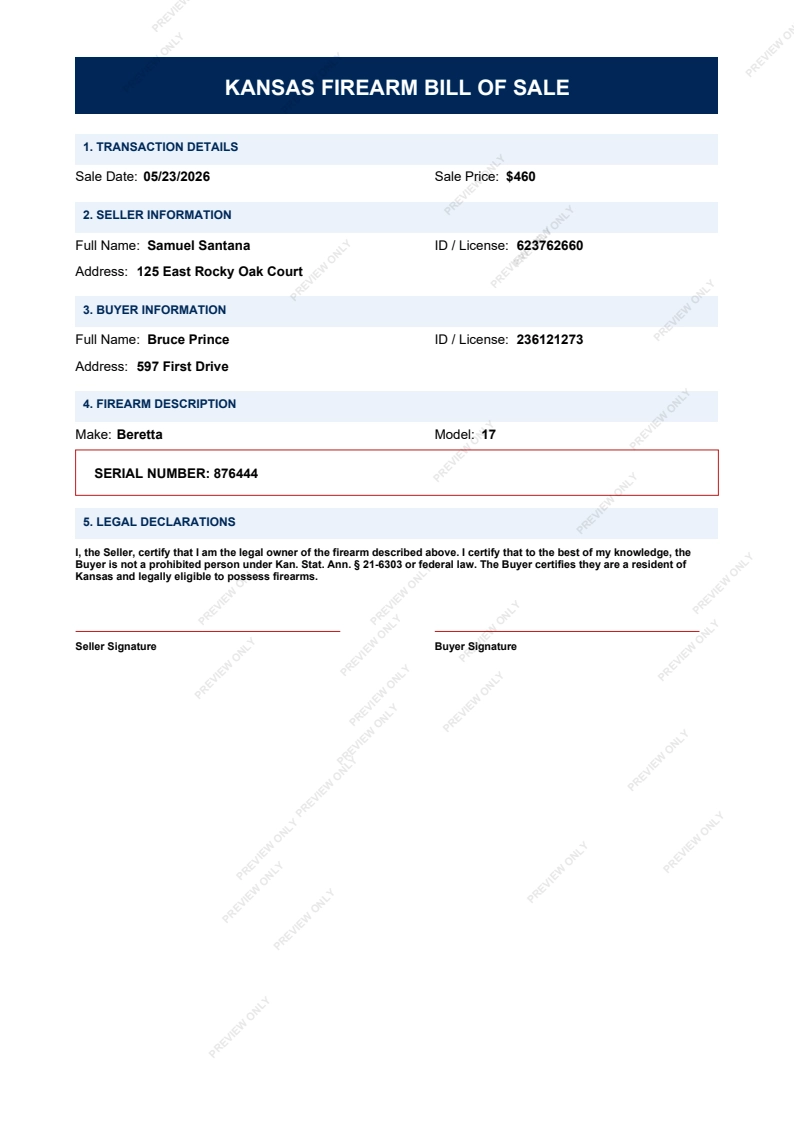
Kansas is one of the most firearms-friendly states in the country — Constitutional Carry since 2015, no background check for private sales, no waiting period, no registration, and no magazine limits. In 2026, Kansas also passed HB 2501, effective July 1, removing the state-level criminal prohibition on suppressors and short-barreled shotguns that had existed separately from federal law. This doesn't eliminate federal oversight — suppressors and SBRs still require NFA registration and ATF approval — but it means Kansans who comply with federal law no longer face a separate state charge. Combined with the federal NFA transfer tax being reduced to $0 under a 2025 federal law, acquiring these items is now more accessible, though the registration and background check process itself remains in place. This Bill of Sale documents the agreed price, the firearm's serial number, and the buyer's ID — your private paper trail in a state that keeps no records.
📄 Sunflower State Form Blueprint Preview:
Kansas Covered, Now the Common Ground
Constitutional Carry, the suppressor law changes, and Kansas's preemption rules above are specific to this state. Filling out and signing the actual Bill of Sale — the fields, the description, the signatures — works the same way everywhere.
See our nationwide Step-by-Step Firearm Bill of Sale Guide for that walkthrough.
📋 Kansas Legal Essentials for Private Sellers
1. No Registry, No Background Check — But Federal Liability Still Applies
Kansas does not require a background check, purchase permit, or registration for private, person-to-person firearm sales, and state law affirmatively bars any local government from creating its own registry or licensing scheme. None of that changes federal law: knowingly selling to someone you have reasonable cause to believe is prohibited remains a federal felony regardless of Kansas's hands-off approach.
⚠️ Don't treat Kansas's lack of state requirements as the full picture — federal prohibited-person rules still apply to every private sale, no matter how few state-level hoops exist.
2. The Suppressor and SBR Rules Are Changing — Verify Current Status
Kansas has moved to remove suppressors, short-barreled rifles, and short-barreled shotguns from its state 'controlled weapons' list, a change driven partly by the federal reduction of the NFA transfer tax. As of mid-2026 this legislation has been moving through the state legislature; confirm its final, current status before relying on it, since federal NFA registration and ATF Form 4 approval remain required either way.
⚠️ Don't assume the state-level change means these items are unregulated — even once fully in effect, it only removes an additional state criminal penalty layered on top of the federal process, which still applies in full.
3. Concealed Carry Age Rules Don't Automatically Set Your Sale Age
Kansas Constitutional Carry allows concealed carry without a license starting at 21, with a provisional license available for residents 18-20. This carry-age framework is separate from any private-sale age requirement — Kansas has no state-specific law setting a minimum age for a private firearm sale, so the practical floor comes from federal guidance: 18 for long guns, 21 as the safer standard for handguns.
⚠️ Don't assume the concealed-carry age of 21 is also the legal minimum age to buy a handgun privately — these are different questions, and confusing them can lead you to either over- or under-restrict who you'll sell to.
4. Strong, Retroactive Preemption Blocks Any Local Add-Ons
Kansas Statute § 12-16,124 gives the state exclusive authority over firearm regulation — no city or county can adopt rules on the sale, purchase, transfer, or possession of firearms, and any conflicting local ordinance adopted before, on, or after July 1, 2015 is automatically void.
⚠️ Don't assume a local ordinance you've heard about in Wichita, Kansas City, or elsewhere changes your obligations as a private seller — Kansas's preemption law is both strong and retroactive, voiding conflicting rules regardless of when they were adopted.
5. Selling to a Prohibited Person Is a Felony, Documentation or Not
Kansas Statute § 21-6303 makes it a felony to knowingly distribute a firearm to a prohibited person. A Bill of Sale that records the buyer's self-certification of eligibility is your strongest good-faith evidence that you took reasonable steps, even though Kansas doesn't require a formal background check process for private sales.
⚠️ Don't rely only on a buyer's verbal assurance that they're eligible — recording their certification in writing on your Bill of Sale gives you something concrete if their eligibility is ever questioned later.
This information reflects publicly available Kansas statutes and enforcement practices. Firearm laws can change — always verify the latest rules and consult a qualified attorney.
Kansas Firearm Transfer FAQ
Is a Bill of Sale required for private gun sales in Kansas?
Kansas law does not mandate a Bill of Sale, but it is your only protection against a 'straw purchase' accusation. In a state with no registry, the ATF trace ends at the last known owner. If that is you, a signed Bill of Sale is your only way to prove you are no longer in possession of the firearm.
What did HB 2501 change for Kansas gun owners in 2026?
HB 2501 removes suppressors, short-barreled rifles (SBRs), and short-barreled shotguns (SBSs) from the state's list of 'controlled weapons,' a change prompted partly by the federal reduction of the NFA transfer tax. ATF Form 4 approval and federal registration are still required regardless of this state-level change. Verify the law's current status via the Kansas Legislature portal before relying on it, since state legislative timelines can shift. Source: Kansas Legislature
What is the minimum age for Constitutional Carry in Kansas?
Kansas allows anyone 21 or older to carry concealed without a permit. Residents 18-20 may apply for a provisional Concealed Carry Handgun License (CCHL) instead. For private sales, Kansas has no state-specific age law beyond the general federal framework — treating 18 as your floor for long guns and 21 for handguns is the safer practice. Source: K.S.A. 21-6302
Does Kansas have a Red Flag law?
No. Kansas has no Extreme Risk Protection Order (ERPO) law.
What are the penalties for selling to a prohibited person in Kansas?
Under K.S.A. 21-6303, knowingly distributing a firearm to a prohibited person is a felony. A Bill of Sale serves as your good-faith evidence that the buyer certified they were legally eligible to purchase the weapon. Source: K.S.A. 21-6303
Can I sell a firearm to a resident of Missouri or Oklahoma?
No. Federal law prohibits private person-to-person transfers across state lines. The transfer must go through a licensed FFL dealer in the buyer's home state. Selling directly to an out-of-state resident is a federal felony.
Is there a magazine capacity limit in Kansas?
No. There are no state-level restrictions on magazine capacity in Kansas. This is protected by the state's comprehensive preemption law, which prevents cities like Wichita or Kansas City from creating their own limits. Source: K.S.A. 12-16,124
Related Forms & Regional Compliance:
Kansas is surrounded by states with similarly robust firearm protections. Missouri and Oklahoma share Kansas' Constitutional Carry stance. However, Colorado to the west has moved in the opposite direction with mandatory background checks and waiting periods. If you are selling to a resident of a neighboring state, federal law still requires the transaction to be completed through an FFL dealer in the buyer's home state.