Nebraska vs. Neighboring States: 2026 Comparison
| Feature | Nebraska (NE) | Iowa (IA) | Kansas (KS) | Missouri (MO) |
|---|---|---|---|---|
| Private Handgun Permit Required | Yes (HPC/CHP) | No | No | No |
| Constitutional Carry | Yes | Yes | Yes | Yes |
| Stand Your Ground | No (Duty to Retreat) | Yes | Yes | Yes |
| Minimum Age (Private Handgun) | 21 (due to HPC) | 18 | 18 | 18 |
| State Firearm Registry | No | No | No | No |
| Family Transfer Exemption | Yes (Specific Relatives) | N/A | N/A | N/A |
Last Updated: Sep 13, 2026
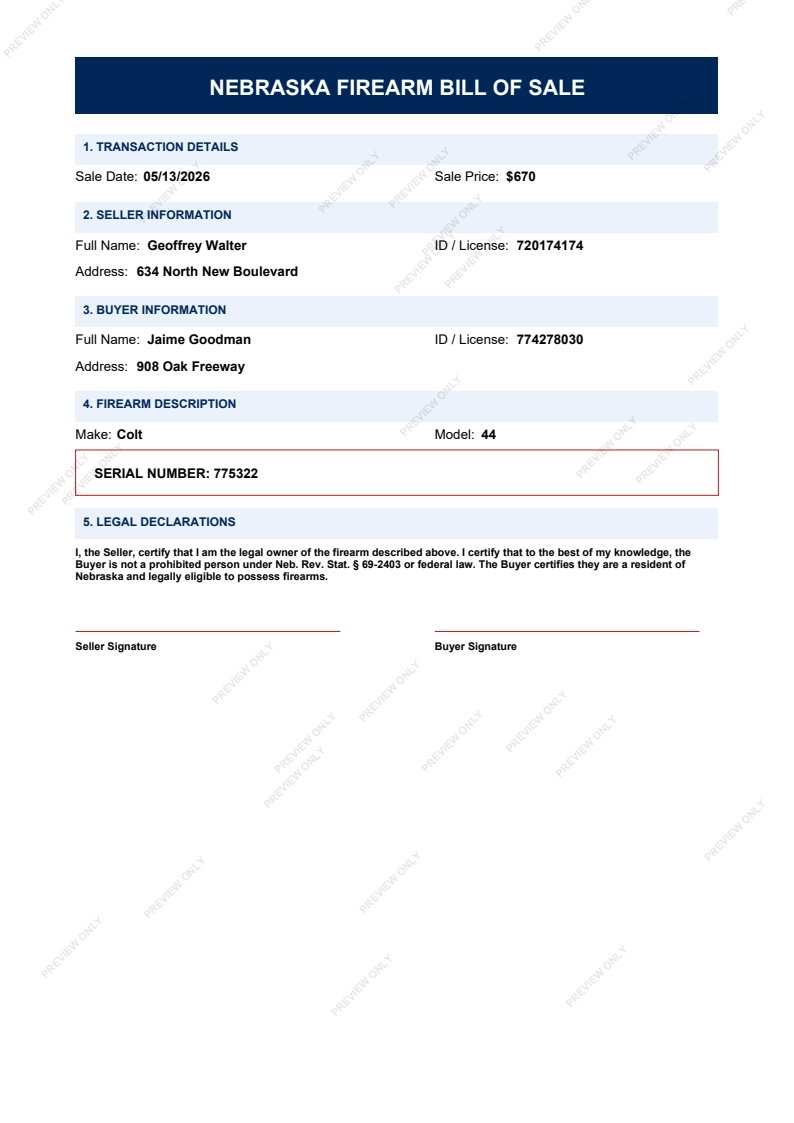
Nebraska still requires a Handgun Purchase Certificate (HPC) for most private handgun sales — even though the state adopted Constitutional Carry in September 2023. The certificate costs $5, is issued by your county sheriff or local police, requires a background check, and is valid for 3 years statewide. Without a valid HPC or Concealed Handgun Permit (CHP), you cannot legally transfer a handgun to a private buyer in Nebraska. Long gun sales have no such requirement. This Bill of Sale documents the buyer's HPC or CHP number, the agreed price, and the firearm's serial number — your private record before and after the county certificate process.
Nebraska's HPC Process Is Above — The Bill of Sale Isn't Unique
The Handgun Purchase Certificate, the family exemption list, and Nebraska's carry-versus-purchase distinction above are specific to this state. Filling out and signing the actual Bill of Sale — the fields, the description, the signatures — works the same basic way everywhere.
See our nationwide Step-by-Step Firearm Bill of Sale Guide for that walkthrough.
📄 Cornhusker State Form Blueprint Preview:
📋 Nebraska Legal Essentials for Private Sellers
1. Constitutional Carry Didn't Touch the Purchase Process
LB 77 (2023) eliminated the permit requirement to carry a concealed handgun for those 21 and older — but it left the Handgun Purchase Certificate requirement completely intact. Carrying and acquiring are two separate legal questions in Nebraska: a buyer can be fully entitled to carry concealed and still be unable to legally receive a handgun from you without an HPC or CHP.
⚠️ Don't assume Constitutional Carry simplified the private-sale process — it changed nothing about the HPC requirement, which remains the central hurdle for a private handgun sale.
2. Carry Age and Purchase Age Are Different Numbers
Permitless concealed carry under LB 77 requires the carrier to be 21 or older (open carry is legal at 18). Separately, the HPC itself requires the applicant to be 21. These numbers happen to align for handguns, but it's worth remembering they're governed by different statutes addressing different questions — carrying versus acquiring.
⚠️ Don't assume an 18-year-old buyer can obtain an HPC just because they can legally open-carry a handgun in Nebraska — the HPC has its own independent 21-year age floor.
3. The Family Exemption Is Broader Than Most Sellers Realize
Neb. Rev. Stat. § 69-2403 exempts transfers to a spouse, sibling, parent, child, grandparent, aunt, uncle, niece, or nephew from the HPC requirement — a longer list than many sellers assume. Relatives by marriage, like a son-in-law or daughter-in-law, aren't included in this list, so those transfers still need a valid HPC or CHP.
⚠️ Don't assume the family exemption only covers immediate relatives like parents and siblings — it extends to aunts, uncles, nieces, and nephews too, though not to in-laws.
4. Long Guns Follow a Completely Different, Simpler Path
The entire HPC system applies only to handguns. Private sales of rifles and shotguns between Nebraska residents require no certificate, no background check, and no state paperwork at all — though federal prohibited-person rules still apply regardless of firearm type.
⚠️ Don't apply handgun rules to a long gun sale by habit — treating a rifle or shotgun sale like a handgun sale means unnecessary steps that Nebraska law doesn't actually require.
5. Nebraska's Self-Defense Law Differs From Most of Its Neighbors
Nebraska imposes a duty to retreat in public if it can be done with complete safety before using deadly force, unlike Stand Your Ground states such as Iowa and Wyoming. Nebraska does maintain Castle Doctrine protections in the home, vehicle, and workplace, where no such retreat obligation applies.
⚠️ Don't assume Nebraska's self-defense law mirrors its permissive gun-sale environment — the state takes a notably different, more restrictive approach to self-defense law than several of its neighbors.
This information reflects publicly available Nebraska statutes and enforcement practices. Firearm laws can change — always verify the latest rules and consult a qualified attorney.
Nebraska Firearm Transfer FAQ
Is a Handgun Purchase Certificate still required in Nebraska?
Yes. This is the most common misunderstanding of the 2023 Constitutional Carry law (LB 77). While you can carry without a permit, Neb. Rev. Stat. § 69-2403 still requires a Handgun Purchase Certificate (HPC) for both dealer and private handgun acquisitions. Transferring a handgun to someone without a valid HPC or CHP is a criminal offense. Source: Neb. Rev. Stat. § 69-2403
How does a buyer get a Handgun Purchase Certificate?
The buyer must apply at their local county sheriff's office or police department. The process requires a Nebraska ID, proof of being at least 21 years old, and a $5 fee. The agency conducts a background check and typically processes the application within 3 days. Once issued, the HPC is valid statewide for 3 years.
Does a Concealed Handgun Permit substitute for the HPC?
Yes. A valid Nebraska Concealed Handgun Permit (CHP) serves as a substitute for the HPC for private handgun sales. CHP holders have already undergone background checks and training, so the separate HPC requirement is waived. You should record the CHP number on the Bill of Sale as evidence of buyer eligibility.
What is Nebraska's Constitutional Carry and what did it actually change?
LB 77 (effective September 2, 2023) allows adults 21 or older to carry a concealed handgun without a permit. However, it did not eliminate the requirement to have an HPC to acquire a handgun — those remain two separate legal questions, governed by different statutes.
What is the family exemption from the HPC requirement?
Under Neb. Rev. Stat. § 69-2403, transfers between certain relatives are exempt from the HPC requirement: spouses, siblings, parents, children, grandparents, aunts, uncles, nieces, and nephews. Relatives by marriage — such as a son-in-law, daughter-in-law, or step-relatives not otherwise covered — simply aren't listed in this statutory exemption, so those transfers still require a valid HPC or CHP. Source: Neb. Rev. Stat. § 69-2403
Are background checks required for private long gun sales in Nebraska?
No. Private sales of long guns between Nebraska residents do not require a background check, HPC, or state paperwork. The HPC requirement is strictly for handguns. However, federal prohibited person rules under 18 U.S.C. § 922(d) apply to all transfers.
Does Nebraska have a duty to retreat?
Yes. While Nebraska has Castle Doctrine protections in your home, vehicle, or workplace, it generally imposes a duty to retreat in public places if it is safely possible to do so before using deadly force. Nebraska does not currently have a full Stand Your Ground law like many of its neighbors.
Can I sell to a resident of Iowa, Kansas, or any neighboring state?
No. Federal law prohibits private person-to-person firearm transfers across state lines. Nebraska borders South Dakota, Iowa, Missouri, Kansas, Colorado, and Wyoming; selling to a resident of any of these states without involving an FFL is a federal felony.
Related Forms & Regional Compliance:
Nebraska is bordered by six states—South Dakota, Iowa, Missouri, Kansas, Colorado, and Wyoming. Despite the permissive laws in many of these neighboring jurisdictions, federal law strictly prohibits hand-to-hand private transfers across state lines. A Nebraska seller must verify the buyer's Nebraska Driver's License and ensure they possess a valid Nebraska-issued permit before finalizing any handgun sale. Sellers should also note that unlike neighbors like Iowa or Kansas, Nebraska maintains a duty to retreat in public spaces.