Kentucky vs. Neighboring States: 2026 Comparison
| Feature | Kentucky (KY) | Tennessee (TN) | Indiana (IN) | Illinois (IL) |
|---|---|---|---|---|
| Constitutional Carry | Yes | Yes | Yes | No |
| Private Sale Check | No | No | No | Yes (ISP) |
| Waiting Period | None | None | None | 72 Hours |
| Assault Weapon Ban | No | No | No | Yes |
| Magazine Limits | None | None | None | Yes |
Last Updated: Aug 31, 2026
Kentucky has been a Constitutional Carry state since July 1, 2019 — any adult 21 or older who can legally possess a firearm may carry concealed without a permit, no training or license required. Private firearm sales here require no background check, no waiting period, and no registration; Kentucky's strong preemption law also keeps these rules uniform across every city and county. In 2026, Kentucky lawmakers overrode a governor's veto to enact new legal protections for firearm manufacturers and sellers against certain lawsuits. None of this changes the seller's own federal responsibility: knowingly transferring a firearm to a prohibited person remains a federal felony regardless of how few state-level requirements apply. This Bill of Sale documents the agreed price, the firearm's serial number, and the buyer's ID — your private record in a state that keeps no registry of its own.
📄 Bluegrass State Form Blueprint Preview:
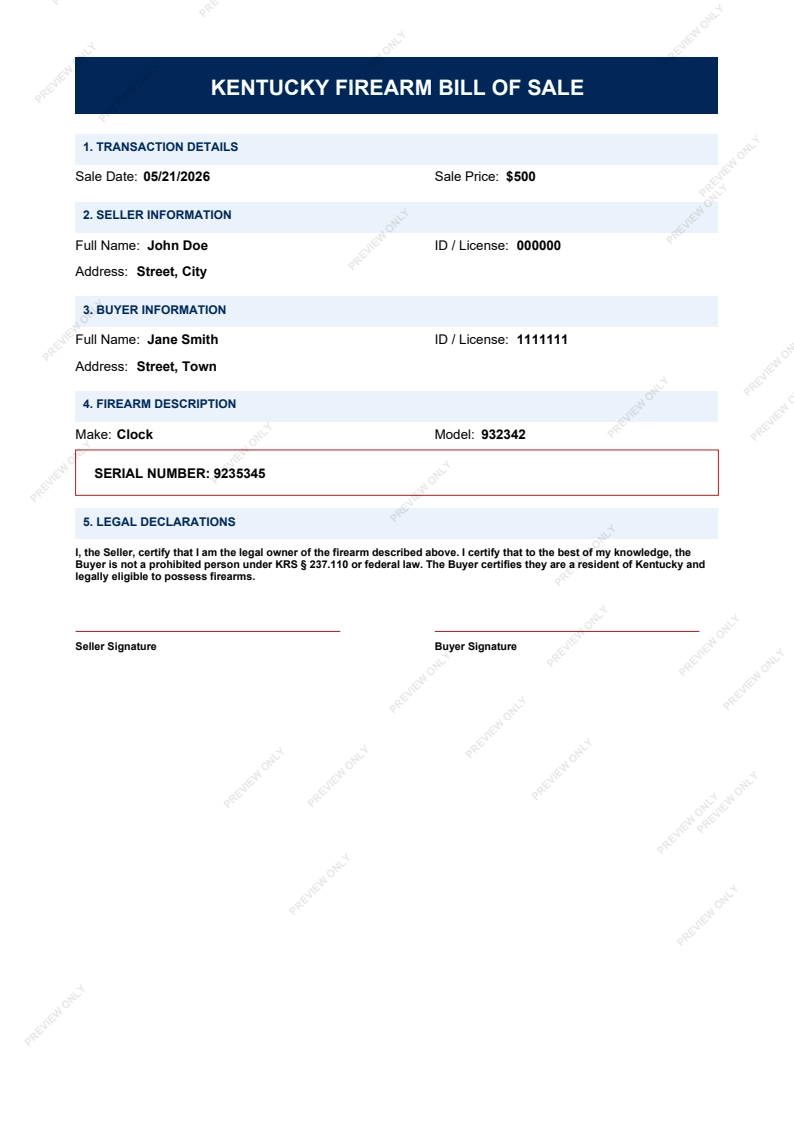
Kentucky's Rules Covered — The Paperwork Itself Is Universal
Constitutional Carry, the CDWL system, and Kentucky's 2026 legislative changes above are specific to this state. Filling out and signing the actual Bill of Sale works the same way no matter where you are.
See our nationwide Step-by-Step Firearm Bill of Sale Guide for that walkthrough.
📋 Kentucky Legal Essentials for Private Sellers
1. No Background Check Access, But Federal Liability Still Applies
Kentucky is a NICS state, meaning FFL dealers contact the FBI directly for background checks — but private sellers have no access to this system at all for a private sale. That gap doesn't remove your responsibility: federal law (18 U.S.C. § 922(d)) still makes it a crime to knowingly transfer a firearm to someone you have reasonable cause to believe is prohibited.
⚠️ Don't assume the lack of a private-sale background check option means you have no exposure — you're still expected to use reasonable judgment, and a Bill of Sale with the buyer's self-certification is your best evidence you did.
2. A CDWL Is Optional Evidence, Not a Legal Requirement
Since Constitutional Carry took effect in 2019, most eligible Kentuckians can carry concealed without any license — so the absence of a Concealed Deadly Weapons License (CDWL) tells you nothing about a buyer's eligibility. If a buyer does hold one, though, it's useful proof they've already passed an 8-hour training course and a background check.
⚠️ Don't treat a buyer without a CDWL as more suspicious than one who has it — most law-abiding Kentucky adults simply don't bother getting a license they don't legally need.
3. A New Provisional License Now Covers 18-20 Year Olds
House Bill 312, enacted via veto override in April 2026, created a provisional CDWL for buyers aged 18-20 — a group that previously had no permit option at all in Kentucky, since permitless carry itself remains restricted to age 21 and up. A provisional CDWL from a young adult buyer is now meaningful evidence of a background check, where none existed before.
⚠️ Don't assume every 18-20 year old buyer lacks any form of vetted credential — this new provisional license, effective July 15, 2026, gives that age group a real option for the first time.
4. Strong Preemption Keeps Rules Uniform, With Local 'Sanctuary' Resolutions Layered On Top
Kentucky's preemption law bars cities and counties from occupying any part of firearm regulation, keeping private-sale rules the same statewide. Separately, several Kentucky counties have adopted 'Second Amendment Sanctuary' resolutions declaring they won't enforce firearm laws they view as unconstitutional — a political statement layered on top of, not a substitute for, the state's actual preemption law.
⚠️ Don't confuse a county's symbolic sanctuary resolution with an actual change in the law — your legal obligations as a private seller come from state and federal statute, not a local government's enforcement stance.
5. A New 2026 Law Shields Dealers and Manufacturers, Not Private Sellers
House Bill 78, also enacted via veto override in April 2026, protects firearm manufacturers, dealers, and trade associations from certain lawsuits over criminal misuse of their products by third parties. This liability shield is aimed at the commercial firearms industry and doesn't extend the same protection to a private, individual seller.
⚠️ Don't assume this new industry protection covers you as a private seller — it's specifically designed for manufacturers and dealers, and your own liability as an individual seller is governed by separate rules.
This information reflects publicly available Kentucky statutes and enforcement practices. Firearm laws can change — always verify the latest rules and consult a qualified attorney.
Kentucky Firearm Transfer FAQ
Is a Bill of Sale required for private gun sales in Kentucky?
Kentucky requires zero documentation for private firearm transfers. With no state registry, the ATF trace ends at the last documented owner. Without a signed Bill of Sale, you have no proof the gun left your hands. A document recording the buyer's ID, the serial number, and the transfer date is your only defense if the firearm surfaces in a criminal investigation years later.
How does KRS § 237.110 impact a private gun sale in Kentucky?
KRS § 237.110 governs Kentucky's Concealed Deadly Weapons License (CDWL) program, which is optional since Kentucky is a Constitutional Carry state. It doesn't directly regulate private sales, but a buyer's CDWL is useful indirect evidence that they've already passed a background check. Recording that license number on your Bill of Sale is a reasonable good-faith step, though it isn't legally required.
Does Kentucky require a background check for private sales?
No. Private sales between Kentucky residents require no background check, no FFL involvement, and no state paperwork. Kentucky is a NICS state — dealers contact the FBI directly rather than a state point of contact — but private sellers have no access to NICS at all. Federal law under 18 U.S.C. § 922(d) still prohibits selling to a prohibited person, and the Bill of Sale records the buyer's self-certification of eligibility as your good-faith defense.
What is the new 2026 provisional CDWL and how does it affect private sales?
In April 2026, the Kentucky legislature overrode a governor's veto to pass House Bill 312, creating a provisional Concealed Deadly Weapons License (CDWL) for 18-20 year olds. For private sellers, this means an 18-20 year old buyer can now present a provisional CDWL as evidence they've passed a background check — previously this age group had no permit option at all in Kentucky.
What is Kentucky's CDWL and why does it matter for sellers?
Kentucky's Concealed Deadly Weapons License (CDWL) requires an 8-hour training course and a background check. If your buyer holds a CDWL, recording the number on your Bill of Sale is useful evidence — a valid CDWL also exempts the holder from the federal NICS check when buying from a licensed dealer, under 18 U.S.C. § 922(t)(3). Source: KRS § 237.110
What is the minimum age for private gun sales in Kentucky?
The practical minimum for a private firearm sale in Kentucky is 18, for both handguns and long guns. Kentucky state law doesn't separately impose a minimum age for private transfers — the 18-year floor comes from general federal guidance, since Kentucky itself leaves the private market largely unregulated.
Is open carry protected in Kentucky?
Yes — Kentucky's open carry right traces back to the 1897 case Holland v. Commonwealth, which recognized a constitutional right to openly carry a firearm. Open carry is legal for any adult 18 or older who can lawfully possess a firearm.
What is Kentucky's industry liability protection law passed in 2026?
In April 2026, the legislature overrode a veto to enact House Bill 78, which shields firearm and ammunition manufacturers, sellers, and trade associations from certain civil lawsuits over the criminal misuse of their products by third parties. This primarily affects dealers and manufacturers rather than private sellers, but it reflects Kentucky's broader pro-firearms legal environment. Source: Kentucky House Bill 78 (2026)
Are NFA items legal in Kentucky?
Yes. All NFA items are legal in Kentucky with proper federal compliance. A 2025 federal law reduced the NFA transfer tax to $0, but the ATF Form 4 approval process, registration, and background check remain fully required. Kentucky has no additional state-specific NFA restrictions.
Does Kentucky have a Red Flag law?
No. Kentucky has no Red Flag law and no Extreme Risk Protection Order (ERPO) mechanism as of 2026. Several Kentucky counties have also adopted 'Second Amendment Sanctuary' resolutions declaring they will not enforce firearm laws they consider unconstitutional.
Can I sell to a resident of Tennessee, Virginia, or Ohio?
No. Federal law prohibits private person-to-person firearm transfers across state lines. Kentucky borders seven states, and selling directly to a resident of any of them without FFL involvement is a federal felony. Always verify the buyer holds a current Kentucky Driver's License or State ID.
Related Forms & Regional Compliance:
Kentucky is nestled among some of the most pro-firearm states in the country. Neighbors like Tennessee, West Virginia, Indiana, and Missouri all share Kentucky's Constitutional Carry stance. However, if you are selling to a resident of Ohio or Illinois, remember that federal law mandates the transfer go through a licensed FFL dealer in the buyer's home state — hand-to-hand private sales across the Ohio River to non-residents are federal felonies.