Tennessee's Three Age Thresholds Are Above — The Form Isn't One of Them
The purchase age, the permitless-carry settlement, and Tennessee's TBI background check system above are specific to this state. Filling out and signing the actual Bill of Sale — the fields, the description, the signatures — works the same basic way everywhere.
See our nationwide Step-by-Step Firearm Bill of Sale Guide for that walkthrough.
Last Updated: 26 Sep, 2026
Tennessee is a solidly pro-gun state — permitless carry since July 2021, no background check for private sales, no waiting period, no registration, and no magazine limits. Although the original 2021 law set the permitless carry age at 21 (or 18 for qualifying military service), a 2023 settlement between the state's Attorney General and a gun-rights group means 18-to-20-year-olds are not currently prosecuted for carrying without a permit — while a separate 2025 law (Public Chapter 356) formally lowered the age to apply for Tennessee's optional Enhanced Handgun Carry Permit from 21 to 18. Under T.C.A. § 39-17-1316, dealer sales route through the Tennessee Bureau of Investigation (TBI) rather than directly through NICS — and knowingly selling to a prohibited person in a private sale is still a serious offense. This Bill of Sale documents the buyer's ID, serial number, and transfer date — your only paper trail in a state that prohibits any government registry.
Tennessee vs. Southeastern Neighbors: 2026 Comparison
| Feature | Tennessee (TN) | Kentucky (KY) | North Carolina (NC) | Virginia (VA) |
|---|---|---|---|---|
| Private Sale Background Check | No | No | No | Yes |
| Constitutional Carry | Yes | Yes | No (In Limbo) | No |
| State Background Check System | TBI | NICS | NICS | VSP |
| Permitless Carry Age | 18 | 21 | N/A | N/A |
| Magazine Capacity Limit | No | No | No | No |
| Statewide Preemption | Strong | Strong | Strong | Strong |
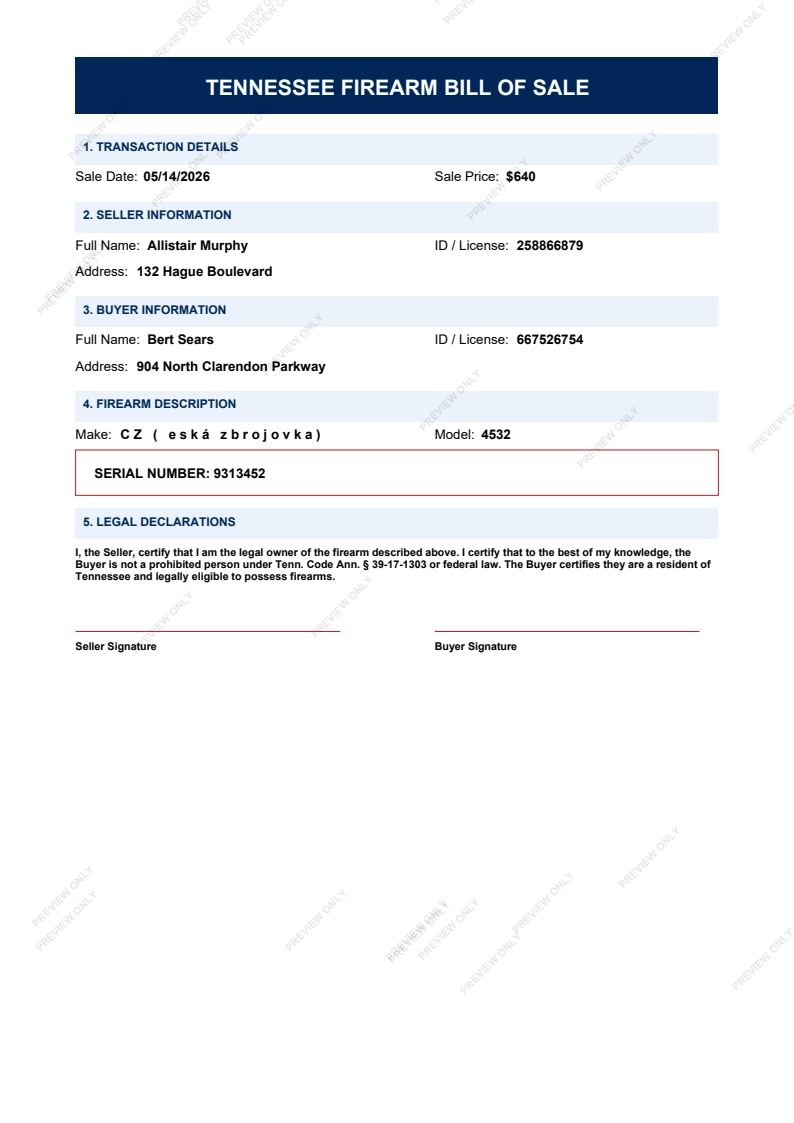
📄 Volunteer State Form Blueprint Preview:
📋 Tennessee Legal Essentials for Private Sellers
1. Three Different Age Numbers Mean Three Different Things
Tennessee has three separate, easily-confused age thresholds: 18 to purchase a firearm privately, 21 under the letter of the permitless-carry statute (though 18-20 year olds aren't currently prosecuted under a 2023 Attorney General settlement), and 18 to apply for the optional Enhanced Handgun Carry Permit since a 2025 law. Confusing any of these with the others leads to real misunderstandings about what's actually required.
⚠️ Don't assume an 18-year-old buyer's legal status is settled just because they can purchase — their ability to carry the firearm they just bought involves a separate, more complicated set of rules.
2. No Background Check Access Doesn't Remove the Reasonable-Cause Standard
Tennessee gives private sellers no way to run a background check, but T.C.A. § 39-17-1316's prohibited-person restrictions still apply in spirit through general knowing-transfer liability. A Bill of Sale with the buyer's self-certification remains your best evidence of good faith.
⚠️ Don't treat the lack of a background check mechanism as removing all legal exposure — you're still expected to exercise reasonable judgment about an obviously ineligible buyer.
3. Ghost Guns Now Follow the Same Rules as Regular Firearms
Since late 2024, Tennessee requires serial numbers and background checks for parts kits and unfinished receivers being transferred — closing what was previously an unregulated category. A private sale involving an unserialized modern firearm now carries real legal risk unless it genuinely qualifies as an antique.
⚠️ Don't assume an unserialized firearm or parts kit is automatically legal to sell privately just because it predates commercial manufacturing norms — verify it actually qualifies for the antique exemption rather than assuming.
4. The Two Carry Permits Aren't Interchangeable Signals
Tennessee's Enhanced Handgun Carry Permit requires 8 hours of training with live fire, while the standard Concealed Handgun Carry Permit has a lower bar. If you're looking at a buyer's permit as informal evidence of vetting, an Enhanced permit reflects meaningfully more preparation than the standard tier.
⚠️ Don't treat every Tennessee carry permit as equal evidence of a buyer's training or vetting — the Enhanced tier involves substantially more than the standard Concealed permit.
5. No Red Flag Law and No Duty to Inform — But Federal Rules Still Apply
Tennessee has no Extreme Risk Protection Order mechanism and no duty for carriers to proactively disclose a firearm to law enforcement. None of this changes federal law, which still prohibits selling to someone you have reasonable cause to believe is prohibited, regardless of how permissive Tennessee's own rules are.
⚠️ Don't treat Tennessee's hands-off approach to background checks and carry disclosure as the complete legal picture — federal prohibited-person rules apply on top of state law no matter how few state requirements exist.
This information reflects publicly available Tennessee statutes and enforcement practices. Firearm laws can change — always verify the latest rules and consult a qualified attorney.
Tennessee Firearm Transfer FAQ
Is a Bill of Sale required for private gun sales in Tennessee?
No — Tennessee requires zero documentation for private firearm transfers. But Tennessee prohibits any state-level registry of firearms under state law, meaning without a signed Bill of Sale, you have no proof the gun ever left your hands. The ATF trace follows the paper trail to the last documented owner. A signed document with the buyer's ID, serial number, and transfer date is your only defense if the firearm surfaces in a criminal investigation years later.
Are background checks required for private sales in Tennessee?
No. Private sales between Tennessee residents require no background check, no FFL involvement, no state paperwork, and no waiting period. However, T.C.A. § 39-17-1316 still prohibits knowingly selling to a prohibited person. The Bill of Sale records the buyer's self-certification as your good-faith defense. Source: T.C.A. § 39-17-1316
What is Tennessee's TBI background check system?
Tennessee uses its own Tennessee Bureau of Investigation (TBI) system for dealer background checks rather than routing directly through the federal NICS system. Tennessee is a Point of Contact state — dealers contact TBI, which searches both state and federal databases including Tennessee-specific records. TBI checks cost up to $10 per transaction for the criminal history check. For private sellers, there is no access to TBI or NICS — the Bill of Sale buyer declaration is your only screening mechanism.
What is the minimum age for private gun sales in Tennessee?
The minimum age for private handgun sales in Tennessee is 18 under state law — three years lower than the federal dealer requirement of 21. For long gun private sales, the minimum is also 18. This purchase age is separate from the permitless-carry age (still 21 by statute, though 18-20 year olds are not currently prosecuted under a 2023 Attorney General settlement) and from the Enhanced Handgun Carry Permit application age (lowered to 18 by a 2025 law, Public Chapter 356) — three related but distinct thresholds. Always verify the buyer's Tennessee Driver's License.
What are Tennessee's two handgun carry permit tiers?
Tennessee offers two optional carry permit tiers for reciprocity purposes. The Concealed Handgun Carry Permit (HCP) is cheaper and easier to obtain but recognized by fewer states. The Enhanced Handgun Carry Permit requires an 8-hour training course with live-fire, costs more, and provides broader reciprocity. Enhanced permit holders can also carry on public college and university campuses (full-time employees only) and have some additional location privileges. If your buyer holds either permit tier, record the number on the Bill of Sale.
What is Tennessee's Guns in Trunks law?
Under T.C.A. § 39-17-1313, enacted in 2013, Tennessee prohibits employers from banning employees from storing firearms in locked personal vehicles on company property, even if the employer has a general no-firearms policy. This is relevant for buyers who ask about keeping their new purchase in their vehicle during work hours. Source: T.C.A. § 39-17-1313
What changed with ghost gun regulations in Tennessee?
Ghost gun regulations took effect in Tennessee in late 2024. Parts kits and unfinished receivers now require serial numbers and background checks when transferred — the same rules that apply to completed firearms. If your private sale involves a firearm without a serial number, verify it was manufactured before these regulations took effect and qualifies under the antique firearms exemption. Selling a non-serialized modern ghost gun through a private sale without proper compliance is a criminal offense.
Does Tennessee have a Red Flag law?
No. Tennessee has not enacted an Extreme Risk Protection Order (ERPO) law as of 2026. The legislature has repeatedly declined ERPO proposals. Tennessee also has no assault weapons ban, no magazine capacity limits, and no safe storage mandate. Tennessee's statewide preemption law prevents any county or city from enacting stricter firearms regulations than state law.
Does Tennessee have a Duty to Inform requirement?
No. Tennessee has no Duty to Inform law — carriers are not required to proactively disclose to law enforcement that they are carrying a firearm when stopped or detained. If a law enforcement officer asks directly, honest disclosure is always advisable, but there is no statutory obligation to volunteer this information.
Can I sell to a resident of Kentucky, Georgia, or any neighboring state?
No. Federal law under 18 U.S.C. § 922 prohibits private person-to-person firearm transfers across state lines. Tennessee borders eight states — Kentucky, Virginia, North Carolina, Georgia, Alabama, Mississippi, Arkansas, and Missouri — and selling directly to a resident of any of them without FFL involvement is a federal felony. Always verify the buyer holds a current Tennessee Driver's License or State ID before completing any transfer.
Related Forms & Regional Compliance:
Tennessee shares borders with eight states: Kentucky, Virginia, North Carolina, Georgia, Alabama, Mississippi, Arkansas, and Missouri. While Tennessee's internal laws are highly permissive, federal law strictly prohibits the private, hand-to-hand transfer of firearms across state lines to residents of these neighboring states without a licensed FFL dealer. Sellers should verify the buyer's Tennessee residency and photo ID before completing any transaction to remain compliant with federal interstate transfer laws.