Virginia's Legal Saga Is Above — The Form Itself Isn't Changing
The background check restoration, the assault weapons ban litigation, and Virginia's rapidly evolving 2026 legal landscape above are specific to this state and worth re-checking given how volatile they've been. Filling out and signing the actual Bill of Sale — the fields, the description, the signatures — works the same basic way everywhere.
See our nationwide Step-by-Step Firearm Bill of Sale Guide for that walkthrough.
Last Updated: Oct 04, 2026
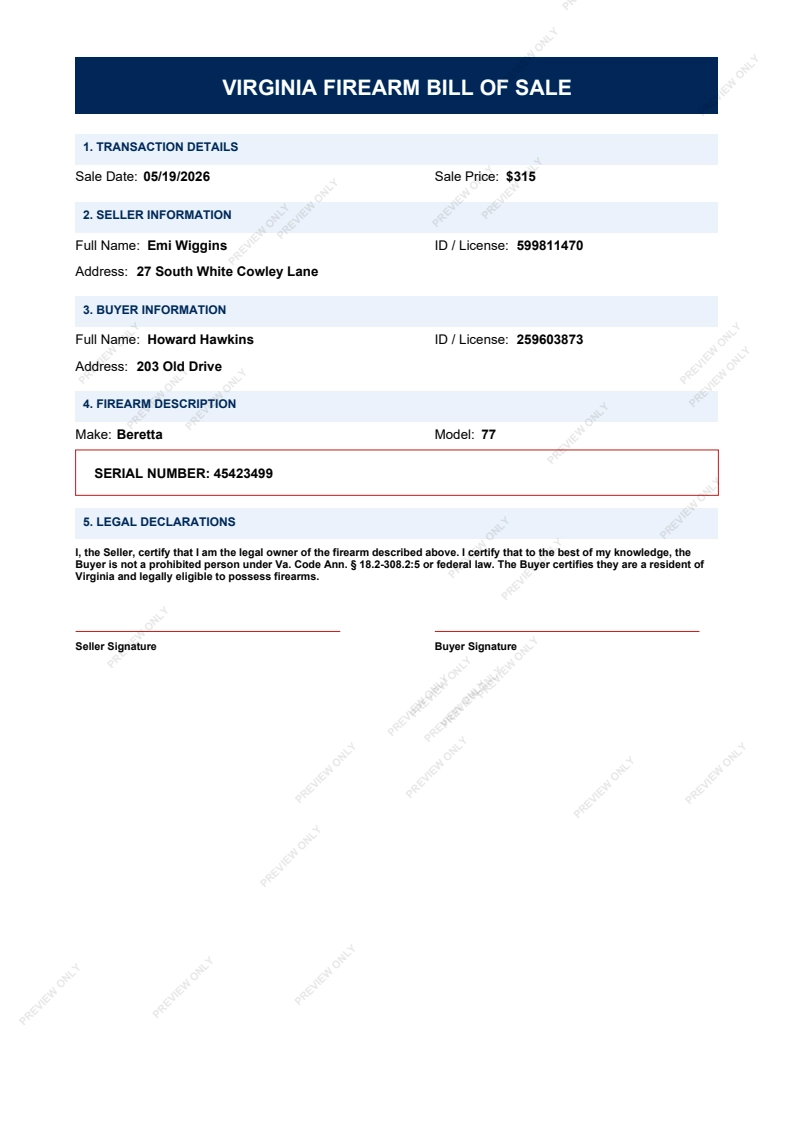
Virginia is in the middle of one of the most dramatic gun law transformations in the country. As of October 29, 2025, a Lynchburg Circuit Court permanently enjoined the Virginia State Police from enforcing the private sale background check requirement under Va. Code § 18.2-308.2:5 — meaning private sales currently require no background check. Simultaneously, Governor Spanberger signed sweeping gun legislation on April 14, 2026, including an assault weapons ban and magazine restrictions effective July 1, 2026. This Bill of Sale documents the agreed price, firearm condition, and buyer's ID — essential documentation in a state where the legal landscape is actively shifting.
📄 Commonwealth of Virginia Form Blueprint:
📋 Virginia Legal Essentials for Private Sellers
1. Background Checks Are Required Again — After a Nine-Month Court Battle
An October 2025 court injunction blocked Virginia's private-sale background check requirement, creating the so-called 'Lynchburg Loophole.' The legislature tried to fix this in April 2026 with HB 1525, but the standing injunction created an open conflict with police until a court finally agreed to dissolve it effective July 1, 2026. As of today, background checks are required again.
⚠️ Don't rely on older information claiming Virginia private sales require no background check — that was only true for a specific window between October 2025 and July 2026, and the requirement is back in force now.
2. The Assault Weapons Ban Exists on Paper But Isn't Being Enforced
Virginia's ban on selling new 'assault firearms' and large-capacity magazines (HB 217/SB 749) technically took effect July 1, 2026, but courts blocked its enforcement almost immediately, and the block has since been extended statewide pending a U.S. Supreme Court ruling expected in 2027. The law exists, but nobody is currently enforcing it.
⚠️ Don't assume this law is either fully dead or fully active — it's in an unusual limbo where it's technically on the books but not currently enforceable, which could change with little notice depending on how the litigation develops.
3. The Public Carry Ban Was Delayed by the Legislature, Not the Courts
Unlike the assault weapons sale ban, Virginia's separate public carry restriction (SB 727/HB 1524) wasn't blocked by a judge — Governor Spanberger herself proposed pushing its effective date back a full year, to July 1, 2027. This is a legislative delay, a different mechanism entirely from the court injunctions affecting the sale ban.
⚠️ Don't confuse the public carry ban's legislative delay with the sale ban's court-ordered block — they're different laws facing different obstacles, even though both were originally set for the same July 1, 2026 date.
4. The Grandfather Date Hasn't Moved, Even Though Enforcement Has
Despite the assault weapons ban currently being unenforceable, the law's grandfather cutoff date of July 1, 2026 hasn't changed. If the ban is eventually upheld, a covered firearm purchased after that date may not qualify for grandfathered status, even though no one is currently stopping such a sale.
⚠️ Don't assume a firearm purchased today is automatically safe from future restriction just because the ban isn't being enforced right now — the original cutoff date still matters if the law is ultimately upheld.
5. Given the Pace of Change, Verify Everything Before Relying On It
Virginia's gun laws have changed dramatically multiple times within a single year — injunctions granted, upheld, then dissolved; effective dates delayed by the legislature; bans blocked by courts shortly after taking effect. This is an unusually volatile legal environment even by the standards of actively litigated states.
⚠️ Don't treat any single snapshot of Virginia gun law — including this one — as permanent. Confirm current status directly with an FFL dealer or attorney immediately before completing any transfer, given how quickly things have changed throughout 2025 and 2026.
This information reflects publicly available Virginia statutes and enforcement practices as researched. Virginia's firearm laws are exceptionally volatile and subject to ongoing litigation — always verify the latest rules and consult a qualified attorney before relying on any of this information.
Virginia Firearm Transfer FAQ
Is a background check currently required for private sales in Virginia?
Yes, as of July 1, 2026 — but this followed an extraordinarily contentious nine-month legal battle. An October 29, 2025 Lynchburg Circuit Court injunction had blocked enforcement (the 'Lynchburg Loophole'). The legislature responded with HB 1525 in April 2026, raising the purchase age to 21 and directing police to resume checks, but the original injunction remained legally in force, creating open conflict — state police briefly resumed checks in May, were found to be defying the court order, and a judge upheld the injunction on June 3, 2026. The same court later agreed to dissolve the injunction effective July 1, 2026, finally ending the standoff. Given how volatile this situation has been, confirm current enforcement status with an FFL dealer before relying on it. Source: Va. Code § 18.2-308.2:5
What is Virginia's new assault weapons ban and is it currently in effect?
Governor Spanberger signed HB 217/SB 749 on May 14, 2026, banning the future purchase, sale, transfer, and import of certain semi-automatic centerfire rifles and pistols, along with magazines over 15 rounds. Current owners are grandfathered and can keep qualifying firearms. The law was set to take effect July 1, 2026, but courts blocked enforcement with a preliminary injunction that was later extended statewide, and as of this writing the ban remains on hold pending a U.S. Supreme Court ruling expected in 2027. Verify the law's current enforcement status before relying on it either way.
What is the new public carry ban on semi-automatic rifles?
SB 727/HB 1524 would prohibit carrying or transporting a semi-automatic centerfire rifle or pistol meeting the state's 'assault firearm' definition on public streets, sidewalks, or parks in specific Virginia cities and counties. Originally set to take effect July 1, 2026, Governor Spanberger herself proposed — and the legislature approved — delaying this law's effective date to July 1, 2027. This is a legislative delay, separate from the court injunctions affecting the related assault weapons sale ban.
What are Virginia's new ghost gun regulations effective July 1, 2026?
HB 40 and SB 323, effective July 1, 2026, require serialization and background checks for key firearm components including unfinished receivers and parts kits. The bills carve out exemptions for antique firearms, permanently inoperable weapons, and manually operated firearms (bolt-action, lever-action). If you are selling or transferring any firearm components, verify whether they fall under the new requirements.
Does Virginia require a Concealed Handgun Permit for carry?
Yes. Virginia requires a Concealed Handgun Permit (CHP) to carry a concealed handgun in public — Virginia has not adopted Constitutional Carry as of 2026. The CHP is shall-issue, valid for 5 years, and requires a background check and safety course. Open carry of a handgun is legal in Virginia without a permit except in prohibited locations.
What is Virginia's new safe storage requirement?
HB 871/SB 348, effective July 1, 2026, requires secure firearm storage under certain circumstances — particularly in homes with children or prohibited persons. This shifts Virginia from a best-practice recommendation to potential criminal liability for unsafe storage. Inform buyers of this obligation at the time of transfer.
What is the 'Lynchburg Loophole' and what does it mean?
The 'Lynchburg Loophole' refers to the roughly nine-month period, starting with an October 29, 2025 court order, during which Virginia State Police could not enforce the private-sale background check requirement. The case, brought by Gun Owners of America and the Virginia Citizens Defense League, resulted in a prolonged standoff between the legislature (which passed HB 1525 in April 2026 to restore checks) and the court (which initially upheld its own injunction in June 2026). The injunction was finally dissolved effective July 1, 2026, closing the loophole.
What is Virginia's one-handgun-per-month limit?
Virginia limits handgun purchases to one per 30-day period under Va. Code § 18.2-308.2:2. This applies to dealer sales, with exemptions for law enforcement and FFL-holding collectors. Now that the private-sale background check requirement has resumed as of July 1, 2026, confirm with your dealer how this limit is currently being applied to private transfers processed through them. Source: Va. Code § 18.2-308.2:2
Who is prohibited from owning a gun in Virginia?
Under Va. Code § 18.2-308.2 and federal law, prohibited persons include convicted felons, those with domestic violence convictions, individuals subject to protective orders, and those adjudicated as mentally incompetent. Virginia's 2026 legislative package expanded the domestic violence prohibition to cover more individuals convicted of domestic-violence offenses. Virginia also has a Red Flag ERPO law. Always ask the buyer to certify on the Bill of Sale that they are not subject to an active ERPO. Source: Va. Code § 18.2-308.2
Can I sell to a resident of Maryland, West Virginia, or any neighboring state?
No. Federal law under 18 U.S.C. § 922 prohibits private person-to-person firearm transfers across state lines. Virginia borders Maryland, West Virginia, Kentucky, Tennessee, and North Carolina — and selling directly to a resident of any of them without FFL involvement is a federal felony. Given Virginia's rapidly changing laws, always verify the buyer holds a current Virginia Driver's License or State ID.
Related Forms & Regional Compliance:
Virginia is bordered by Maryland, West Virginia, Kentucky, Tennessee, and North Carolina. While internal private sales in Virginia currently do not require a background check due to recent court rulings, federal law strictly prohibits the private transfer of firearms across state lines to residents of neighboring states without a licensed FFL dealer. Sellers should be particularly mindful of the highly restrictive laws in Maryland and the varying permit requirements in North Carolina.