Maryland vs. Neighboring States: 2026 Comparison
| Feature | Maryland (MD) | Virginia (VA) | West Virginia (WV) | Pennsylvania (PA) |
|---|---|---|---|---|
| Private Handgun Transfer | FFL or Police Required | FFL Required | Direct Sale Allowed | FFL Required |
| HQL / Purchase Permit | Yes (4hr Training) | No | No | No |
| 7-Day Waiting Period | Yes | No | No | No |
| Magazine Limits | 10 Rounds | No | No | No |
| Assault Weapon Ban | Yes (Broad Ban) | No | No | No |
| State Registry | Yes (Regulated Only) | No | No | No (Sales DB) |
| State Preemption | Weak (Local Exceptions) | Strong | Strong | Strong |
Last Updated: Sep 12, 2026
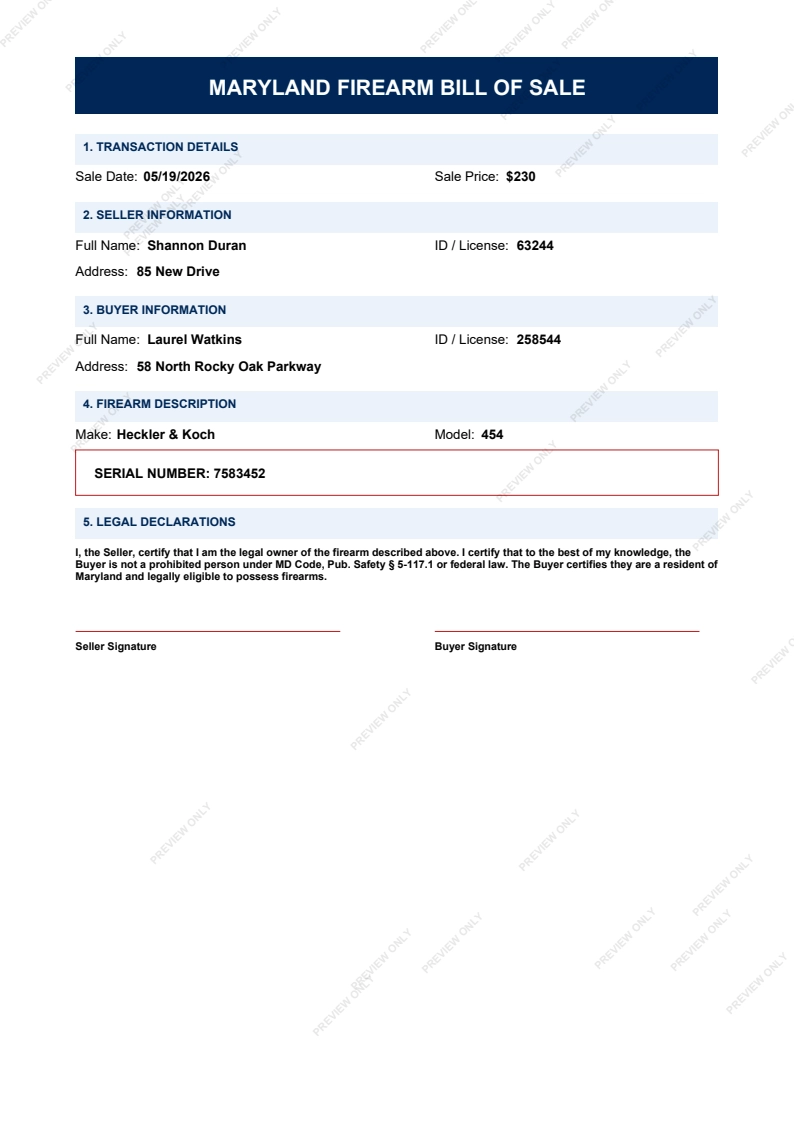
Maryland has some of the most complex private gun sale rules in the country — and they differ completely depending on whether you are selling a handgun or a long gun. Every handgun transfer, including private sales, must go through either a licensed FFL dealer or a Maryland State Police barracks. The buyer must hold a valid Handgun Qualification License (HQL), which requires a 4-hour certified safety training course with a live-fire component, fingerprinting, and a state background check. Long gun transfers between private parties have fewer restrictions but still require a background check through a licensed dealer. This Bill of Sale documents the HQL number, the agreed price, and the firearm's serial number — your private record before you walk into the dealer or barracks.
Maryland's Process Is Above — The Document Itself Is Standard
The HQL requirement, the Handgun Roster, and the long-gun background check rules above are specific to Maryland. Filling out and signing the actual Bill of Sale — the fields, the description, the signatures — works the same basic way everywhere.
See our nationwide Step-by-Step Firearm Bill of Sale Guide for that walkthrough.
📄 Old Line State Form Blueprint Preview:
📋 Maryland Legal Essentials for Private Sellers
1. There's No Such Thing as a Direct Private Handgun Sale
Every handgun transfer in Maryland — even between two private individuals who know each other well — must go through a licensed FFL dealer or a Maryland State Police barracks. Both parties appear in person, the dealer files the MSP 77R form, and a 7-day waiting period begins before the buyer can take possession.
⚠️ Don't assume you can hand a handgun directly to a buyer just because you trust them — Maryland treats a direct private handgun transfer as a criminal offense, with no informal exception for friends or family.
2. The Long-Gun Loophole Closed — Background Checks Now Apply There Too
Maryland used to exempt private rifle and shotgun sales from background checks, requiring them only for dealer sales. After the legislature overrode a governor's veto, that loophole closed: all long gun transfers, private or otherwise, now require a background check through a licensed dealer. Long guns still avoid the HQL requirement and the 7-day wait that apply to handguns.
⚠️ Don't rely on outdated information suggesting long guns can be sold privately without a background check — that exemption no longer exists, even though the process is still simpler than for handguns.
3. The Handgun Qualification License Is a 4-Hour Course, Not a 16-Hour One
Some sources incorrectly describe Maryland's HQL as requiring 16 hours of training — that figure actually belongs to Maryland's separate Wear & Carry permit for concealed carry. The HQL itself, required to purchase or receive any handgun, requires just a 4-hour certified safety course that includes a live-fire component, plus fingerprinting and a state background check.
⚠️ Don't confuse the HQL (purchase requirement, 4 hours) with the Wear & Carry permit (concealed carry requirement, 16 hours) — they serve different purposes and a buyer only needs the HQL to legally receive a handgun.
4. Only Roster-Approved Handguns Can Be Legally Sold
Maryland maintains an official Handgun Roster, and only handguns manufactured after January 1, 1985 that appear on this approved list may be legally sold or transferred in the state. Before agreeing to a sale, check whether the specific make and model appears on the current Roster.
⚠️ Don't assume a handgun is transferable just because it's legal to own — an off-Roster handgun cannot be legally sold or transferred within Maryland, even if you've owned it for years.
5. Preemption Has Real Exceptions — Local Rules Can Still Apply
Unlike states with comprehensive preemption, Maryland allows certain jurisdictions — including Baltimore City, Montgomery County, and Anne Arundel County — to maintain additional local firearm rules on top of state law. Maryland's own constitution also doesn't contain a specific provision protecting an individual right to bear arms, unlike most states.
⚠️ Don't assume Maryland's state-level rules are the complete picture — depending on where the sale takes place, additional local requirements in certain counties or Baltimore City may apply on top of everything covered here.
This information reflects publicly available Maryland statutes and enforcement practices. Maryland's firearm laws are among the most detailed and frequently updated in the country — always verify the latest rules and consult a qualified attorney.
Maryland Firearm Transfer FAQ
Can I sell a handgun privately in Maryland?
Yes, but there is no such thing as a direct private handgun transfer in Maryland. Every handgun transfer — including private sales — must be processed through either a licensed FFL dealer or a Maryland State Police (MSP) barracks. Both parties must appear in person, the dealer submits the MSP 77R form, and a 7-day waiting period begins. Attempting a direct handover without this process is a criminal offense. Source: MSP 77R Form
What is the Handgun Qualification License (HQL) and how do I get one?
Maryland's HQL is required to purchase or receive any handgun, including in a private sale. Getting one requires a 4-hour certified firearms safety training course (which includes a live-fire component), fingerprinting, and a state background check conducted by the Maryland State Police. Always verify and record the buyer's HQL number on your Bill of Sale before proceeding to the dealer or barracks. Source: Maryland State Police – HQL
What is Maryland's Handgun Roster and why does it matter for private sellers?
Maryland maintains an official Handgun Roster. Only handguns manufactured after January 1, 1985, that appear on this approved list may legally be sold or transferred in the state. Transferring an off-Roster handgun is a criminal offense. Source: Maryland Handgun Roster
Is there a waiting period in Maryland?
Yes. Maryland requires a mandatory 7-day waiting period for all regulated firearms, including handguns and assault-style weapons. The period begins when the MSP 77R form is submitted, and the firearm cannot be released until the 7 days have passed and approval is granted. This cannot be waived, even for carry permit holders. Long guns outside the assault weapons category are not subject to this waiting period.
Are assault weapons legal to sell privately in Maryland?
No. Maryland has a broad assault weapons ban under MD Code, Crim. Law § 4-303. This covers many semi-automatic rifles like AR-15s and AK-style rifles, which cannot be legally sold or transferred within the state. These are classified as regulated firearms and are subject to the same strict transfer requirements as handguns. Source: MD Code, Crim. Law § 4-303
What is the magazine capacity limit in Maryland?
Since 2013, Maryland has prohibited the sale or transfer of detachable magazines holding more than 10 rounds. While magazines over 10 rounds owned before this date may be possessed, they cannot be transferred to another person within Maryland.
Do long gun sales require a background check in Maryland?
Yes. After the legislature overrode a governor's veto, Maryland now requires a background check through a licensed FFL dealer for all rifle and shotgun sales, including private, person-to-person transfers. This closed a previous exemption that only covered dealer sales. There are tailored exceptions for transfers between close relatives, temporary loans, and antique firearms. Unlike handguns, long guns require no HQL and no 7-day waiting period — just the dealer-facilitated background check itself.
Does Maryland have a gun registry?
Yes. Maryland is one of the few states with a state-level registry for regulated firearms. The Maryland State Police keep records of all handgun and assault weapon transfers processed through the 77R system. Standard long guns are not registered.
Does Maryland have local firearm regulations beyond state law?
Yes. Unlike many states, Maryland's preemption law has exceptions for jurisdictions like Baltimore City, Montgomery County, and Anne Arundel County, which have additional local rules. The Maryland Constitution also does not contain a specific provision protecting an individual right to bear arms, unlike most other states.
What is Maryland's Red Flag law?
Maryland's Extreme Risk Protection Order (ERPO) law allows law enforcement, family members, and healthcare providers to petition a court to temporarily remove firearms from high-risk individuals. Ensure the buyer certifies on the Bill of Sale that they are not subject to an active ERPO.