West Virginia's Carry Rules Are Above — The Form Itself Works the Same Everywhere
The 2026 permitless carry age change, the optional CHL, and West Virginia's preemption rules above are specific to this state. Filling out and signing the actual Bill of Sale — the fields, the description, the signatures — follows the same basic steps no matter where you are.
See our nationwide Step-by-Step Firearm Bill of Sale Guide for that walkthrough.
Last Updated: Oct 11, 2026
West Virginia is one of the most firearms-friendly states in the country — no state-mandated background check for private sales, no waiting period, no magazine limits, and no state firearm registry. Constitutional Carry has been in effect since May 24, 2016, and House Bill 4106, signed by Governor Morrisey on April 1, 2026, extended it to adults 18 to 20 effective June 12, 2026, ending the old provisional-license track for that age group. Governor Morrisey also signed two firearm industry protection bills, HB 2067 and HB 3342, on April 25, 2025. Under W. Va. Code § 61-7-10, selling a firearm to a prohibited person is still a serious criminal offense. This Bill of Sale documents the buyer's ID, serial number, and transfer date — your only paper trail in a state that keeps no private-sale records.
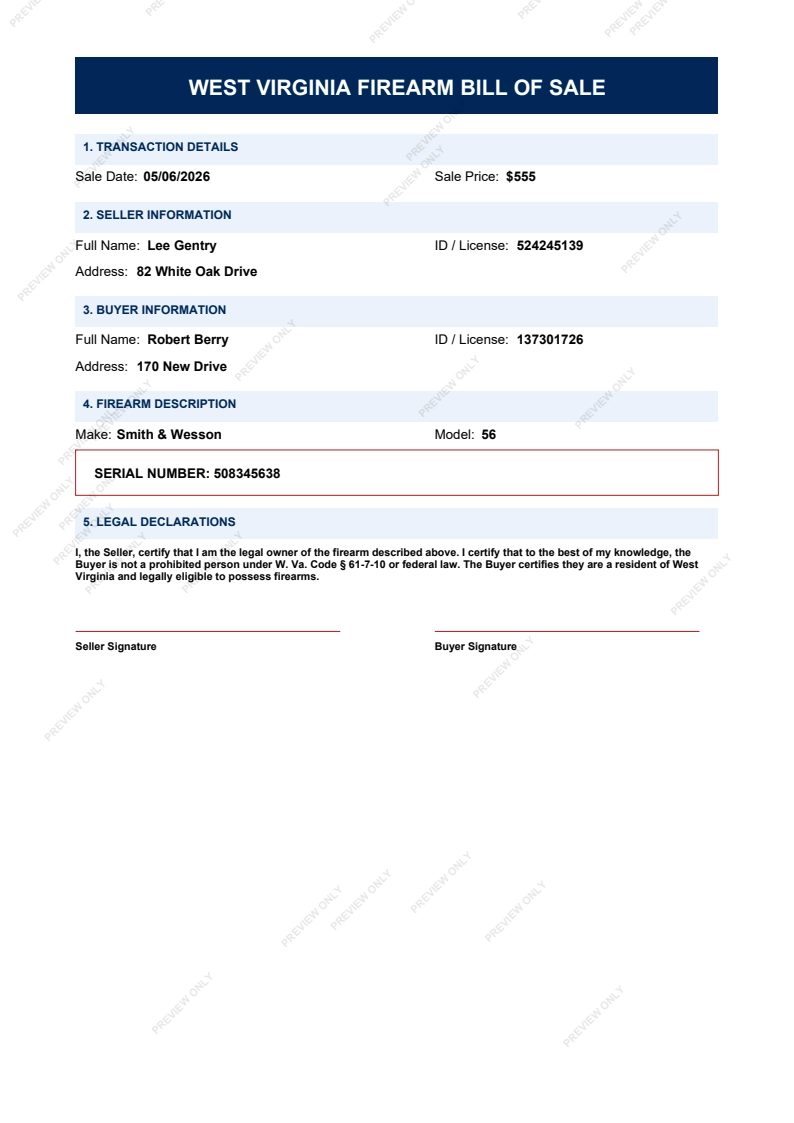
📄 Mountain State Form Blueprint Preview:
📋 West Virginia Legal Essentials for Private Sellers
1. No State Background Check, But the Sale Itself Is Still Regulated
West Virginia imposes no background check, waiting period, or paperwork on private sales between residents. Even so, W. Va. Code § 61-7-10 makes it a criminal offense to knowingly sell a firearm to a prohibited person, and § 61-7-7 defines who is prohibited. Federal law under 18 U.S.C. § 922(d) applies on top of both.
⚠️ Don't treat the lack of a state background check as the lack of legal exposure — the 'knowing' standard still applies, and a Bill of Sale with the buyer's self-certification is your best evidence of good faith.
2. Permitless Carry Now Starts at 18, But Buying a Handgun Is a Separate Question
House Bill 4106 took effect on June 12, 2026, lowering the age for permitless concealed carry from 21 to 18 by amending § 61-7-7 and repealing § 61-7-3. This changes who may carry, not the rules for buying. Federal law still sets 21 for handgun purchases from licensed dealers, and a private seller should treat the buyer's age and eligibility as a separate check from the buyer's right to carry.
⚠️ Don't assume that because an 18-year-old can now carry concealed without a license, every sale to that buyer is automatically fine — confirm age with a valid ID and make sure the buyer is not otherwise prohibited.
3. The Provisional License Track Is Gone for 18-20 Year Olds
Before June 2026, adults aged 18 to 20 could carry concealed only after obtaining a provisional license, and carrying without one was a crime under § 61-7-3. HB 4106 repealed that provision and folded the age group into the general permitless framework. Open carry has been legal at 18 for longer.
⚠️ Don't rely on older articles or forum posts describing the provisional-license requirement for under-21s — that rule was repealed and no longer applies.
4. A CHL Is Optional Evidence, Not a Requirement
West Virginia has been a Constitutional Carry state since May 24, 2016, so most eligible adults no longer carry a Concealed Handgun License. A buyer's valid CHL is still useful evidence of eligibility because it is issued after a background check, but its absence says nothing negative about the buyer.
⚠️ Don't treat a buyer without a CHL as suspicious — permitless carry means most law-abiding West Virginians have no reason to hold one.
5. Preemption Is Strong, With a Pre-1999 Exception
West Virginia preempts local regulation of several aspects of firearms, which keeps private-sale rules uniform statewide. Local ordinances that were already in effect before 1999 were grandfathered, so a few older local rules can still exist, mostly affecting carry rather than private sales.
⚠️ Don't assume every local firearm rule in West Virginia is automatically void — grandfathered pre-1999 ordinances may still apply in some towns, so check local rules if your buyer plans to carry in a specific city.
This information reflects publicly available West Virginia statutes and enforcement practices. Firearm laws can change — always verify the latest rules and consult a qualified attorney.
West Virginia Firearm Transfer FAQ
Is a Bill of Sale required for private gun sales in West Virginia?
No. Private sales in West Virginia are not restricted by state law: no background check, no required bill of sale, and no waiting period. Because West Virginia keeps no firearm registry, a signed Bill of Sale is your only proof the gun ever left your hands. An ATF trace follows the paper trail to the last documented owner, and that is you until you can show otherwise. A signed document with the buyer's ID, serial number, and transfer date is your best defense if the firearm surfaces in a criminal investigation.
Are background checks required for private sales in West Virginia?
No. Private sales between West Virginia residents have no state-mandated background check. However, W. Va. Code § 61-7-10 makes it a criminal offense to knowingly sell a firearm to a prohibited person, § 61-7-7 defines who is prohibited, and federal law (18 U.S.C. § 922(d)) applies on top of both. The Bill of Sale records the buyer's self-certification of eligibility as your good-faith defense. Source: W. Va. Code § 61-7-10
What did HB 4106 change for Constitutional Carry in 2026?
House Bill 4106, signed by Governor Morrisey on April 1, 2026, took effect June 12, 2026. It lowered the age for permitless concealed carry from 21 to 18 by amending W. Va. Code § 61-7-7 and repealing § 61-7-3, the provision that had made it a crime for someone under 21 to carry concealed without a license. West Virginia has been a Constitutional Carry state for adults 21 and older since May 24, 2016, so this change affects carrying only. Federal rules still set 21 for handgun purchases from licensed dealers, and optional licenses remain available. Source: W. Va. Code § 61-7-7
What is West Virginia's Concealed Handgun License and why does it matter for sellers?
West Virginia keeps an optional Concealed Handgun License (CHL), mainly useful for reciprocity with other states. Because it is issued after a background check, a buyer's valid CHL is useful evidence of eligibility, and you can record the license number on your Bill of Sale. With permitless carry now available from age 18, the absence of a CHL tells you nothing about a buyer's eligibility.
Can a buyer carry a loaded firearm in a vehicle in West Virginia?
Yes. A loaded firearm may be kept in a vehicle, concealed or open, without a permit. Separate rules apply to hunting-season transport, school property, and other prohibited places, so remind buyers that the vehicle rule does not override those restrictions.
Does West Virginia have a Red Flag law?
No. West Virginia has no Extreme Risk Protection Order mechanism as of 2026. The state also has no assault weapons ban, no magazine capacity limits, and no safe storage mandate.
Who is prohibited from owning a gun in West Virginia, and can cities add their own rules?
W. Va. Code § 61-7-7 sets the state's prohibited-person categories, including convicted felons, people with domestic violence convictions, fugitives, unlawful drug users, and those adjudicated as mentally incompetent, alongside the federal categories. West Virginia preempts local regulation of firearms, though local ordinances that were already in effect before 1999 were grandfathered, so check local rules for any carry-related questions. Source: W. Va. Code § 61-7-7
Can I sell to a resident of Virginia, Ohio, or any neighboring state?
No. Federal law (18 U.S.C. § 922) prohibits private person-to-person firearm transfers across state lines. West Virginia borders Virginia, Maryland, Pennsylvania, Ohio, and Kentucky, and selling directly to a resident of any of them without an FFL dealer involved is a federal felony. Always verify that the buyer holds a current West Virginia driver's license or state ID.
Related Forms & Regional Compliance:
West Virginia is bordered by Pennsylvania, Maryland, Virginia, Kentucky, and Ohio. While West Virginia's internal laws are highly permissive, federal law strictly prohibits the private, hand-to-hand transfer of firearms across state lines to residents of these neighboring states without a licensed FFL dealer. Sellers should be particularly cautious of the restrictive laws in Maryland and the shifting legal landscape in Virginia.