Ohio's Age Rules and Preemption Are Above — The Form Isn't Ohio-Specific
The 21-year handgun age floor, the 2025 preemption update, and Ohio's Constitutional Carry rules above are specific to this state. Filling out and signing the actual Bill of Sale — the fields, the description, the signatures — works the same basic way everywhere.
See our nationwide Step-by-Step Firearm Bill of Sale Guide for that walkthrough.
Ohio vs. Regional Neighbors: 2026 Comparison
| Feature | Ohio (OH) | Michigan (MI) | Pennsylvania (PA) | Indiana (IN) |
|---|---|---|---|---|
| Private Sale Background Check | No | Yes | Handguns Only | No |
| Constitutional Carry | Yes | No | No | Yes |
| Handgun Purchase Permit | No | Yes | No | No |
| Waiting Period | No | No | No | No |
| State Registry | No | Yes | No | No |
Last Updated: Sep 20, 2026
Ohio became a Constitutional Carry state on June 13, 2022, when Senate Bill 215 took effect — eliminating the requirement for a permit to carry a concealed handgun for any 'qualifying adult' 21 or older. Private sales require no background check and no registration, but Ohio uniquely sets its own state-level minimum age of 21 for handgun sales, including private transactions, under O.R.C. § 2923.211. In 2025, Senate Bill 58 further strengthened Ohio's preemption law (ORC § 9.68), barring any state or local government from requiring firearm liability insurance or possession fees — keeping the rules completely uniform across all 88 counties. This Bill of Sale documents the buyer's ID and the firearm's serial number — your only paper trail in a state that keeps no private sale records.
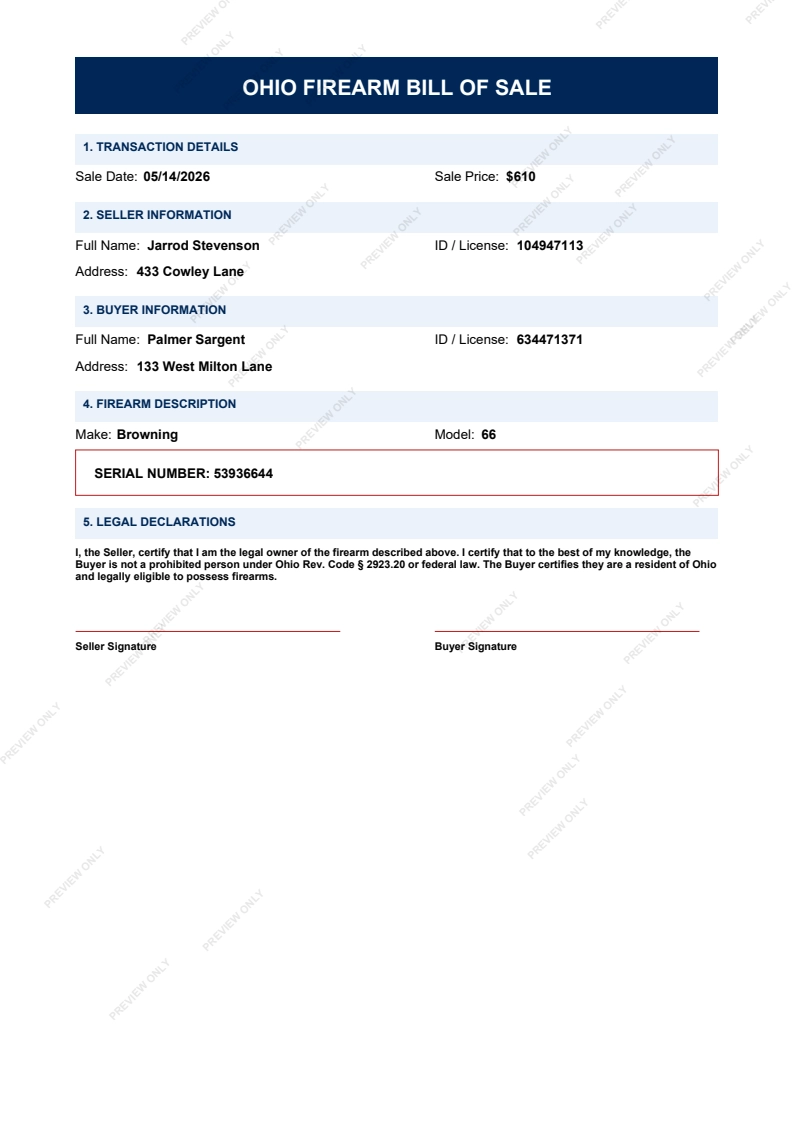
📄 Buckeye State Form Blueprint Preview:
📋 Ohio Legal Essentials for Private Sellers
1. Ohio's Handgun Age Floor Is 21 Even for Private Sales — A Genuine Exception
Unlike most permissive states where 18 is the private-sale floor for handguns, Ohio's own state law (O.R.C. § 2923.211) sets 21 as the minimum age for a handgun sale, private or otherwise. Long guns follow the more typical 18-year floor. This isn't just the federal dealer rule showing up again — it's written directly into Ohio state law.
⚠️ Don't apply the common 18-for-private-sale pattern seen in many neighboring states — Ohio specifically requires 21 for any handgun sale, a genuine state-level exception worth double-checking before every handgun transfer.
2. No Background Check Access Doesn't Mean No Responsibility
Ohio doesn't give private sellers a way to run a NICS check, but ORC § 2923.13 still makes it a third-degree felony to sell to someone you know, or have reasonable cause to believe, is a prohibited person — including fugitives, those under indictment or convicted of a violent felony, and certain drug offenders.
⚠️ Don't treat the absence of a background check mechanism as the absence of legal risk — the reasonable-cause standard still applies, and a Bill of Sale with the buyer's self-certification is your best evidence of good faith.
3. 2025's Senate Bill 58 Protects Your Wallet, Not Just Your Rights
Effective April 9, 2025, Senate Bill 58 amended ORC § 9.68 to bar any state or local government from requiring firearm liability insurance or charging a fee just for possessing a firearm. This closes off a category of local regulation some cities had considered as a workaround to Ohio's existing preemption law.
⚠️ Don't assume a local 'gun ownership fee' or insurance mandate you've heard proposed could actually apply to you — as of April 2025, Ohio law explicitly forecloses that approach statewide.
4. Constitutional Carry's Age and the Purchase Age Now Line Up at 21
Since Senate Bill 215 (2022), a 'qualifying adult' must be 21 to carry a concealed handgun without a permit. Combined with the state's own 21-year handgun purchase age, this means Ohio's carry age and purchase age align neatly for handguns — unlike some states where these two thresholds differ.
⚠️ Don't assume Ohio's carry age and purchase age might be different numbers, as they are in some other states — for handguns specifically, both are 21 under Ohio law.
5. Registry Prohibition Runs Two Levels Deep
Ohio law bars the creation of a state-level firearm registry, and its preemption statute (ORC § 9.68) separately prevents local governments from creating their own. This double layer means no municipality — even one with strong local gun-control preferences — can build a workaround registry.
⚠️ Don't assume a city with a reputation for stricter gun policies might maintain its own local firearm registry — Ohio's preemption law specifically forecloses that possibility statewide.
This information reflects publicly available Ohio statutes and enforcement practices. Firearm laws can change — always verify the latest rules and consult a qualified attorney.
Ohio Firearm Transfer FAQ
Is a Bill of Sale required for private sales in Ohio?
Ohio law does not mandate a bill of sale, but it is a critical tool for liability protection. Because Ohio has no state-level registry, this document is your only evidence that ownership was legally transferred on a specific date. It should include the firearm's serial number and the buyer's information to ensure you are no longer linked to the weapon if it is later used in a crime.
Are background checks required for private transfers in Ohio?
No. Under current Ohio law, private individuals are not required to conduct NICS background checks when selling to other Ohio residents. However, you are strictly prohibited from selling to anyone you know or have 'reasonable cause to believe' is a prohibited person under ORC § 2923.13. Using a Bill of Sale where the buyer certifies their eligibility helps demonstrate your due diligence. Source: ORC § 2923.13
What is the minimum age for a private sale in Ohio?
Ohio is one of the few states where the 21-year handgun age floor applies even in private sales. Under O.R.C. § 2923.211(B), state law — not just federal dealer rules — prohibits selling a handgun to anyone under 21, including private, person-to-person transactions. Long guns follow the more typical 18-year floor. Always verify age using a valid Ohio photo ID. Source: O.R.C. § 2923.211
What are the rules for 'Constitutional Carry' in Ohio?
Since the enactment of Senate Bill 215 in 2022, any 'qualifying adult' (21+ and not prohibited from possession) can carry a concealed handgun without a permit. Sellers should confirm the buyer's age and Ohio residency — note that Ohio's own state law sets 21 as the minimum age to purchase a handgun even privately, so the carry age and purchase age align at 21 for handguns. Source: Senate Bill 215
Is there a waiting period in Ohio?
No, Ohio has no state-mandated cooling-off or waiting period. The transfer of the firearm and the payment can happen immediately upon the signing of the Bill of Sale and verification of the buyer's identity.
Does Ohio have a gun registry?
No. Ohio law specifically prohibits the establishment of a state-level database or registry of firearms or firearm owners. Preemption laws under ORC § 9.68 ensure that local municipalities cannot create their own registries either. This makes your private Bill of Sale the only existing record of the transaction. Source: ORC § 9.68
Who is a 'prohibited person' in Ohio?
Under ORC § 2923.13, prohibited persons (those 'under disability') include fugitives from justice, individuals under indictment for or convicted of any felony offense of violence, those with certain drug-related convictions, and persons adjudicated as 'mentally incompetent.' Selling to such an individual is a third-degree felony. Source: ORC § 2923.13
Can I sell to a resident of Michigan or Pennsylvania?
No. Federal law prohibits the direct private sale of firearms between residents of different states. If the buyer is from Michigan, Pennsylvania, or any other state, the firearm must be shipped to or dropped off at a licensed FFL dealer in the buyer's home state to conduct a background check and legal transfer.
Related Forms & Regional Compliance:
Ohio is bordered by Michigan, Pennsylvania, West Virginia, Kentucky, and Indiana. While Ohio's internal laws are permissive, federal law prevents private firearm sales between residents of different states. Interstate sales must be handled by a licensed FFL dealer. Sellers should be particularly aware of the varying requirements in neighboring states like Michigan or Pennsylvania when traveling near state lines.