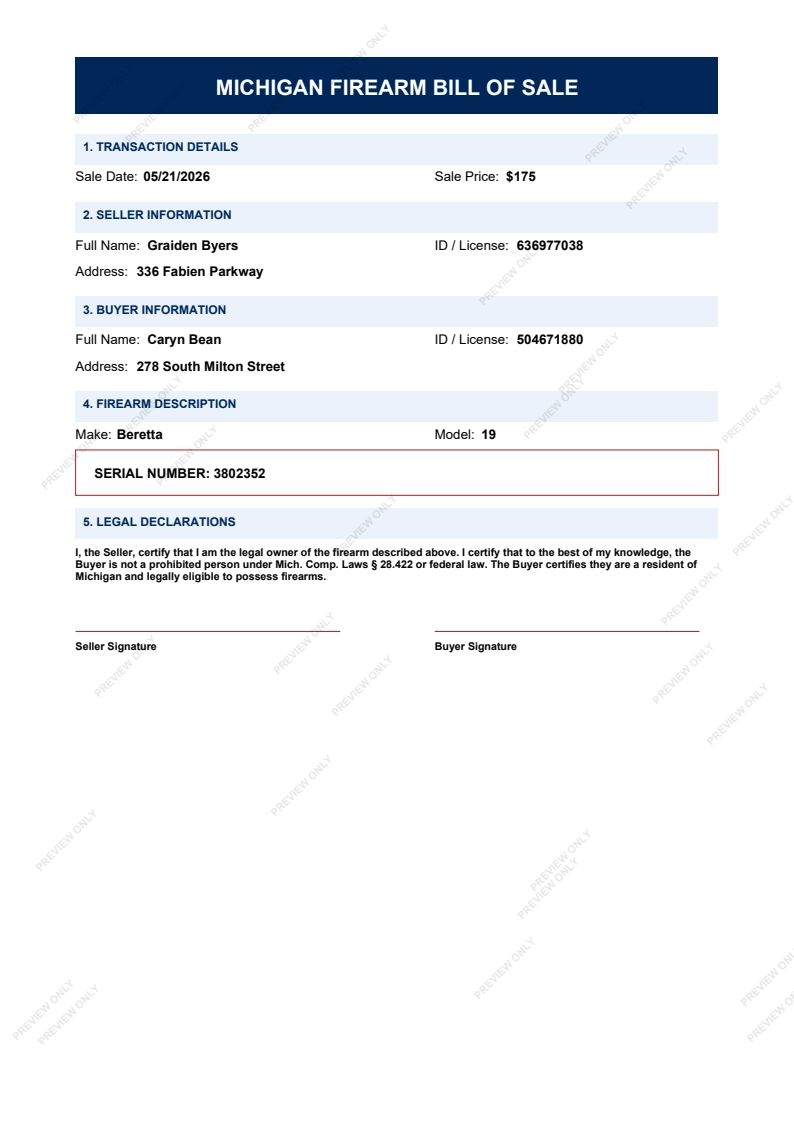
Michigan's gun laws changed fundamentally on February 13, 2024 — exactly one year after the Michigan State University shooting. Three major laws took effect simultaneously: universal background checks for all private sales including long guns, mandatory safe storage when minors are present, and a new Red Flag law. Before 2024, long gun private sales required no background check in Michigan. Now a handgun transfer requires the buyer to hold either a License to Purchase or a valid CPL, while a long gun transfer requires a background check through a licensed dealer. A Pistol Sales Record must be filed with local law enforcement within 10 days for handgun transfers. This Bill of Sale documents the agreed price and firearm details before you complete the required state paperwork.
Michigan's Process Is Above — The Document Itself Isn't Unique
The LTP requirement, the RI-060 filing, and Michigan's 2024 legal changes above are specific to this state. Filling out and signing the actual Bill of Sale — the fields, the description, the signatures — works the same basic way everywhere.
See our nationwide Step-by-Step Firearm Bill of Sale Guide for that walkthrough.
📄 Great Lakes State Form Blueprint Preview:
📋 Michigan Legal Essentials for Private Sellers
1. The Long-Gun Loophole Closed on the MSU Shooting Anniversary
Before February 13, 2024, Michigan required background checks only for handgun purchases — long guns could be sold privately with no check at all. That changed as part of a three-law package that took effect exactly one year after the Michigan State University shooting: rifle and shotgun sales now require a background check through a licensed dealer, closing what state officials called an outdated loophole.
⚠️ Don't rely on older information suggesting long guns can be sold privately without any background check — that exemption ended in February 2024, and the process now requires dealer involvement.
2. A CPL Skips the LTP Step, But Doesn't Skip Paperwork Entirely
A buyer with a valid Concealed Pistol License (CPL) doesn't need to separately obtain a License to Purchase (LTP) before a handgun sale, since the CPL already reflects a completed background check. The seller still must complete the Pistol Sales Record (RI-060) and submit a copy to local law enforcement within 10 days, regardless of which credential the buyer holds.
⚠️ Don't assume a buyer's CPL means no paperwork is needed at all — the RI-060 filing requirement applies whether the buyer has an LTP or a CPL.
3. Safe Storage Rules Follow the Gun Home, Not Just the Sale
Michigan's safe storage law requires firearms to be locked away or secured with a locking device whenever the owner knows or reasonably should know a minor could be present. This obligation doesn't end at the sale — it's the buyer's ongoing legal responsibility once they take possession, and penalties scale up to a felony with up to 15 years in prison if a minor obtains an improperly stored firearm and someone is killed as a result.
⚠️ Don't treat safe storage as a topic that ends once your sale is complete — reminding the buyer of this ongoing obligation in your Bill of Sale is a reasonable practice, since the law follows the firearm into their home.
4. The Age Floor for a Private Handgun Sale Is Lower Than Most Assume
Michigan allows an 18-year-old to purchase a handgun through a private sale after obtaining a License to Purchase — the 21-year age floor most people associate with handguns only applies to purchases from a licensed FFL dealer. Long guns follow the same 18-year floor regardless of whether the sale is private or through a dealer.
⚠️ Don't apply the federal dealer age of 21 to your own private handgun sale by mistake — Michigan state law sets a lower floor of 18 for a private transaction, provided the buyer has a valid LTP.
5. Red Flag Orders and Prohibited Buyers Are a Separate Layer on Top of the Paperwork
Michigan's Extreme Risk Protection Order (ERPO) law, effective the same day as the background check expansion, lets family members, law enforcement, and mental health professionals petition a court to remove firearms from someone deemed a significant risk. Completing the LTP or RI-060 paperwork doesn't substitute for your own judgment — federal law still holds you responsible if you have reasonable cause to believe a buyer is prohibited or under an active ERPO.
⚠️ Don't assume that because a buyer passed the state's background check process, you have no further responsibility — asking directly about ERPO status and documenting the buyer's certification on your Bill of Sale adds another layer of protection.
This information reflects publicly available Michigan statutes and enforcement practices. Michigan's firearm laws changed significantly in 2024 and continue to evolve — always verify the latest rules and consult a qualified attorney.
Michigan Firearm Transfer FAQ
Do I need a background check for a private sale in Michigan?
Yes — and this applies to long guns too since February 13, 2024, when Michigan's 2023 gun safety package took effect. Every private buyer must present either a valid License to Purchase (LTP) or a Concealed Pistol License (CPL) before you can legally transfer a handgun; long gun sales require a background check through a licensed dealer. The LTP is obtained from local law enforcement and is valid for 30 days.
What is the License to Purchase and how does it work?
The License to Purchase (LTP) under MCL 28.422 is Michigan's state-level purchase permit required for handgun transfers. The buyer must submit to a background check at a local police department or sheriff's office before the sale. CPL holders are exempt from this separate LTP requirement, since their CPL already reflects a completed background check. Source: MCL 28.422
What is the Pistol Sales Record (RI-060) and what are my obligations?
The Pistol Sales Record (RI-060) must be completed for every handgun transfer. Both buyer and seller sign the form, and the seller must submit a copy to local law enforcement within 10 days. This requirement, along with the seller's recordkeeping duties, is set out under MCL 28.422a. Source: MCL 28.422a
Is a separate Bill of Sale necessary if I complete the RI-060?
Yes — the RI-060 is the state's record, not your private contract. A Bill of Sale documents the agreed price and the firearm's condition, which are not included on state forms. Federal law separately makes it a serious crime to knowingly sell to a prohibited person; the Bill of Sale's buyer declaration serves as your good-faith defense.
Can I sell a rifle or shotgun to an 18-year-old in Michigan?
Yes — the minimum age for long gun and private handgun purchases in Michigan is 18. While federal law requires age 21 at FFL dealers for handguns, Michigan state law allows 18-year-olds to purchase from private sellers provided they obtain a License to Purchase first.
What is Michigan's safe storage law and how does it affect private sales?
Michigan's safe storage law (MCL 750.232a), part of the 2023 gun safety package effective February 13, 2024, requires firearms to be stored in a locked container or secured with a locking device when the owner knows or reasonably should know a minor is likely to be present. Penalties scale up to a felony with up to 15 years in prison if a minor obtains an improperly stored firearm and it causes a death. Sellers should include a reminder of these obligations in their Bill of Sale to mitigate potential civil liability. Source: 2023 PA 17
Does Michigan have a Red Flag law?
Yes — Michigan's Extreme Risk Protection Order (ERPO) law took effect February 13, 2024. It allows family, law enforcement, and mental health professionals to petition a court to temporarily remove firearms from individuals deemed a significant risk. Buyers should certify on the Bill of Sale that they are not subject to an active ERPO.
Does Michigan have a gun registry?
Michigan maintains a database of all pistol transfers via the RI-060 system. While not a traditional registry of all owners, the 2024 universal background check expansion creates a paper trail for handgun transfers through this system and for long gun transfers through the dealer background check process.
Can a non-Michigan resident buy a gun through a private sale?
Generally, only standard long guns may be purchased by non-residents, and only if the transaction complies with both Michigan and federal law. Handguns require Michigan residency for a private-sale purchase, since the License to Purchase process is tied to the buyer's local police jurisdiction.
Is Michigan moving toward Constitutional Carry?
As of 2026, Michigan has not adopted Constitutional Carry; various bills have been introduced but have not passed. Michigan currently requires a Concealed Pistol License (CPL) for concealed carry, which requires training and a background check, though open carry without a permit remains legal for those 18 and older who can legally possess a firearm.
Related Forms & Regional Compliance:
Michigan is unique for its dual-peninsula geography and extensive water borders, which complicate private transfers. While neighbors like Ohio and Indiana have moved toward Constitutional Carry, Michigan's 2024 laws created a strict barrier; federal law also prohibits hand-to-hand private sales between residents of different states. If your buyer is from Ohio, Indiana, or Wisconsin, the firearm must be shipped to an FFL in their home state to comply with the Gun Control Act. Be especially mindful of the international crossings in Detroit and Port Huron; transporting a firearm across the Canadian border without strict federal authorization is a severe international felony.