Wisconsin's No-Check Rules Are Above — Your Bill of Sale Is the Only Record
The lack of a state background check for private sales, the straw-purchase rules, and the pending SB 1046 above are specific to Wisconsin. Filling out and signing the actual Bill of Sale — the fields, the description, the signatures — follows the same basic steps no matter where you are.
See our nationwide Step-by-Step Firearm Bill of Sale Guide for that walkthrough.
Last Updated: Oct 15, 2026
Wisconsin has no universal background check requirement for private gun sales — private transfers between residents require no FFL dealer, no permit, and no waiting period, and Wisconsin has no named 'assault weapons' or magazine-capacity statute. Senate Bill 1046, introduced in the 2025–26 legislative session, would tighten rules around firearm dealers, straw purchases, and sales to prohibited persons, but private sales between residents are not subject to a state background check today, so check the bill's status before relying on any change. That does not make a sale risk-free: federal law (18 U.S.C. § 922(d)) prohibits knowingly selling a firearm to a prohibited person, Wis. Stat. § 941.29 defines who is prohibited, including convicted felons, and § 941.2905 makes straw purchases a crime. This Bill of Sale documents the buyer's ID, the serial number, and the transfer date — your only paper trail in a state with no private-sale records.
Wisconsin vs. Regional Neighbors: 2026 Comparison
| Feature | Wisconsin (WI) | Minnesota (MN) | Illinois (IL) | Michigan (MI) |
|---|---|---|---|---|
| Private Sale Background Check | No | Yes (Handguns/SAMSAWs) | Yes | Yes |
| Private Sale Record or Report | No | Yes (Reported to Local Police) | Yes (Seller Keeps 10 Years) | Yes (Handguns, RI-060) |
| Constitutional Carry | No | No | No | No |
| Assault Weapons Ban | No | No | Yes | No |
| Red Flag Law | No | Yes | Yes | Yes |
| Minimum Age (Private Handgun) | 18 | 21 (Permit to Purchase) | 21 (18-20 With Parent/Guardian Sponsor) | 18 |
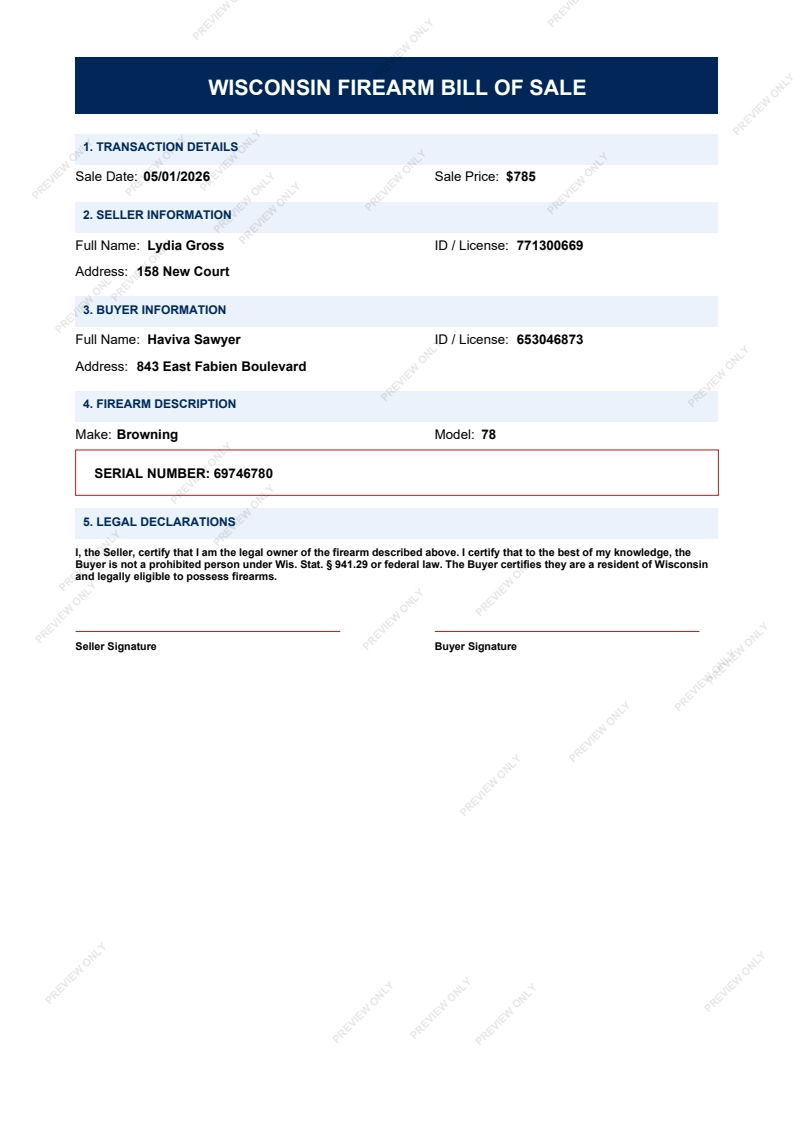
📄 Badger State Form Blueprint Preview:
📋 Wisconsin Legal Essentials for Private Sellers
1. Dealers Face a State Check, Private Sellers Don't
When a Wisconsin dealer sells a handgun, the buyer goes through an additional state Department of Justice background check under Wis. Stat. § 175.35, on top of the federal check. A private sale between residents has no equivalent step: no FFL, no state check, no waiting period, and no state paperwork. Wisconsin is also not a 'must notify' state, so there is no state record trail to lean on.
⚠️ Don't assume the state's dealer rules protect you in a private sale — nobody screens the buyer except you, and you are the one who will be asked about the transfer later.
2. The Real Legal Risk Comes From Federal Law and What You Know
Wis. Stat. § 941.29 defines who may not possess a firearm in Wisconsin, including convicted felons, but the main rule that applies to a seller is federal: 18 U.S.C. § 922(d) prohibits knowingly selling to a prohibited person or to someone you have reasonable cause to believe is prohibited. The absence of a state sale statute does not remove that exposure.
⚠️ Don't treat the lack of a state background check as permission to ignore warning signs — if you have reason to believe the buyer is prohibited, selling is still a federal crime.
3. Straw Purchases Are Their Own Crime
Wis. Stat. § 941.2905 makes straw purchases a crime. That is a separate problem from selling to a prohibited person directly: it covers a buyer acquiring a firearm on behalf of someone else, and it is exactly the situation a seller can be pulled into without realising it.
⚠️ Don't go ahead with a sale if the buyer mentions the gun is 'for a friend' or 'for a relative' — walk away and let that person buy it in their own name.
4. A CCW License Is About Carrying, Not Buying
Wisconsin has not adopted Constitutional Carry, so carrying concealed requires a CCW license, which is shall-issue and requires firearms training and a background check. Buying from a private seller does not require that license. A buyer with a CCW license has passed a background check to get it, which is useful evidence for your records, but a buyer without one is not automatically ineligible to purchase.
⚠️ Don't treat a missing CCW license as a red flag — it only means the buyer cannot carry the handgun concealed, not that they cannot legally own it.
5. SB 1046 and Other Proposals Are Not Law — But Watch Them
Senate Bill 1046 (2025–26 session) would require dealers who sell at least five firearms a year to hold a DOJ permit for each sales location and would rewrite §§ 175.35 and 175.37. Separate Democratic proposals, such as expanded private-sale background checks, a 48-hour waiting period, and red flag orders, have also been introduced and have so far stalled. None of them applies to a private sale today.
⚠️ Don't assume proposed bills have changed anything yet, and don't assume nothing will change either — confirm the current status of any of these bills before you rely on this page.
This information reflects publicly available Wisconsin statutes and enforcement practices. Firearm laws can change — always verify the latest rules and consult a qualified attorney.
Wisconsin Firearm Transfer FAQ
Are background checks required for private gun sales in Wisconsin?
No. Background checks in Wisconsin apply to licensed dealers, not private sellers. Private sales between Wisconsin residents require no background check, no FFL dealer, no waiting period, and no state paperwork. Handgun purchases from a dealer go through an additional state DOJ check under Wis. Stat. § 175.35, but that does not apply to a private sale. You are still not free to sell to anyone: federal law (18 U.S.C. § 922(d)) prohibits knowingly selling to a prohibited person, Wis. Stat. § 941.29 defines who may not possess a firearm in Wisconsin, and § 941.2905 makes straw purchases a crime. The Bill of Sale records the buyer's self-certification of eligibility as your good-faith evidence. Source: Wis. Stat. § 941.29
Is a Bill of Sale required in Wisconsin?
No. Wisconsin does not require any documentation for a private firearm sale, and the state keeps no private-sale records. That makes your own Bill of Sale the only proof that the firearm left your hands. If the gun is later traced, the trail leads to the last documented owner, and that is you until you can show otherwise. Record the buyer's ID, the serial number, and the transfer date.
What is Wisconsin's SB 1046 and could it change private sales?
Senate Bill 1046, introduced in the 2025–26 session, would repeal and recreate Wis. Stat. §§ 175.35 and 175.37 and, among other things, require firearms dealers who offer to sell at least five firearms a year to hold a Department of Justice permit for each sales location. It also regulates 'gun industry members' and adds provisions on firearms crimes. Other Democratic proposals, such as expanded private-sale background checks, a 48-hour waiting period, and red flag orders, have been introduced separately, and one 2026 summary describes SB 1046 as having limited traction. Nothing in this bill changes private sales today, but check its status before relying on that.
What is Wisconsin's CCW license and why does it matter for sellers?
Wisconsin requires a Concealed Carry Weapons (CCW) license to carry concealed and has not adopted Constitutional Carry. The state is shall-issue, and the license requires firearms training and a background check. If your buyer holds a valid CCW license, record the license number on the Bill of Sale, since it shows the buyer already passed a background check. Without one, the buyer may still lawfully buy from you, but cannot carry the handgun concealed.
Does Wisconsin have a Red Flag law?
No. Wisconsin has no Extreme Risk Protection Order mechanism as of 2026, and Democratic efforts to pass one have stalled. Wisconsin also has no named assault weapons ban and no magazine capacity limits under current law.
What is the minimum age for private gun sales in Wisconsin?
The minimum age to buy a firearm from a private seller in Wisconsin is 18, for both handguns and long guns. The federal 21-year requirement for handguns applies to purchases from licensed dealers, not to private sales. Always verify the buyer's age with a valid Wisconsin driver's license or state ID.
What is Wisconsin's child access law?
Wis. Stat. § 948.55 makes it a crime to recklessly leave or store a loaded firearm where a child can easily reach it, subject to specific conditions. A private seller has no legal duty to warn the buyer, but it is a useful reminder to give anyone taking home a new firearm.
Does Wisconsin have a duty to inform law?
No. Wisconsin is not a 'must notify' state, so a license holder is not required by statute to volunteer to a police officer that they are carrying. If an officer asks directly, answering honestly is still the safest course.
Does Wisconsin have preemption for local gun ordinances?
Yes. Wisconsin's preemption law generally forbids cities and counties from passing firearm ordinances stricter than state law, although local governments may restrict the discharge of firearms except in self-defense. That keeps private-sale rules uniform across the state.
Can I sell to a resident of Illinois, Minnesota, or any neighboring state?
No. Federal law (18 U.S.C. § 922) prohibits private person-to-person firearm transfers across state lines. If a private seller sells to someone in another state, a federally licensed dealer in the buyer's state of residence must facilitate the transfer. Wisconsin borders Minnesota, Iowa, Illinois, and Michigan, and selling directly to a resident of any of them without an FFL is a federal felony.
Related Forms & Regional Compliance:
Wisconsin shares borders with Minnesota, Iowa, Illinois, and Michigan. While Wisconsin's current private sale laws are permissive, federal law strictly prohibits the hand-to-hand transfer of firearms across state lines to residents of these neighboring states without a licensed FFL dealer. Sellers should be especially cautious of the highly restrictive laws in Illinois and the background check requirements in Minnesota and Michigan.