Last Updated: Aug 10, 2026
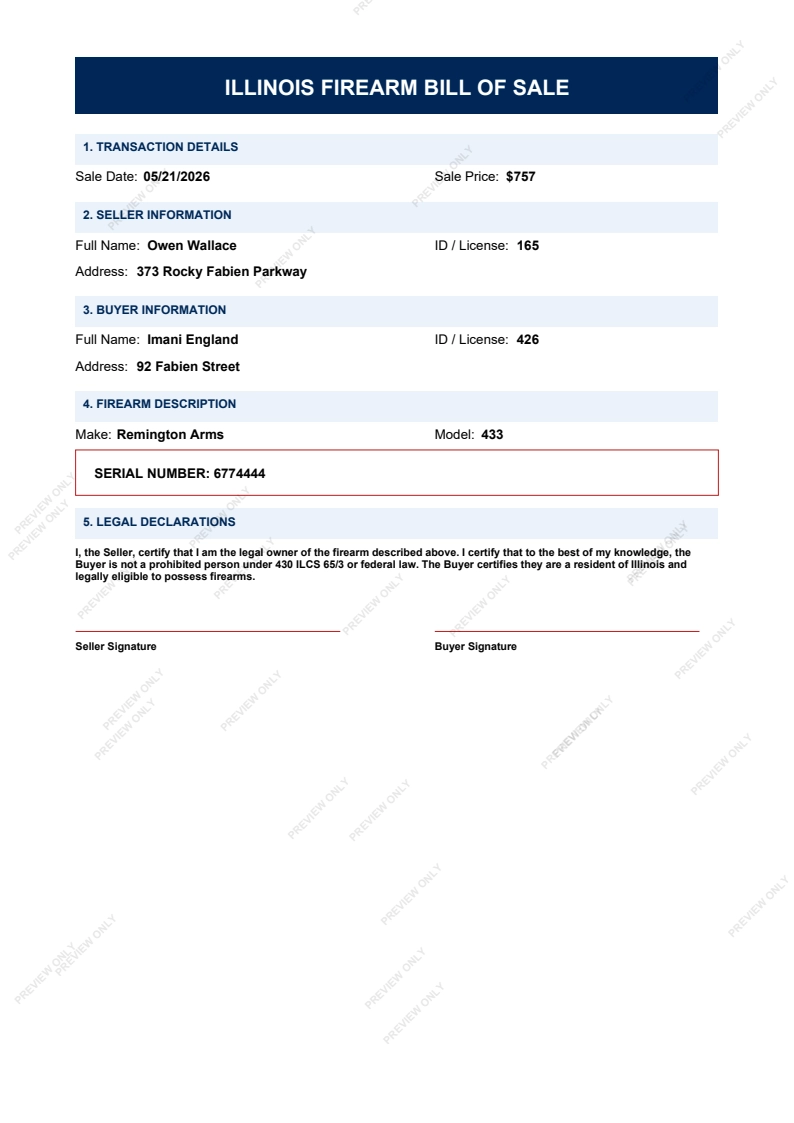
Illinois is one of the most regulated states in the country for private gun sales — and a 2024 law change made sellers directly responsible for the background check. Every buyer must hold a valid Firearm Owner's Identification (FOID) card just to possess a firearm or ammunition. Since January 1, 2024, the seller must personally initiate and complete an automated background check through the Illinois State Police system, obtain an approval number, and record that number on the sale paperwork before completing any transfer. There is also a mandatory 72-hour waiting period that applies to every firearm — handguns, rifles, and shotguns alike — and the seller must keep a record of the sale for 10 years. This Bill of Sale documents the agreed price, the FOID verification, and the transfer date — your private record that the state's paperwork does not replace.
📄 Illinois Firearm Record Document Blueprint:
📋 Illinois Legal Essentials for Private Sellers
1. The Seller Initiates the Background Check, Not the Buyer
Since January 1, 2024, Illinois law puts the responsibility on the seller to personally start and complete an automated background check through the Illinois State Police's Person-to-Person Transfer portal. You'll enter the buyer's FOID number and date of birth to receive an approval number, which is valid for 10 days and must appear on your sale paperwork.
⚠️ Don't assume a buyer showing you their physical FOID card is enough — you still have to run the transaction through the ISP portal yourself and get an approval number before the sale is legal.
2. The 72-Hour Wait Applies to Every Firearm, No Exceptions
Illinois requires a 72-hour waiting period for all firearms — handguns, rifles, and shotguns alike — starting from the moment buyer and seller agree to the sale. This applies uniformly, even to buyers who already hold a Concealed Carry License.
⚠️ Don't assume a CCL holder or an experienced gun owner can skip the wait — the 72-hour clock applies to every transaction with no exceptions for buyer experience or licensing.
3. PICA's Magazine and Assault Weapon Limits Apply to Private Sales Too
The Protect Illinois Communities Act, effective January 2023, bans selling or transferring magazines over 10 rounds for long guns or 15 rounds for handguns, along with a defined list of assault weapons. Items legally owned before the ban are grandfathered for possession by the original owner, but that grandfathering doesn't transfer to a new buyer through a sale.
⚠️ Don't assume a magazine or firearm you've legally owned since before 2023 is automatically sellable — grandfathered status covers your continued possession, not your ability to transfer it to someone else.
4. You're on the Hook for Records Even After the Sale Is Done
Illinois requires private sellers to retain a record of the transaction — including the buyer's information and the ISP approval number — for at least 10 years after the sale. This isn't optional paperwork; it's a legal obligation that outlives the transaction itself.
⚠️ Don't treat your Bill of Sale as disposable once the deal is done — Illinois law expects you to be able to produce it a decade later if it's ever needed.
5. Selling to an Out-of-State Buyer Still Requires an FFL, FOID or Not
Illinois's FOID and background-check system only governs transfers between Illinois residents. If your buyer lives in Indiana, Wisconsin, or any other state, federal law requires the transaction to go through a licensed FFL dealer in the buyer's home state — the Illinois-specific FOID process doesn't apply, and doesn't substitute for that requirement.
⚠️ Don't assume completing the Illinois FOID check somehow satisfies federal law for an out-of-state buyer — it doesn't, and a direct interstate transfer is still a federal felony regardless of FOID compliance.
This information reflects publicly available Illinois statutes and enforcement practices. Illinois's firearm laws are among the most detailed in the country and have recently been shaped by ongoing litigation — always verify the latest rules and consult a qualified attorney.
Illinois Rules Are Above — The Form Itself Isn't Illinois-Specific
The FOID verification, 72-hour wait, and 10-year record-keeping requirement above are unique to Illinois. Filling out the actual Bill of Sale — the fields, the description, the signatures — follows the same basic format everywhere.
See our nationwide Step-by-Step Firearm Bill of Sale Guide for that part.
Illinois Firearm Transfer FAQ
How do I verify a buyer's FOID card in Illinois?
Sellers must use the ISP Person-to-Person Transfer portal. You enter the buyer's FOID number and date of birth to receive an approval number. This number is valid for 10 days and must be recorded on your Bill of Sale. Source: ISP Person-to-Person Transfer Portal
What is the waiting period for firearms in Illinois?
Illinois has a mandatory 72-hour waiting period for all firearms — handguns, rifles, and shotguns alike. The clock starts once the agreement to purchase is made, even in private transactions, and it cannot be waived for any buyer, including concealed carry license holders. Source: 720 ILCS 5/24-3
Can I sell high-capacity magazines in Illinois?
No. Under the Protect Illinois Communities Act, it is generally illegal to sell or transfer magazines holding more than 10 rounds for long guns or 15 rounds for handguns. Magazines legally owned before the January 2023 ban are grandfathered for possession only, not for sale. Verify your magazines' capacity before listing them in a private sale. Source: Protect Illinois Communities Act (PICA)
Do I need to keep records of the sale?
Yes. Illinois law requires private sellers to keep a record of the transfer for at least 10 years. This Bill of Sale, along with the ISP approval number, fulfills your legal obligation to document who you sold the firearm to and when.
Related Forms & Regional Compliance:
Illinois stands as a strict regulatory contrast to its Midwestern neighbors. While Indiana, Missouri, and Iowa have all adopted permitless carry and have no FOID requirements, Illinois continues to tighten its borders against unregulated transfers. Neighboring Wisconsin also lacks a FOID system, making it critical for Illinois sellers to remember that selling to a resident of any neighboring state without a licensed FFL dealer is a federal felony.