Last Updated: Aug 18, 2026
Indiana became a Constitutional Carry state on July 1, 2022 — anyone 18 or older who meets the state's 'proper person' criteria can now carry openly or concealed without a permit. Private sales here require no background check, no waiting period, and no state paperwork. But Indiana has two specific rules sellers should know: selling or delivering a deadly weapon to someone you know to be intoxicated is a Class B misdemeanor under IC 35-47-4-1, and selling a handgun to someone who is not a 'proper person' — as defined under IC 35-47-1-7 — is a Level 5 felony under IC 35-47-2-7. Without a signed Bill of Sale, you have no evidence you did your homework.
Indiana's Specifics vs. the Standard Process
Constitutional Carry, the 'proper person' standard, and Indiana's felony provisions above are specific to this state. Completing the actual Bill of Sale — the fields, the signatures, keeping your copy — works the same way everywhere.
See our nationwide Step-by-Step Firearm Bill of Sale Guide for that walkthrough.
📋 Indiana Legal Essentials for Private Sellers
1. Constitutional Carry Doesn't Eliminate the 'Proper Person' Standard
Since July 1, 2022, Indiana no longer requires a license to carry a handgun — but the buyer must still be a 'proper person' under IC 35-47-1-7, which excludes convicted felons, drug abusers, and others barred by law. The absence of a License to Carry a Handgun (LTCH) tells you nothing about eligibility anymore, since most eligible buyers no longer bother getting one.
⚠️ Don't treat the lack of an LTCH as a red flag — Constitutional Carry made the license optional, so most law-abiding buyers simply don't have one.
2. Knowingly Selling to Someone Under a Red Flag Order Is a Specific Felony
Indiana's Jake Laird Law (IC 35-47-14) lets courts seize firearms from individuals found dangerous to themselves or others. Separately, IC 35-47-4-6.7 makes it a Level 5 felony to knowingly sell or transfer a firearm to someone you know has been found dangerous by a court under that law — a distinct offense from the buyer's own prohibited status.
⚠️ Don't assume a buyer's calm demeanor is enough reassurance — if you have actual knowledge someone is under a dangerous-person finding, selling to them is a felony on your part specifically, not just theirs.
3. Visible Intoxication Is Its Own Legal Trigger to Refuse a Sale
Separate from any background eligibility, IC 35-47-4-1 makes it a Class B misdemeanor to sell or deliver a firearm to someone you know to be intoxicated at the time. This applies regardless of whether the buyer is otherwise a fully eligible, proper person.
⚠️ Don't proceed with a sale just because the buyer passed every other check — visible intoxication at the moment of transfer is its own separate legal problem, and the safest move is to reschedule.
4. The Age Floor Isn't Always 18 — Juvenile Delinquency Can Push It to 23
Indiana generally allows private firearm sales to buyers 18 and older, but anyone adjudicated a juvenile delinquent for an act that would be a felony if committed as an adult cannot legally purchase a firearm until turning 23. This is easy to miss since it doesn't show up on a standard ID check.
⚠️ Don't assume 18 is a hard floor for every buyer — a young adult buyer with a juvenile record for a felony-equivalent act may not be eligible until 23, and there's no visual way to know without asking directly.
5. Strong Preemption Means No City Can Add Its Own Rules
Under IC 35-47-11.1, Indiana reserves firearm regulation exclusively to the state — no city, county, or other local unit of government can impose additional requirements like waiting periods, registration, or extra paperwork on private sales.
⚠️ Don't assume a local ordinance you've heard about — in Indianapolis or elsewhere — actually changes your obligations as a private seller; Indiana's preemption law almost certainly overrides it.
This information reflects publicly available Indiana statutes and enforcement practices. Firearm laws can change — always verify the latest rules and consult a qualified attorney.
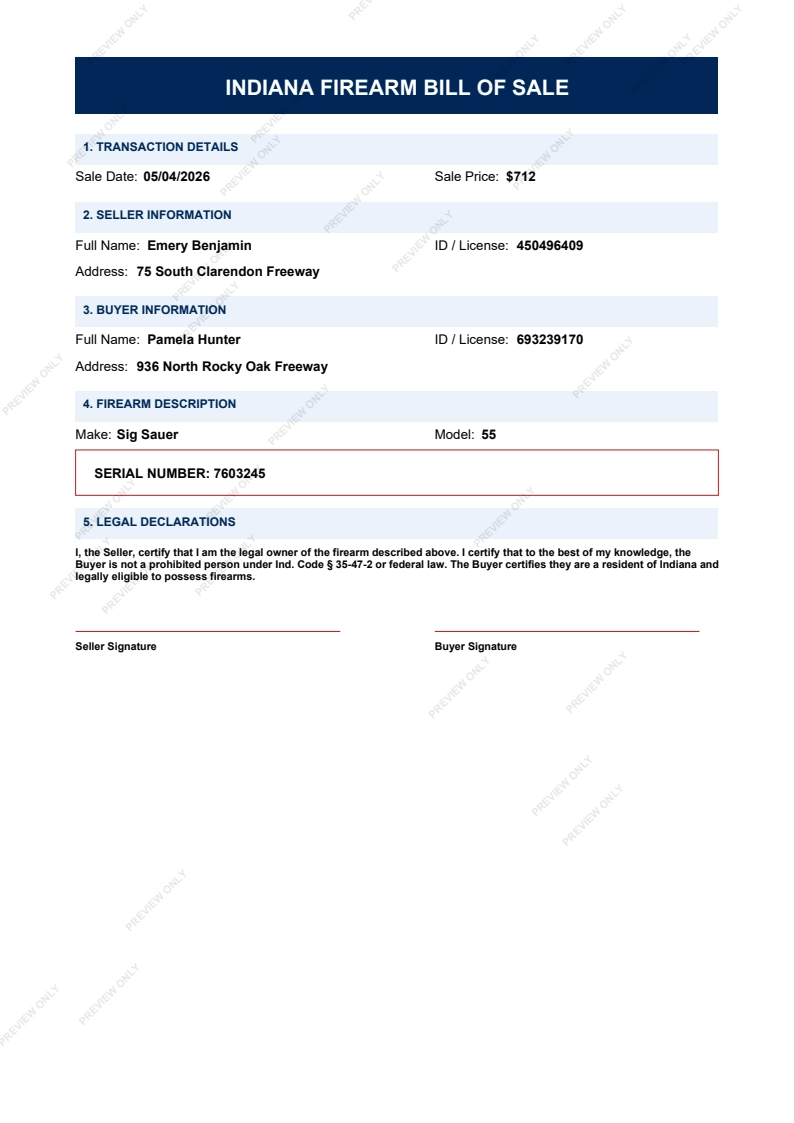
📄 Hoosier State Form Blueprint Preview:
Indiana Firearm Transfer FAQ
Is a Bill of Sale required in Indiana?
Indiana requires zero documentation for private firearm transfers — no paperwork, no background check, no state involvement. But the ATF trace follows the paper trail to the last documented owner, and that is you until you can prove otherwise. A signed Bill of Sale with the buyer's ID, the serial number, and the transfer date is your only defense if the firearm surfaces in a criminal investigation. Indiana has no state registry, so without this document, you have no proof the gun ever left your hands.
What is Constitutional Carry in Indiana and when did it take effect?
Indiana became a Constitutional Carry state on July 1, 2022. Any U.S. citizen 18 or older who is a 'proper person' under Indiana Code can now carry a handgun openly or concealed without a license. For private sellers, this means the absence of a License to Carry a Handgun (LTCH) is completely normal. Verify ID instead. More details: Indiana State Police.
What is Indiana's free License to Carry and why does it matter for sellers?
Indiana still issues its License to Carry a Handgun (LTCH) — and uniquely, it is completely free. A lifetime LTCH costs nothing and provides reciprocity in 32 other states. As a seller, if your buyer has an LTCH, record the number on the Bill of Sale. It means they passed a background check at the time of issuance.
Can I sell a handgun to an 18-year-old in Indiana?
Generally yes — Indiana allows private handgun sales to buyers who are at least 18. However, there is an important exception: under Indiana Code, anyone adjudicated as a juvenile delinquent for an act that would be a felony if committed by an adult cannot purchase any firearm until they turn 23. Always verify ID and ask the buyer to certify their eligibility.
Can I sell a firearm to someone who is intoxicated in Indiana?
No. Indiana specifically prohibits selling a handgun to someone who is visibly intoxicated — this is a separate criminal offense under IC 35-47-4-1. If a buyer appears intoxicated at the time of the transaction, you must refuse the sale regardless of their otherwise legal eligibility.
Who is a prohibited person in Indiana?
Under IC 35-47-1-7, a prohibited person is anyone who is not a 'proper person' — including convicted felons, drug abusers, and those found dangerous under Indiana's Red Flag Law (the 'Jake Laird Law,' IC 35-47-14). Knowingly selling or transferring a firearm to someone you know has been found dangerous by a court under this law is itself a Level 5 felony, separate from the buyer's own prohibited status. Always ask the buyer to certify they are not subject to a dangerous person order. Source: IC 35-47-4-6.7
Is there a waiting period in Indiana?
No. Indiana has no state-mandated waiting period. Under IC 35-47-11.1, Indiana has strong preemption, meaning no city or county can impose local waiting periods. The rules are uniform statewide.
Can I sell to a resident of Illinois, Ohio, or Kentucky?
No. Federal law prohibits private person-to-person firearm transfers across state lines. Selling directly to a resident of another state without FFL involvement is a federal felony. Always verify the buyer holds a current Indiana Driver's License or State ID.
Are NFA items legal to sell privately in Indiana?
Indiana is fully NFA-friendly. As of 2026, the ATF Form 4 approval process still fully applies even if tax stamp rules have changed federally. A private Bill of Sale does not substitute for ATF approval on NFA items like suppressors or SBRs.
Does Indiana have a gun registry?
No. Indiana has no state-level firearm registry and no requirement to report private sales. Your Bill of Sale is a private document. Indiana's preemption laws prevent any local government from creating a local registry.
Related Forms & Regional Compliance:
Indiana is a central hub of firearm freedom in the Midwest, but it is surrounded by states with wildly different laws. While Kentucky and Ohio share Indiana's permitless carry stance, crossing the border into Illinois means navigating a strict FOID card and background-check system, and Michigan requires its own purchase permit and background check for handguns, plus a license to carry concealed — neither state's system resembles Indiana's hands-off approach. Always remember: federal law dictates that you cannot sell a firearm hand-to-hand to a resident of another state; you must use a licensed FFL dealer in the buyer's home state.