Last Updated: Aug 08, 2026
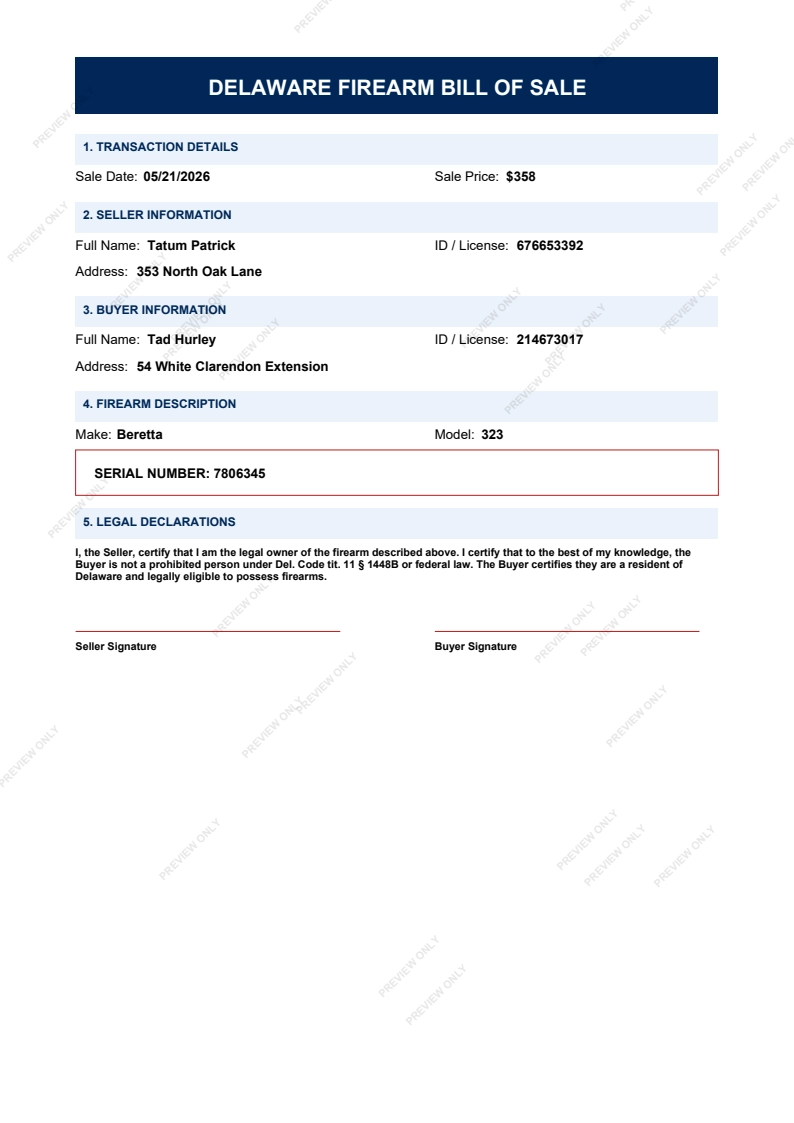
Delaware just got significantly stricter for private gun sales. Delaware already required unlicensed sellers to conduct any firearm transfer through a licensed FFL dealer for a background check — both parties must appear together at the dealer's place of business. As of November 16, 2025, buyers must also first obtain a Handgun Qualified Purchaser Permit from the Delaware State Police before purchasing or receiving a handgun, which requires a firearms safety course, fingerprinting through IdentoGO, and a background check by the State Bureau of Identification (SBI). Buyers who already hold a valid Delaware Concealed Carry Deadly Weapon (CCDW) license are exempt from this new permit requirement. This Bill of Sale documents the agreed price, the firearm's condition, and the buyer's permit details before you visit the dealer — your private record of the transaction that the state's paperwork does not replace.
Note: Verified for Delaware SB 2 Compliance
📄 Delaware Firearm Form Draft Preview:
The Part That's the Same Everywhere
Delaware's FFL requirement, Permit to Purchase process, and the state paperwork above are specific to this state. The actual mechanics of completing the Bill of Sale — filling in the fields, getting signatures, keeping your copy — don't change from state to state.
See our nationwide Step-by-Step Firearm Bill of Sale Guide for that part.
📋 Delaware Legal Essentials for Private Sellers
1. Every Sale Goes Through an FFL, No Exceptions for Friends
Delaware requires unlicensed sellers to conduct any firearm transfer through a licensed FFL dealer, who runs the background check through the State Bureau of Identification (SBI). Both you and the buyer must appear together at the dealer's place of business — there's no legal way to complete a private sale without this step, aside from a handful of narrow exceptions like short-term loans to someone you know personally.
⚠️ Don't assume a deal with someone you know well skips the FFL requirement — the personal-acquaintance exemptions in Delaware law are narrow (like a loan of 14 days or less), not a general carve-out for private sales.
2. Handgun Buyers Need a Permit to Purchase Since November 2025
As of November 16, 2025, anyone buying or receiving a handgun in Delaware — including in a private sale — must first hold a Handgun Qualified Purchaser Permit, obtained after a safety course, IdentoGO fingerprinting, and an SBI background investigation. Buyers who already hold a valid Concealed Carry Deadly Weapon (CCDW) license are exempt from this new permit.
⚠️ Don't take a buyer's word that they're 'in process' for the permit — the FFL dealer will need to verify a completed, valid permit or CCDW license before the transfer can proceed.
3. The Long-Gun Age Requirement Is Currently Unsettled
Delaware raised the purchase age for both handguns and long guns to 21 in 2022, but a Delaware Superior Court ruling in August 2025 struck down the long-gun portion of that law as unconstitutional under the state constitution. Where this leaves the actual age requirement is unclear while the ruling's status is worked out — it may have reverted toward the federal baseline of 18 for long guns.
⚠️ Don't rely on your own assumption about the current long-gun age minimum — confirm the live requirement with your FFL dealer or the Delaware State Police before completing the sale, since this is actively changing.
4. The 17-Round Magazine Limit Is Higher Than Most States, But Still Firm
Delaware's large-capacity magazine ban, enacted in 2022, kicks in above 17 rounds — more permissive than the 10-round caps common in neighboring states like Connecticut, New York, and New Jersey. Magazines legally owned before the ban are grandfathered for possession, but that grandfathering does not extend to selling or transferring them.
⚠️ Don't assume a magazine over 17 rounds is transferable just because you've legally owned it for years — grandfathered possession rights don't carry over to a private sale.
5. Suppressors Stay Illegal in Delaware Regardless of Federal Changes
Delaware bans civilian possession of suppressors under state law, independent of federal NFA rules. Even as federal suppressor requirements have shifted, Delaware's state-level prohibition remains fully in effect.
⚠️ Don't assume a suppressor is sellable in Delaware just because federal paperwork or tax stamps have changed — the state ban applies on top of, not instead of, federal law.
This information reflects publicly available Delaware statutes and enforcement practices. Delaware's firearm laws — especially the age requirement — are actively changing through litigation; always verify the latest rules and consult a qualified attorney.
Delaware Firearm Transfer FAQ
Does Delaware require a background check for private sales?
Yes. Under Del. Code § 1448B, all private firearm transfers must go through a licensed FFL dealer who runs a background check through the State Bureau of Identification (SBI). Delaware is a point-of-contact state, meaning the check goes through the SBI rather than directly to the federal NICS system. Both the seller and buyer must appear together at the dealer's location to complete the transfer. Skipping this step is a criminal offense. Source: Del. Code § 1448B
What is Delaware's new Permit to Purchase requirement?
As of November 16, 2025, anyone buying a handgun in Delaware must first obtain a Handgun Qualified Purchaser Permit from the Delaware State Police. Getting the permit requires completing a certified firearms safety training course, fingerprinting through IdentoGO, and a background investigation by the State Bureau of Identification (SBI). CCDW (Concealed Carry Deadly Weapons) license holders are exempt from this requirement. As a seller, always verify that a handgun buyer holds either a valid permit or a CCDW license before proceeding. Source: Delaware State Police – Permit to Purchase
Is a Bill of Sale necessary in Delaware?
While the FFL dealer records the transfer for the state, the Bill of Sale is your private contract. It documents the agreed price, the firearm's condition, and the buyer's permit details before you visit the dealer. If the buyer backs out after the background check is initiated, or if a price dispute arises later, this document is your proof. Delaware's background check can take up to 25 days in some cases — having a signed agreement protects both parties during that window.
What is Delaware's Red Flag law?
Delaware enacted a Red Flag law in 2018 — called the Lethal Violence Protective Order (LVPO). It allows family members, household members, and law enforcement to petition a court to temporarily remove firearms from someone deemed a danger to themselves or others. As a seller, ask the buyer to certify on the Bill of Sale that they are not currently subject to an LVPO — knowingly selling to someone under such an order is a criminal offense. Source: Delaware Courts – LVPO
Can I sell a magazine with more than 17 rounds in Delaware?
No. Delaware prohibits the sale, transfer, or possession of magazines capable of holding more than 17 rounds. This limit was enacted in 2022 and applies to private transfers as well as dealer sales. Delaware's 17-round limit is more permissive than states like Connecticut or California, which cap magazines at 10 rounds, but existing large-capacity magazines owned before the ban are grandfathered for possession only — not for sale or transfer. Source: Del. Code § 1469
Are suppressors legal in Delaware?
No. Delaware state law prohibits civilian possession of suppressors regardless of federal law. This is an important distinction — even where federal NFA requirements have changed, Delaware's state-level ban remains in effect. Do not include a suppressor in any private sale in Delaware.
What is the minimum age for private gun sales in Delaware?
This is currently in flux. Delaware raised the purchase age to 21 for both handguns and long guns in 2022, but a Delaware Superior Court ruling in August 2025 struck down that long-gun age increase as unconstitutional under the state constitution. As a result, the age for long guns may have reverted toward the federal baseline of 18, while handguns remain at 21 under federal law regardless. Given the pending legal uncertainty, verify the current age requirement directly with an FFL dealer or the Delaware State Police before completing any sale.
Is there a waiting period in Delaware?
There is no fixed statutory waiting period in Delaware, but the transfer cannot be completed until the SBI approves the background check. In high-volume periods this can create a de facto wait — Delaware law allows up to 25 days before a transfer can proceed without a denial. Source: Delaware State Police
Can I sell to a family member without a background check?
Yes, with limits. Delaware exempts certain transfers between immediate family members from the background check requirement. However, extended family members such as cousins, in-laws, and aunts or uncles are not included in this exemption — those transfers still require an FFL background check. Source: Del. Code § 1448B
Who is a prohibited person in Delaware?
Prohibited persons include convicted felons, those with certain violent misdemeanor convictions, and individuals adjudicated as mentally incompetent. Selling to a prohibited person is a felony regardless of whether you used an FFL dealer. Source: Del. Code § 1448