Last Updated: Sep 14, 2026
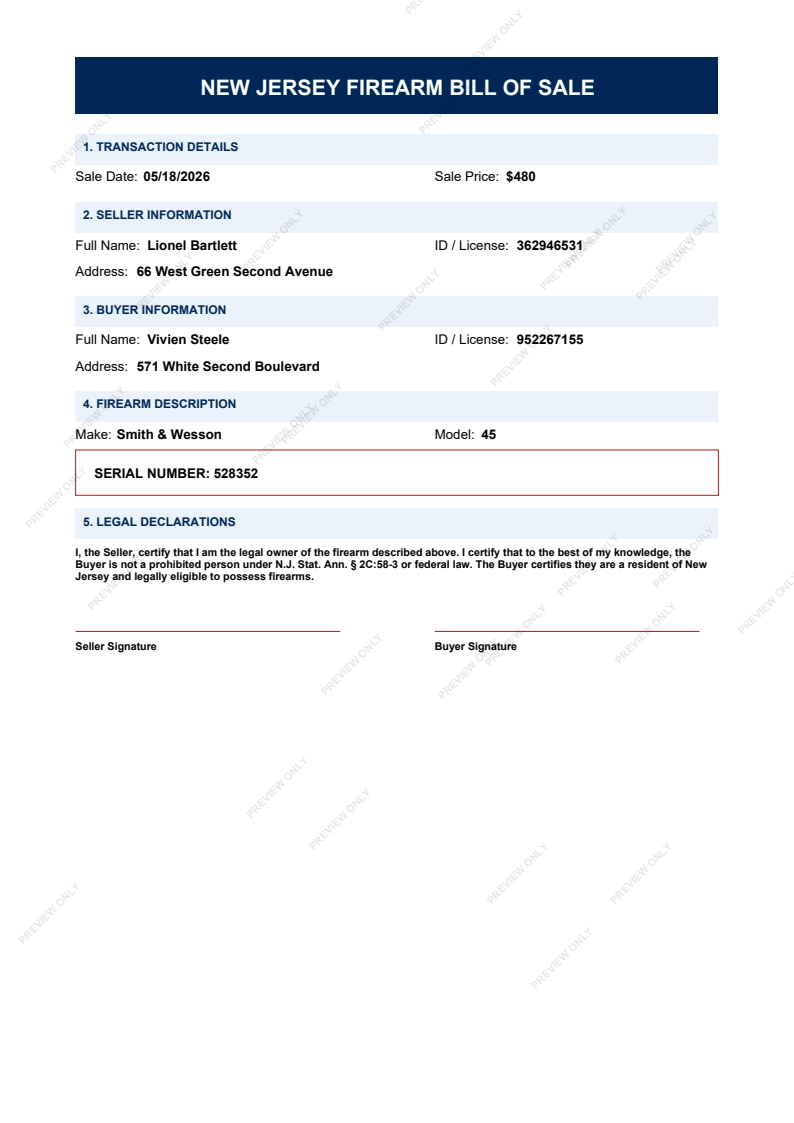
New Jersey has the most complex private gun sale process in the country — and there is effectively no such thing as a casual private sale here. Every handgun transfer requires the buyer to hold a Firearms Purchaser Identification Card (FPIC) plus a separate per-handgun Permit to Purchase, both must go through an FFL dealer, and a copy of the permit is sent to the NJ State Police Firearms Investigations Unit. The entire application process goes through the FARS online portal; state law requires a decision within 30 days for residents, though real-world processing at some police departments has been reported to take considerably longer. Long gun transfers require the FPIC only, with no per-firearm permit needed. This Bill of Sale documents the agreed price, the FPIC number, and firearm condition — your private record before visiting the dealer.
New Jersey's Process Is Above — The Form Itself Isn't the Hard Part
The FPIC, the per-handgun Permit to Purchase, and New Jersey's FARS system above are specific to this state. Filling out and signing the actual Bill of Sale — the fields, the description, the signatures — works the same basic way everywhere.
See our nationwide Step-by-Step Firearm Bill of Sale Guide for that walkthrough.
📄 Garden State Form Blueprint Preview:
📋 New Jersey Legal Essentials for Private Sellers
1. There's No Real 'Private' Sale — Everything Runs Through FARS and an FFL
Every handgun transfer in New Jersey, even between two private individuals who know each other, must go through a licensed FFL dealer and the state's FARS system. The buyer needs a valid FPIC plus a separate Permit to Purchase for that specific handgun. A direct, hand-to-hand handgun transfer is a criminal offense, full stop.
⚠️ Don't assume a casual sale between friends skips New Jersey's process — the FFL and FARS requirement applies regardless of how well you know the buyer, with the sole exception of the narrow immediate-family pathway.
2. The Family Exemption Skips the Dealer, Not the Permit
Immediate family transfers are exempt from the dealer visit and NICS check, processed instead directly through FARS with both parties certifying the relationship. But the recipient still needs a valid FPIC — and for a handgun, a Permit to Purchase — before the transfer can happen. The exemption streamlines the process; it doesn't eliminate the underlying credential requirement.
⚠️ Don't assume a family transfer requires no paperwork at all — the recipient still needs their own valid FPIC or Permit to Purchase, just without the dealer and NICS step.
3. The Safety Course Only Slows Down First-Timers
Since 2022, a state-approved firearms safety course is required before a first-time FPIC or handgun permit application can be processed — but subsequent permits and FPIC renewals skip this step entirely. If your buyer has never held either credential before, budget extra time for this requirement.
⚠️ Don't assume every applicant needs the safety course — a buyer renewing an FPIC or applying for their second handgun permit has already cleared this hurdle.
4. The Magazine and Assault Weapon Bans Are Currently Unsettled Law
On July 17, 2026, the Third Circuit Court of Appeals, sitting en banc, struck down both New Jersey's 10-round magazine limit and its assault weapons ban as unconstitutional, with the ruling taking effect without a stay on July 31, 2026. The state has signaled it will continue fighting this in court, meaning the practical legal status could shift again with little notice.
⚠️ Don't treat the 10-round magazine limit or assault weapons ban as settled, enforceable law right now — this is an actively moving legal situation, and relying on outdated information here carries real risk.
5. Hollow-Point Ammunition Has Its Own Separate Transport Rules
Hollow-point ammunition is legal to keep at home in New Jersey, but carrying it outside your dwelling is restricted to direct transport to and from specific permitted locations like a shooting range. This is a distinct rule from the state's other firearm restrictions and catches out-of-state visitors as much as residents.
⚠️ Don't assume hollow-point ammunition follows the same rules as your firearm or magazine — this is a separate restriction with its own transport requirements that apply even if everything else about your sale is fully compliant.
This information reflects publicly available New Jersey statutes and enforcement practices. New Jersey's firearm laws are complex and currently subject to significant ongoing litigation — always verify the latest rules and consult a qualified attorney.
New Jersey Firearm Transfer FAQ
Can I sell a gun privately in New Jersey?
Technically yes, but there is no such thing as a casual private sale in New Jersey. Every handgun transfer must go through a licensed FFL dealer who processes the transaction through the NJ State Police FARS system. The buyer must hold a valid FPIC plus a separate per-handgun Electronic Permit to Purchase. Attempting a direct hand-to-hand transfer is a criminal offense. Source: N.J.S.A. 2C:58-3
What is the difference between the FPIC and the Permit to Purchase?
New Jersey requires two separate credentials for handguns. The Firearms Purchaser Identification Card (FPIC) covers all long gun purchases and is valid for 10 years. The Permit to Purchase is a separate $25 credential required for each individual handgun and is valid for 90 days. Both are applied for through the FARS online portal.
What is the FARS portal and how does it work?
New Jersey's Firearms Application and Registration System (FARS) is the state's centralized online platform for all firearms permit applications and transfers. For private handgun sales, the FARS portal is used to process the Electronic Permit transfer. Immediate family members are exempt from the dealer and NICS check step, but the recipient must still hold a valid FPIC (and, for a handgun, a Permit to Purchase) obtained through FARS before the transfer — both parties then certify the family relationship through the portal. Source: NJSP – Immediate Family Transfer Exemption
Is the 2022 firearms safety course mandatory?
Yes — since 2022, all first-time FPIC and handgun permit applicants must complete a state-approved firearms safety course before their application can be processed. Subsequent permits or FPIC renewals do not require another course. As a seller, verify your buyer has completed this requirement, as it can add weeks to the timeline.
Is there a waiting period in New Jersey?
There is no traditional waiting period once the buyer has their permits, but New Jersey does not follow the federal three-day default proceed rule. You must wait for explicit state approval before completing any transfer. Furthermore, New Jersey limits buyers to one handgun purchase per 30-day period.
What are New Jersey's magazine and assault weapon restrictions?
New Jersey's statute caps magazines at 10 rounds and separately bans a defined list of 'assault firearms' by name and feature. However, on July 17, 2026, the Third Circuit Court of Appeals (sitting en banc) ruled both the magazine capacity limit and the assault weapons ban unconstitutional, and the ruling took effect without a stay on July 31, 2026. The state has indicated it will continue pursuing the litigation. Given this rapidly evolving legal situation, verify the current enforcement status directly with an FFL dealer or attorney before relying on either restriction. Source: N.J.S.A. 2C:39-1
What is the hollow-point ammunition restriction in New Jersey?
New Jersey uniquely restricts where hollow-point ammunition may be carried. While legal to keep at home, it may not be carried outside a dwelling except when being transported directly to and from locations like a shooting range. Driving with a loaded hollow-point magazine is a criminal offense even for permit holders. Source: NJSP – Hollow Point Ammunition Transport
Is a Bill of Sale mandatory in New Jersey?
While the FARS portal and dealer records are required by the state, they do not personally protect the seller. The Bill of Sale is your private contract documenting the price, condition, and permit numbers. Since a copy of every handgun Permit to Purchase is sent to the NJ State Police, the state effectively maintains a record of all handgun transfers.
Who is prohibited from owning a gun in New Jersey?
Prohibited persons include convicted felons, those with domestic violence convictions, individuals with certain mental health histories, and anyone the state determines is 'not in the interest of public health, safety or welfare.' New Jersey also has a Red Flag law allowing for Extreme Risk Protective Orders.
Does New Jersey recognize out-of-state carry permits?
No. New Jersey does not honor any other state's carry permit. Non-residents visiting with firearms are only protected by the federal FOPA safe passage provision if the firearm is unloaded, locked in a container, and the traveler has a lawful destination in another state.
Related Forms & Regional Compliance:
New Jersey shares borders with New York, Pennsylvania, and Delaware. Due to the state's mandatory FARS and FFL requirements, hand-to-hand private transfers to residents of any state — including neighbors — are strictly prohibited and constitute a criminal offense under N.J.S.A. 2C:58-3. Sellers must be exceptionally cautious regarding New Jersey's unique restrictions, including strict hollow-point ammunition transport laws that apply even to those traveling from more permissive neighboring jurisdictions like Pennsylvania. The state's magazine capacity limit is also currently in legal flux following a July 2026 federal appeals court ruling — verify current enforcement status before relying on it.