New York's Rules Are Above — The Form Itself Isn't the New York Part
The NYPL requirement, the semi-automatic rifle license, and New York's narrow family exemption above are specific to this state. Filling out and signing the actual Bill of Sale — the fields, the description, the signatures — works the same basic way everywhere.
See our nationwide Step-by-Step Firearm Bill of Sale Guide for that walkthrough.
New York vs. Regional Neighbors: 2026 Comparison
| Feature | New York (NY) | Pennsylvania (PA) | New Jersey (NJ) | Connecticut (CT) |
|---|---|---|---|---|
| Private Sale FFL Required | Yes | Handguns Only | Yes | Yes |
| Semi-Auto Rifle License | Yes | No | No | No |
| Magazine Capacity Limit | 10 Rounds | No | 10 Rounds | 10 Rounds |
| Handgun Permit Required | Yes | No | Yes | Yes |
| Red Flag Law | Yes | No | Yes | Yes |
| Statewide Registry | Yes (Handguns) | No | Yes | Yes |
Last Updated: Sep 19, 2026
New York has some of the most complex gun laws in the country — and the rules differ significantly between upstate New York and New York City. Every private handgun sale requires the buyer to hold a valid New York Pistol License (NYPL). Every private firearm sale regardless of type requires an FFL background check since the 2013 SAFE Act. Semi-automatic rifles require a separate purchase license since 2022. This Bill of Sale documents the buyer's NYPL or license number, the agreed price, and firearm condition before you visit the dealer — your private record in a state that keeps extensive official records.
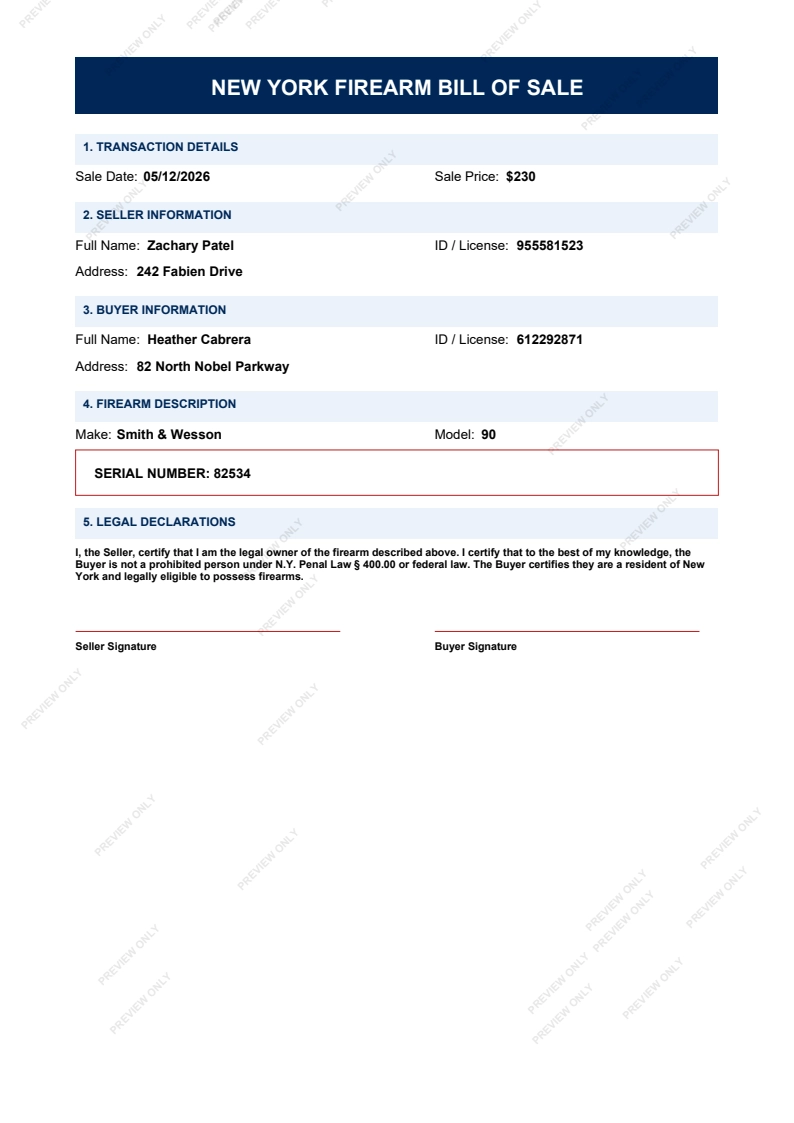
📄 Empire State Form Blueprint Preview:
📋 New York Legal Essentials for Private Sellers
1. The Family Exemption Is Narrower Than It Sounds — And Never Covers Handguns
New York's immediate family exemption from background checks covers only spouses, domestic partners, children, and stepchildren — not parents, siblings, or grandparents, despite repeated legislative attempts to expand it. Critically, this exemption applies only to long guns. A handgun transfer always requires the buyer to hold a valid NYPL first, regardless of family relationship.
⚠️ Don't assume selling a handgun to your sibling or parent qualifies for any family exemption — it doesn't, on two separate grounds: the relationship isn't covered, and handguns aren't covered by this exemption at all.
2. The Bill of Sale Does Real Administrative Work Here, Not Just Legal Protection
In most states, a Bill of Sale is optional paperwork for your own protection. In New York, it's practically required — licensing officers use it to formally remove a handgun from the seller's permit and add it to the buyer's, a process that can take several weeks even after the FFL transfer is complete.
⚠️ Don't treat the Bill of Sale as an afterthought once the FFL transfer is done — it's often the document that actually completes the licensing paperwork on both ends.
3. Recertification Cycles Differ by License Type
An NYPL holder must recertify every 3 years for a concealed carry license, but every 5 years for a premise permit. Missing either deadline results in automatic revocation of the license — and by extension, the legal right to possess the handguns registered to it.
⚠️ Don't assume every NYPL follows the same 5-year cycle — concealed carry licenses recertify on a shorter, 3-year timeline, and a buyer's license could lapse sooner than you'd expect.
4. Semi-Automatic Rifles Now Follow Their Own Licensing Track
Since September 4, 2022, any semi-automatic rifle purchase requires the buyer to be 21 and hold a specific Semi-Automatic Rifle License — separate from any handgun or assault-weapon requirement. Buyers 18-20 can still legally buy manually operated long guns (bolt, lever, pump action), just not semi-automatics.
⚠️ Don't assume any rifle purchase follows the same rules as a standard long gun — a semi-automatic action specifically triggers this newer, separate licensing requirement regardless of whether the rifle qualifies as an 'assault weapon.'
5. Traveling Through New York With a Firearm Carries Real Arrest Risk, Even When Compliant
New York and Port Authority police have repeatedly arrested travelers who were fully compliant with the federal FOPA 'safe passage' law, particularly at NYC-area airports — a pattern confirmed by federal court rulings and NRA-ILA's own advisory warning against relying on FOPA at New York airports. This matters for sellers whose buyers may be transporting the firearm through New York afterward.
⚠️ Don't assume FOPA compliance guarantees safe passage through New York, especially through airports — courts have upheld arrests even when travelers met every federal requirement, so advise buyers to consider shipping firearms through an FFL instead of flying with them through New York.
This information reflects publicly available New York statutes and enforcement practices. Firearm laws can change — always verify the latest rules and consult a qualified attorney.
New York Firearm Transfer FAQ
Can I sell a gun privately in New York?
Technically yes, but there is no such thing as a casual private sale. Every private transfer must go through a licensed FFL dealer for a background check under the SAFE Act. The immediate family exception is narrower than many assume — it covers only spouses, domestic partners, children, and stepchildren, and it applies only to long guns, never to handguns. Handgun buyers must always hold a valid New York Pistol License prior to transfer, regardless of their relationship to the seller.
What is the process for selling a handgun in New York?
First, verify the buyer has a valid NYPL. Both parties visit an FFL for the background check and transfer. Once approved, the buyer must add the handgun to their license through their local licensing officer (county clerk or sheriff). Most offices require a formal Bill of Sale to process this amendment, which can take several weeks.
Is a Bill of Sale required in New York?
Yes. Uniquely, a formal Bill of Sale is practically required because licensing officers use it to remove the firearm from the seller's permit and add it to the buyer's. It must include the agreed price, serial number, and NYPL numbers for both parties.
What is a New York Pistol License and how does it work?
An NYPL is required to possess any handgun in the state. It involves background checks, fingerprints, and character references. Permits issued outside of NYC are NOT valid within NYC without NYPD Commissioner validation. Recertification is required every 3 years for concealed carry licenses and every 5 years for premise permits; failure to recertify results in automatic revocation.
What is New York's semi-automatic rifle license requirement?
Since September 4, 2022, buyers must be at least 21 and hold a specific license to purchase any new semi-automatic rifle. Buyers aged 18-20 are limited to manually operated rifles (bolt, lever, pump action) and shotguns. Selling a semi-auto rifle without verifying this license creates criminal liability.
Are assault weapons legal to sell in New York?
No. The SAFE Act bans the sale and transfer of firearms classified as assault weapons (semi-autos with detachable magazines and one or more banned features). Weapons owned before the ban and registered with the State Police by the April 15, 2014 deadline are grandfathered for possession but cannot be sold or transferred within the state.
What is the magazine limit in New York?
The limit is 10 rounds for both handguns and rifles. Magazines manufactured before 1994 that hold more than 10 rounds may be possessed by the original owner but cannot be sold or transferred within New York.
Does New York require lost or stolen firearms to be reported?
Yes. Under Penal Law § 400.10, owners must report lost or stolen firearms to local law enforcement within 24 hours of discovering the loss. Failure to do so is a Class A misdemeanor.
Does New York recognize out-of-state carry permits?
No. New York does not honor any other state's carry permit. Following the Bruen decision, New York is shall-issue but has implemented extensive 'sensitive location' restrictions where carry is prohibited.
Who is prohibited from owning a gun in New York?
Prohibited persons include felons, those convicted of 'serious offenses' (including certain misdemeanors), individuals reported by mental health professionals as likely to cause harm, and those subject to an ERPO Red Flag order.
Related Forms & Regional Compliance:
New York is bordered by New Jersey, Pennsylvania, Connecticut, Massachusetts, and Vermont. Federal law strictly prohibits private hand-to-hand transfers across state lines to residents of any neighboring state. Sellers should be extremely cautious when transporting firearms near state lines; New York law enforcement frequently does not recognize the federal Firearm Owners Protection Act (FOPA) 'safe passage' provisions, and travelers can be arrested for transporting firearms through New York even if they are compliant with federal law.