Last Updated: Sep 13, 2026
Massachusetts has some of the most complex private gun sale rules in the country — and 2024-2026 brought major changes with the MIRCS Unified Gun Portal, created under Chapter 135 of the Acts of 2024. Every private sale requires both parties to hold valid licenses — an LTC for handguns and large-capacity weapons, or an FID card for standard long guns. The transfer must be reported through the MIRCS Unified Gun Portal within 7 days using the FA10 form. Private sellers are limited to 4 transactions per calendar year under M.G.L. c. 140, §128A; a 5th transaction must go through a licensed dealer. All firearms must also be registered in the new system by October 2026 regardless of when they were acquired. This Bill of Sale documents the buyer's LTC or FID number, the agreed price, and the firearm's condition — your private record that supplements the mandatory state reporting.
📄 Bay State Form Blueprint Preview:
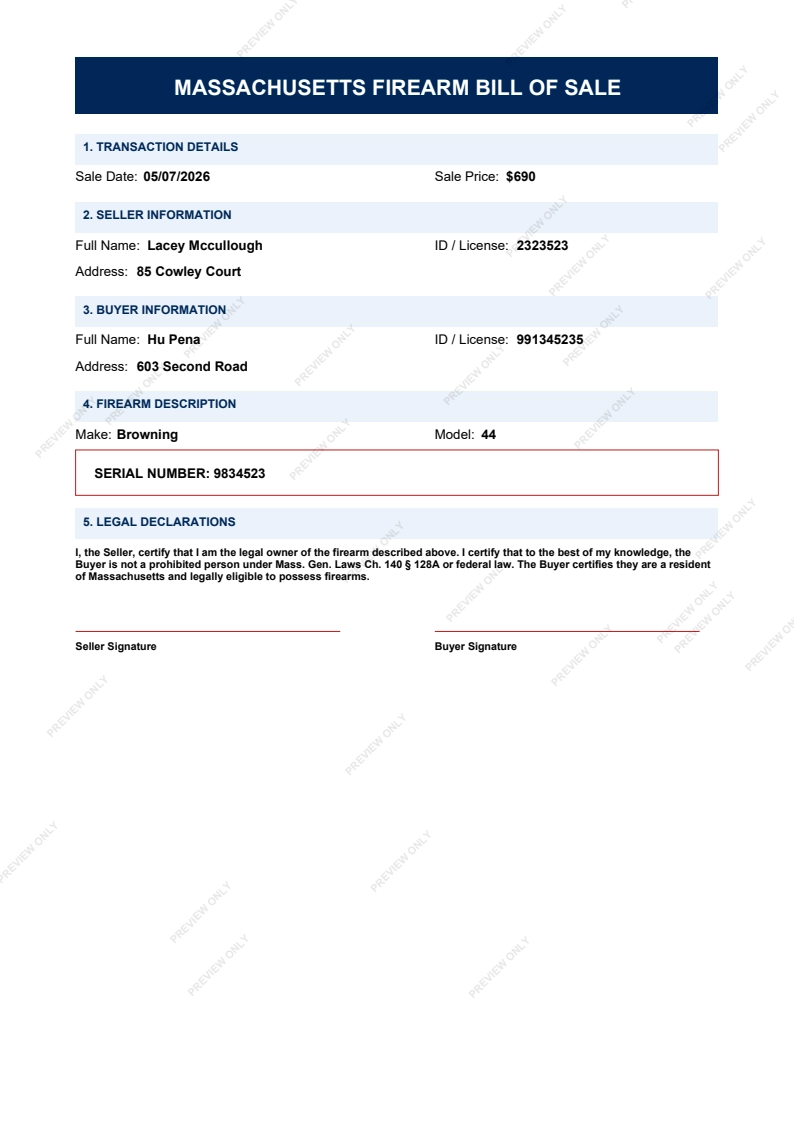
Massachusetts's Details Are Above — The Form Itself Isn't One of Them
The MIRCS portal, the 4-transaction limit, and Massachusetts's licensing rules above are specific to this state. Filling out and signing the actual Bill of Sale — the fields, the description, the signatures — works the same basic way everywhere.
See our nationwide Step-by-Step Firearm Bill of Sale Guide for that walkthrough.
📋 Massachusetts Legal Essentials for Private Sellers
1. You're Capped at 4 Private Transfers a Year
Under M.G.L. c. 140, §128A, a licensed resident who isn't a dealer can sell or transfer no more than 4 firearms in a calendar year through private transactions — this includes sales, gifts, and loans of 7 days or longer. A 5th transaction in the same year must go through a licensed dealer instead.
⚠️ Don't lose track of how many firearms you've already transferred this year — exceeding the 4-transaction cap without using a dealer for the additional sale is itself a separate legal problem, on top of whatever else is being sold.
2. The MIRCS Portal Replaced the Old System — And Added a Registration Deadline
Since October 2025, all private-sale reports go through the new MIRCS Unified Gun Portal via an electronic FA10 form, filed within 7 days of the transaction. Separately, Chapter 135 of the Acts of 2024 requires that every firearm in Massachusetts — regardless of when it was acquired — be registered in this new system by October 2026.
⚠️ Don't assume reporting your sale through MIRCS also satisfies the separate firearm registration requirement — if your own firearms haven't yet been registered in the new system, that's a distinct deadline you still need to handle.
3. A Safety Device Must Accompany Every Sale, Installed or Not
Massachusetts law requires that a state-approved safety device (like a trigger lock) accompany every firearm at the time of sale, whether or not it's actually installed on the gun. Skipping this is treated as a breach of warranty and an unfair trade practice under state law.
⚠️ Don't assume this requirement only applies to licensed dealers — it applies to your private sale too, and forgetting the device is a documented legal violation, not just an oversight.
4. The Magazine Cutoff Date Is 1994, Not the Sale Date
Whether a large-capacity magazine (over 10 rounds, or 5 shotgun shells) is legal to sell depends on when it was manufactured — before September 13, 1994 — not when you're selling it. Pre-1994 magazines can only be transferred privately between two LTC holders; anything manufactured after that date is illegal to sell privately regardless of how long you've owned it.
⚠️ Don't assume a magazine is sellable just because you've legally possessed it for years — check the manufacture date specifically, since a post-1994 large-capacity magazine remains illegal to transfer no matter how long you've had it.
5. License 'Suitability' Denials Are Real, But Currently Being Challenged in Court
Massachusetts still allows police chiefs to deny an LTC application if they find the applicant 'unsuitable' based on credible information of risk. Since the 2022 Bruen decision, this standard has faced repeated legal challenges, with several district courts ruling it unconstitutional as applied to specific denials — a case currently before Massachusetts' highest appellate review could reshape how this works.
⚠️ Don't assume a buyer's currently valid license guarantees their eligibility won't be questioned later — this area of Massachusetts law is genuinely in flux, so verifying license status right before a sale, not relying on memory of an old check, is the safer practice.
This information reflects publicly available Massachusetts statutes and enforcement practices. Massachusetts's firearm laws are complex and actively being litigated — always verify the latest rules and consult a qualified attorney.
Massachusetts Firearm Transfer FAQ
Can I sell a gun privately in Massachusetts?
Yes, but both parties must hold valid Massachusetts firearms licenses — an LTC for handguns and large-capacity weapons, or an FID card for non-large-capacity rifles and shotguns. The transfer must be reported through the MIRCS Unified Gun Portal within 7 days using the FA10 form. Private sellers are limited to 4 transactions per calendar year under M.G.L. c. 140, §128A; a 5th transaction must go through a licensed dealer. Source: M.G.L. c. 140, §128A
What is the new MIRCS Unified Gun Portal and how does it affect private sales?
Launched in October 2025, the MIRCS Unified Gun Portal replaced older registration systems. All private sale FA10 reports must now be filed electronically through this portal. A critical new deadline: all firearms in Massachusetts must be registered through MIRCS by October 2026. The buyer must also report the purchase within 7 days. Source: Mass.gov – Firearm Modernization Law
What is the difference between an LTC and an FID card?
An FID card (Firearms Identification Card) covers non-large-capacity rifles and shotguns, with a minimum age of 18 (or 15 with parental consent). An LTC (License to Carry) requires the applicant to be at least 21 and covers all legal firearms, including handguns. Both are 'shall-issue' since Massachusetts amended its law after the 2022 Bruen decision. As a seller, you must verify the buyer holds the correct license type for the specific firearm.
Does Massachusetts require a safety device with every firearm sale?
Yes. Under M.G.L. c. 140, §131K, all sales must include a state-approved safety device. While the seller doesn't need to install it, the device must accompany the firearm at transfer. Failure to include one constitutes a breach of warranty and an unfair trade practice under state law. Source: M.G.L. c. 140, §131K
Can I sell a large-capacity magazine in Massachusetts?
Only if it was manufactured before September 13, 1994 (the federal assault weapons ban date). Massachusetts prohibits the sale or transfer of magazines holding more than 10 rounds (or 5 shotgun shells) manufactured after that date. Pre-ban magazines may only be sold privately between LTC holders. Selling a post-ban large-capacity magazine is a serious felony.
How many guns can I sell privately in Massachusetts?
Massachusetts limits private sellers to 4 firearm transactions per calendar year under M.G.L. c. 140, §128A. This includes sales, gifts, and loans of 7 days or more. Loans under 7 days between licensed individuals are permitted but must still be reported via MIRCS. Source: M.G.L. c. 140, §128A
Does Massachusetts recognize out-of-state carry permits?
No. Massachusetts does not honor any other state's carry permit. Out-of-state residents cannot receive firearms through a private sale in MA without a non-resident LTC from the State Police Firearms Records Bureau. Non-residents traveling through are only protected by federal FOPA rules if the firearm is unloaded and locked in the trunk.
Who is prohibited from owning a gun in Massachusetts?
Prohibited persons include convicted felons, those with violent crime or drug convictions, and anyone subject to a domestic violence restraining order under M.G.L. c. 209A. Local police chiefs can also deny licenses to someone they deem 'unsuitable' based on reliable, articulable, and credible information of risk — though this standard remains under active legal challenge in Massachusetts courts, with several district court rulings finding it unconstitutional as applied. Always verify the buyer's license is active through the MIRCS portal before completing any transfer.