Last Updated: Sep 14, 2026
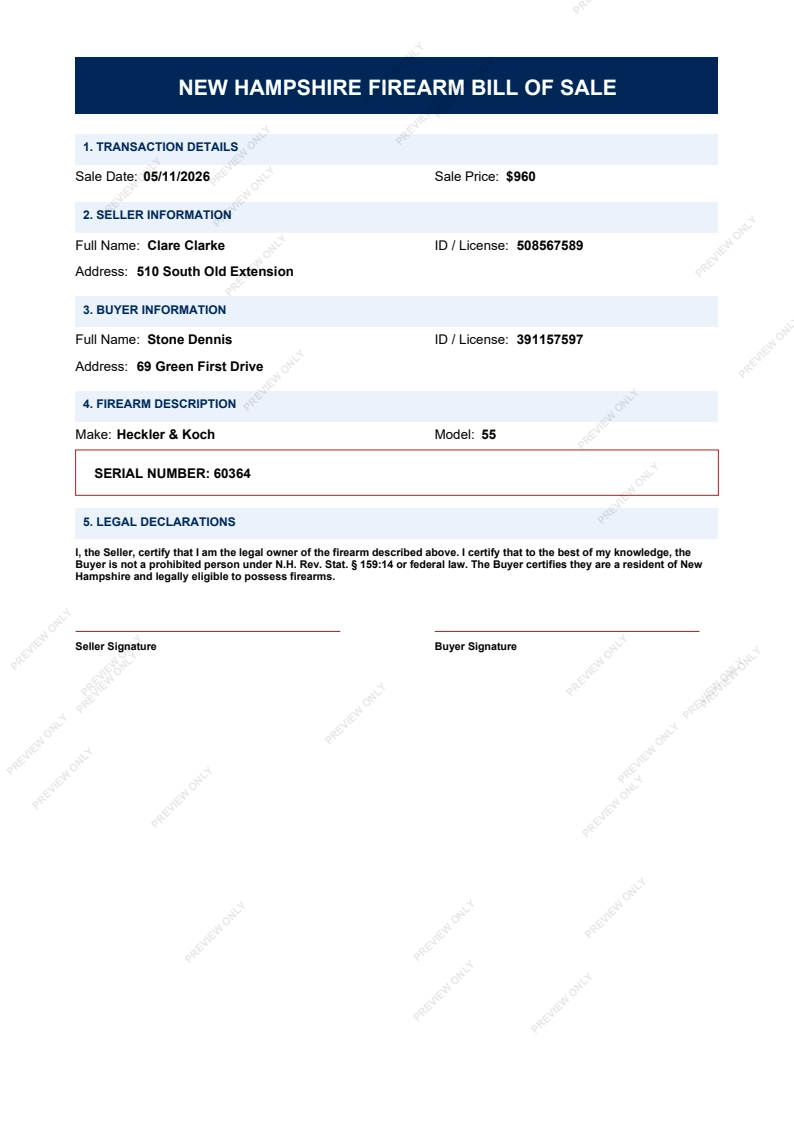
New Hampshire lives up to its 'Live Free or Die' motto when it comes to private gun sales — no background check, no permit, no waiting period, no registration, and no state paperwork of any kind. Private sales between residents are entirely unregulated at the state level beyond federal prohibited person rules. Constitutional Carry has been in effect since February 22, 2017, when Governor Sununu signed Senate Bill 12 into law. But there is one unique New Hampshire rule: a private seller must either personally know the buyer has no reason to be prohibited, or the buyer must have a valid license to carry. Without one of these conditions, the transfer is legally questionable. This Bill of Sale documents the buyer's ID and the transfer date — your only paper trail in a state that keeps no records.
How to Transfer a Firearm Privately in New Hampshire
Need a field-by-field breakdown on how to legally execute this transfer? Read our comprehensive, nationwide Step-by-Step Firearm Bill of Sale Guide.
📋 New Hampshire Legal Essentials for Private Sellers
1. The 'Personally Know' Rule Is the Real Verification Standard
Under RSA 159:14, a private seller must either personally know the buyer well enough to have no reason to believe they're prohibited, or the buyer must hold a valid Pistol/Revolver License (PRL). This is the actual legal safeguard behind New Hampshire's otherwise unregulated private-sale market — it's not optional, even though there's no formal background check process.
⚠️ Don't treat 'personally know' as a loose or informal standard — selling to a total stranger without a PRL is legally questionable under RSA 159:14, not just inadvisable.
2. The PRL Is Cheap, Fast, and the Safest Documentation Option
New Hampshire's optional Pistol/Revolver License costs just $10 for residents, is valid for five years, and must be issued or denied within 14 days of application. Because it requires a background check to obtain, a buyer's PRL is the single strongest piece of evidence you can record on a Bill of Sale to show you satisfied RSA 159:14.
⚠️ Don't assume a buyer without a PRL is automatically ineligible — many legally eligible New Hampshire residents simply never bother getting one since it's not required to carry.
3. Family Transfers to Minors Follow a Narrow Exception
New Hampshire has no general state-defined minimum age for firearm possession, but transferring a firearm to someone under 18 is only permitted from a parent, grandparent, or legal guardian. Every other private sale defaults to the federal floor of 18.
⚠️ Don't assume any adult can legally sell to a minor with parental permission — the exception is specifically limited to parents, grandparents, and guardians, not any consenting adult.
4. Suppressor Ownership and Suppressor Hunting Are Different Questions
Suppressors are fully legal to own in New Hampshire, and the federal transfer tax dropped to $0 as of January 1, 2026. But RSA 207:4-a specifically bars using a suppressor while hunting, regardless of federal tax changes — this is a state hunting-law restriction layered on top of otherwise permissive suppressor ownership.
⚠️ Don't assume the federal tax stamp change affects New Hampshire's hunting-specific suppressor ban — that's a separate state law that federal changes don't touch.
5. No Registry and No Red Flag Law, But Federal Liability Remains
New Hampshire has no state firearm registry and has repeatedly rejected Red Flag legislation, most recently SB 555 and HB 1642 in the 2025-2026 session. None of this changes federal law: knowingly selling to someone you have reasonable cause to believe is prohibited remains a federal offense under 18 U.S.C. § 922(d).
⚠️ Don't treat New Hampshire's permissive state framework as the complete legal picture — federal prohibited-person rules apply regardless of how few state-level requirements exist.
This information reflects publicly available New Hampshire statutes and enforcement practices. Firearm laws can change — always verify the latest rules and consult a qualified attorney.
New Hampshire vs. New England Neighbors: 2026 Comparison
| Feature | New Hampshire (NH) | Vermont (VT) | Massachusetts (MA) | Maine (ME) |
|---|---|---|---|---|
| Private Sale Background Check | No | Yes | Yes | No |
| Constitutional Carry | Yes | Yes | No | Yes |
| Magazine Capacity Limit | No | Yes | Yes | No |
| Red Flag Law | No | Yes | Yes | Yes |
| State Firearm Registry | None | No | No (MIRCS Records) | No |
| Suppressor Hunting | No (RSA 207:4-a) | Yes | No | Yes |
📄 Granite State Form Blueprint Preview:
New Hampshire Firearm Transfer FAQ
Is a Bill of Sale required in New Hampshire?
No — New Hampshire requires zero documentation for private firearm transfers. However, with no state firearm registry, a Bill of Sale is your only evidence that a firearm left your possession. This is particularly important for satisfying the unique 'personally know' requirement of RSA 159:14.
What is New Hampshire's 'personally know or has a license' rule?
Under RSA 159:14, a private seller must either personally know the buyer and have no reason to believe they are prohibited, or the buyer must hold a valid Pistol/Revolver License (PRL). Selling to a stranger without a PRL is legally questionable, making the PRL the safest verification for private sellers. Source: RSA 159:14
What is New Hampshire's Pistol/Revolver License and why does it matter for sellers?
The optional PRL under RSA 159:6 costs $10 and is valid for 5 years. For sellers, it is the strongest evidence of eligibility because it means local law enforcement has recently verified the buyer's background. You should record the PRL number on your Bill of Sale whenever possible. Source: RSA 159:6
What is the minimum age for private gun sales in New Hampshire?
New Hampshire has no state-defined minimum age for possession, but only a parent, grandparent, or guardian can transfer a firearm to someone under 18. For all other private sales, the federal floor of 18 applies. Always verify the buyer's New Hampshire ID to confirm age and residency.
Can suppressors be used for hunting in New Hampshire?
No. While suppressors are legal to own and the federal transfer tax on them was reduced to $0 as of January 1, 2026, RSA 207:4-a specifically prohibits their use for any hunting activity in New Hampshire. They remain legal for target shooting and home defense. Source: RSA 207:4-a
Does New Hampshire have a Red Flag law?
No. New Hampshire has repeatedly rejected Extreme Risk Protection Order (ERPO) legislation, including during the 2025-2026 session (SB 555, HB 1642). The state also codifies Stand Your Ground protections under RSA 627:4. Source: RSA 627:4
Who is a prohibited person in New Hampshire?
New Hampshire follows federal guidelines under 18 U.S.C. § 922(d), which includes convicted felons, fugitives, and those adjudicated as mentally incompetent. As of 2026, New Hampshire has no state-specific Red Flag mechanism to remove firearms from individuals.
Can I sell to a resident of Massachusetts or Vermont?
No. Federal law prohibits hand-to-hand private firearm transfers across state lines. Selling directly to a resident of Vermont or Massachusetts without involving an FFL is a federal felony.