Vermont's Rules Are Above — The Form Itself Isn't One of Them
The waiting period structure, the preemption law, and Vermont's unusual combination of permissive carry with strict sales above are specific to this state. Filling out and signing the actual Bill of Sale — the fields, the description, the signatures — works the same basic way everywhere.
See our nationwide Step-by-Step Firearm Bill of Sale Guide for that walkthrough.
Last Updated: Oct 01 2026
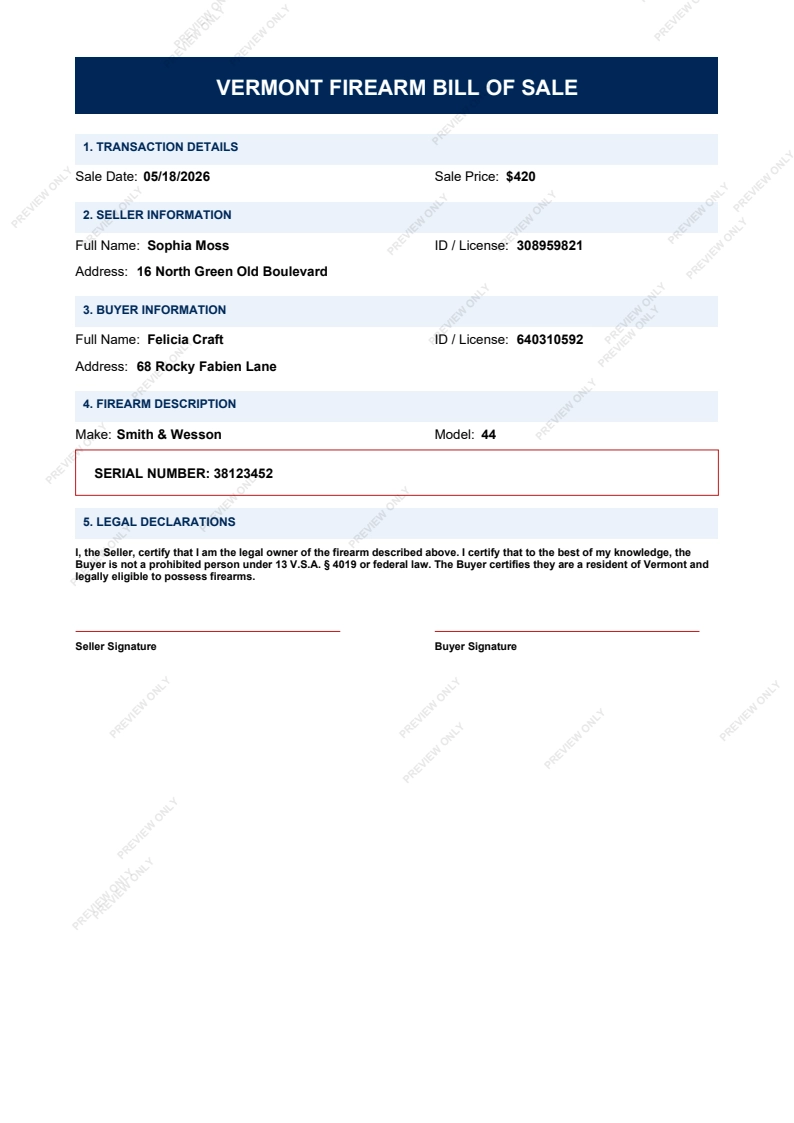
Vermont has a historically unique place in American gun law — it invented Constitutional Carry. 'Vermont Carry' was the term used before any other state adopted permitless carry, because Vermont has never required a permit to carry openly or concealed. But since 2018, Vermont has significantly tightened private sale rules. Every private firearm transfer now requires both parties to appear at a licensed FFL dealer for a NICS background check under 13 V.S.A. § 4019. There is also a mandatory waiting period — 72 hours after the background check starts or 7 business days, whichever is shorter. This Bill of Sale documents the agreed price and firearm condition before you visit the dealer — your private contract that the state's paperwork does not replace.
📄 Green Mountain State Form Blueprint Preview:
📋 Vermont Legal Essentials for Private Sellers
1. 'Vermont Carry' and Vermont's Strict Sale Rules Coexist — And That's Unusual
Vermont is the only state that has never required a carry permit, a tradition dating back to its 1777 constitution. Yet since 2018, it has some of the strictest private sale requirements in the country — mandatory FFL involvement, a NICS check, and a multi-day waiting period. Most states that are permissive about carrying are also permissive about selling; Vermont is a genuine exception to that pattern.
⚠️ Don't assume Vermont's famous permitless-carry tradition means private sales are equally unregulated — carrying and selling are governed by completely different, and very different, legal frameworks here.
2. The Waiting Period Has a Ceiling, Not Just a Floor
Vermont's waiting period runs until 72 hours after NICS provides a transaction number, or 7 business days after the dealer initiates the check, whichever comes first. The 2022 closure of the 'Charleston Loophole' eliminated the old rule that let a sale proceed automatically after just 3 days if NICS hadn't responded — now the dealer must wait up to the full 7 business days if needed.
⚠️ Don't assume a stalled background check means the sale is dead after 72 hours — the dealer can and should keep waiting up to 7 business days total before the old 'default proceed' shortcut would ever apply.
3. Vermont Does Have Preemption — Despite What You Might Read Elsewhere
Under 24 V.S.A. § 2295, Vermont law bars towns and cities from directly regulating firearm possession, ownership, transfer, or sale. This has been used to block local efforts, including a 2013 Burlington ordinance that attempted to ban certain assault weapons and magazines. Some advocacy groups continue pushing to repeal this preemption law, which itself confirms it remains active.
⚠️ Don't assume Vermont allows unlimited local gun regulation just because it has a reputation for local control on other issues — state preemption specifically covers firearms, with only narrow carve-outs for discharge rules and municipal property.
4. The Family Exemption Is Unusually Broad, But Still Has a Line
Vermont's background-check exemption for family transfers extends further than most states — covering step-relatives and even great-grandparents and great-grandchildren, not just immediate family. In-laws, however, are not included, despite the otherwise expansive list.
⚠️ Don't assume every extended relative qualifies for Vermont's family exemption just because the list is unusually long — in-laws specifically fall outside it, even as step- and great-relations are included.
5. Magazine Limits Run in Opposite Directions From What You'd Expect
Vermont's magazine capacity limits are asymmetric: 10 rounds for rifles but 15 rounds for handguns — the reverse pattern from what a seller might assume. Magazines owned before April 11, 2018 can still be possessed, but cannot be sold or transferred within Vermont regardless of how long they've been owned.
⚠️ Don't assume rifle and handgun magazines share the same limit — Vermont's asymmetric caps mean a magazine legal for a handgun might exceed the limit for a rifle, and vice versa isn't automatically true either.
This information reflects publicly available Vermont statutes and enforcement practices. Firearm laws can change — always verify the latest rules and consult a qualified attorney.
Vermont Firearm Transfer FAQ
Can I sell a gun privately in Vermont?
Technically yes, but there is no such thing as a casual private sale in Vermont since 2018. Under 13 V.S.A. § 4019, both seller and buyer must appear together at a licensed FFL dealer who processes the transfer through a NICS background check. The dealer takes temporary possession of the firearm, completes the check, and releases it only after approval. A direct hand-to-hand transfer outside of the immediate family exemption is a criminal offense. Source: 13 V.S.A. § 4019
What is Vermont's waiting period?
Vermont mandates a waiting period for most firearm transfers of 72 hours after the background check starts, or 7 business days, whichever occurs first. This structure is what closed Vermont's 'Charleston Loophole' in 2022 — previously, a dealer could complete a sale after just 3 days even without a definitive NICS answer (a 'default proceed'). Now, if NICS hasn't responded by 72 hours, the dealer must continue waiting up to a full 7 business days rather than defaulting to an automatic approval. Source: 13 V.S.A. § 4019a
What is 'Vermont Carry' and why is it historically significant?
Vermont formerly had very few gun control laws and is the only state where Constitutional Carry has always been the case — hence the alternative term 'Vermont Carry.' Vermont's constitution of 1777, predating the federal Bill of Rights, guarantees the right to bear arms. Vermont has never required a carry permit — not before 2018 and not now. This makes Vermont unique: it has some of the strictest private sale rules in the country while simultaneously having no carry permit requirement whatsoever, not even for non-residents.
What are Vermont's magazine capacity limits?
Vermont enacted laws banning the sale of handgun magazines that hold more than 15 rounds and rifle magazines that hold more than 10 rounds. These asymmetric limits — 10 for rifles, 15 for handguns — are unique to Vermont. Always verify that any magazines included in a private sale comply with the correct limit for the firearm type. Pre-ban magazines owned before April 11, 2018 may be possessed but cannot be transferred within Vermont. Source: 13 V.S.A. § 4021
What is the family exemption from Vermont's background check requirement?
Vermont exempts certain sales or transfers from these requirements. The family exemption under 13 V.S.A. § 4019 is notably broad — it covers spouse, parent, stepparent, child, stepchild, sibling, stepsibling, grandparent, stepgrandparent, grandchild, stepgrandchild, great-grandparent, step-great-grandparent, great-grandchild, and step-great-grandchild. This is one of the most expansive family definitions in any state's background check exemption. In-laws are not included.
What is the minimum age for private gun sales in Vermont?
As of April 11, 2018, the sale of firearms to persons under 21 years of age is prohibited unless the person is law enforcement, an active or veteran member of the National Guard or U.S. Armed Forces, or a person who can produce a certificate of satisfactory completion of a Vermont hunter safety course. For long guns, the minimum age is 18 with a valid hunter safety certificate. For handguns, the minimum age is 21 with no exceptions for hunter safety. Always verify the buyer's Vermont Driver's License or State ID.
Does Vermont have statewide preemption?
Yes. Under 24 V.S.A. § 2295, Vermont law preempts towns, cities, and incorporated villages from directly regulating the possession, ownership, transfer, sale, or licensing of firearms, ammunition, or their components. This has been used to successfully block local efforts, including a 2013 Burlington ordinance attempting to ban assault weapons and certain magazines. A narrow carve-out allows some municipal authority over discharge ordinances and posted municipal property. Source: 24 V.S.A. § 2295
Does Vermont have a Red Flag law?
Yes. Vermont enacted an Extreme Risk Protection Order (ERPO) law in 2018 — one of the earlier state-level Red Flag laws. A 2023 suicide prevention package expanded the ERPO law and added a secure storage requirement in certain circumstances, particularly when minors are present. Vermont has one of the highest rates of firearm suicide in the country, which drove the 2023 legislation. Always ask the buyer to certify on the Bill of Sale that they are not currently subject to an active ERPO.
Who is prohibited from owning a gun in Vermont?
Under Vermont and federal law, prohibited persons include convicted felons, those with domestic violence convictions, individuals subject to protective orders, and those adjudicated as mentally incompetent. Vermont specifically prohibits bump stocks under the 2018 law. Vermont also regulates ghost gun parts — they cannot be sold without serial numbers and a background check. Always ask the buyer to certify compliance with all prohibited person categories on the Bill of Sale.
Can I sell to a resident of New Hampshire, Massachusetts, or New York?
No. Federal law under 18 U.S.C. § 922 prohibits private person-to-person firearm transfers across state lines. Vermont borders New Hampshire, Massachusetts, and New York — and selling directly to a resident of any of them without FFL involvement is a federal felony. Note the irony: Vermont's neighbor New Hampshire is one of the most permissive states in the country while Vermont has some of the strictest private sale requirements in New England.
Related Forms & Regional Compliance:
Vermont is bordered by New York, New Hampshire, and Massachusetts. While Vermont has long-standing traditions of permitless carry, federal law strictly prohibits the private transfer of firearms across state lines to residents of these neighboring states without a licensed FFL dealer. Sellers should be aware that New York and Massachusetts have highly restrictive firearm laws, while New Hampshire remains one of the few neighboring states with more permissive private sale regulations.