North Carolina's 2023-2026 Changes Are Above — The Form Isn't One of Them
The pistol permit repeal, the pending SB 50 carry legislation, and North Carolina's duty-to-inform rule above are specific to this state. Filling out and signing the actual Bill of Sale — the fields, the description, the signatures — works the same basic way everywhere.
See our nationwide Step-by-Step Firearm Bill of Sale Guide for that walkthrough.
Last Updated: Sep 19, 2026
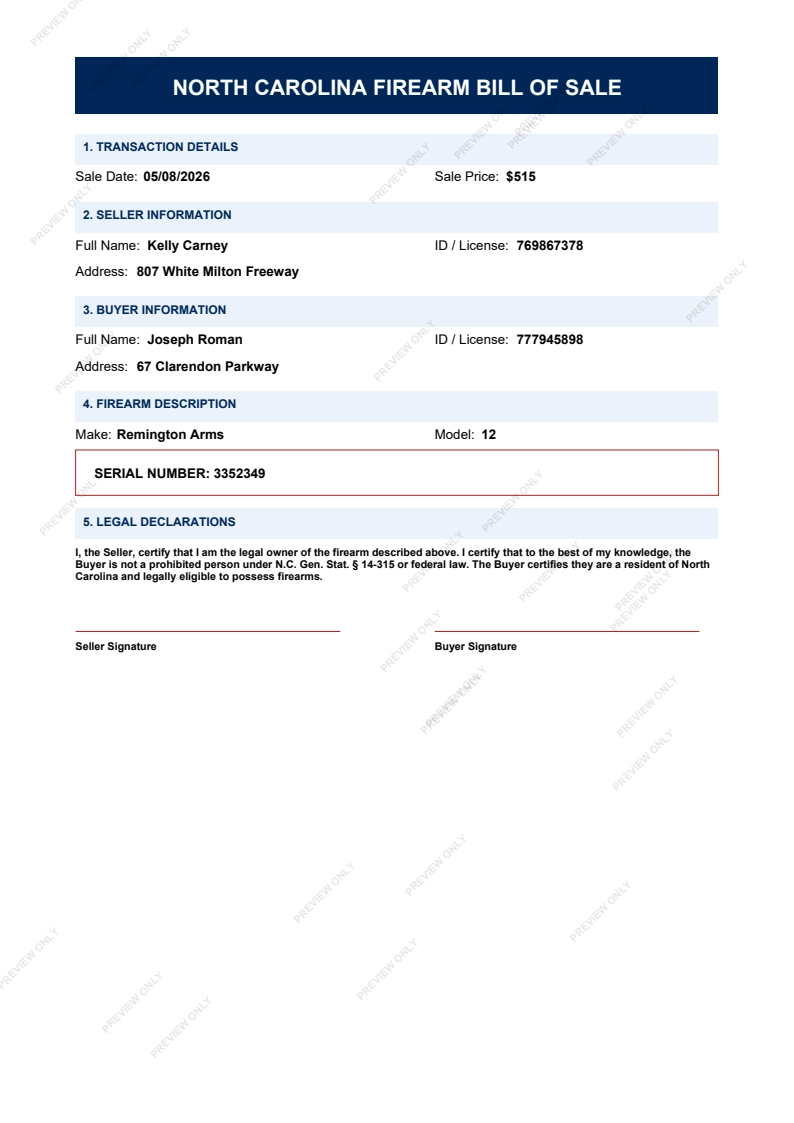
North Carolina made a major change in 2023 — Senate Bill 41 eliminated the century-old Pistol Purchase Permit requirement that had been in place since 1919, effective March 29, 2023. Private handgun sales now require no permit, no background check, and no sheriff involvement. Long gun private sales have always been unregulated. Selling a firearm to a minor or another prohibited person remains a criminal offense under state and federal law — and without a signed Bill of Sale, you have no evidence you did your homework. North Carolina is also actively debating Senate Bill 50, the Freedom to Carry Act, which would eliminate the concealed carry permit requirement; the Senate overrode a gubernatorial veto in July 2025, but the House override remains pending. Until the House acts, a concealed carry permit is still required. This Bill of Sale documents the buyer's ID and the transfer date — your only paper trail in a state that keeps no private sale records.
📄 Tar Heel State Form Blueprint Preview:
📋 North Carolina Legal Essentials for Private Sellers
1. The 2023 Repeal Removed the Sheriff, Not Your Legal Responsibility
Senate Bill 41 eliminated the century-old Pistol Purchase Permit on March 29, 2023, removing the requirement to involve a sheriff before a handgun sale. This doesn't eliminate federal liability: knowingly selling to someone you have reasonable cause to believe is prohibited remains a crime under 18 U.S.C. § 922(d), regardless of the simpler state process.
⚠️ Don't assume the 2023 repeal means private sales are now unregulated in every sense — it removed a specific state permit requirement, not your responsibility to avoid knowingly selling to a prohibited buyer.
2. Selling to a Minor Has Its Own Specific, Serious Penalty
NCGS § 14-315 makes selling or giving a handgun to a minor a Class H felony, separate from any general prohibited-person liability. Other weapons sold to a minor carry a Class 1 misdemeanor. This statute exists specifically to protect minors — it isn't a general 'prohibited person' law, so don't rely on it for broader guidance about adult buyers.
⚠️ Don't cite this statute as covering adult prohibited-person sales generally — it's specifically about minors, and confusing the two could lead you to misunderstand your actual obligations regarding adult buyers.
3. Constitutional Carry Is Stuck in Legislative Limbo
Senate Bill 50 (the Freedom to Carry Act) would eliminate the concealed carry permit requirement, and the Senate already overrode a gubernatorial veto in July 2025. But the House has repeatedly postponed its own override vote, leaving the current permit requirement fully in effect. A buyer's CHP status hasn't changed in relevance yet, but this could shift with little notice.
⚠️ Don't assume Constitutional Carry has already taken effect just because the Senate acted — the House override remains the missing piece, and until it happens, a CHP is still required to carry concealed.
4. 'Concealed' Includes Places You Might Not Expect
A handgun placed in a vehicle's glove compartment is legally 'concealed' under North Carolina law, requiring a CHP just as much as carrying concealed on your person would. Without a permit, the handgun needs to be in plain view within the vehicle.
⚠️ Don't assume a handgun tucked in a glove box is automatically legal without a permit just because it's inside a locked vehicle — North Carolina treats this as concealed carry, triggering the same permit requirement.
5. The Duty to Inform Is Triggered by Officer Contact, Not Fully Proactive
CHP holders must disclose their concealed weapon to a law enforcement officer when approached or addressed by that officer — the statute doesn't require volunteering the information before any contact occurs, but it does apply broadly whenever an officer engages with you, not just if they specifically ask about a firearm.
⚠️ Don't assume the duty to inform only applies if an officer directly asks 'are you carrying' — it applies whenever you're approached or addressed by the officer at all, a broader trigger than many buyers realize.
This information reflects publicly available North Carolina statutes and enforcement practices. North Carolina's firearm laws are actively evolving through pending legislation — always verify the latest rules and consult a qualified attorney.
North Carolina Firearm Transfer FAQ
Is a permit required for private handgun sales in North Carolina?
No. Effective March 29, 2023, Senate Bill 41 repealed the requirement for a Pistol Purchase Permit. Private sellers are no longer required to involve the sheriff or verify a permit before a handgun transfer.
Is a Bill of Sale required in North Carolina?
It is not legally mandated, but it is highly recommended. Since the permit requirement was repealed, the Bill of Sale is your only evidence that a firearm left your possession, as North Carolina does not maintain a firearm registry.
Are background checks required for private sales in North Carolina?
No background check is required for private transfers. However, federal law (18 U.S.C. § 922(d)) still prohibits knowingly selling to someone you have reasonable cause to believe is prohibited from possessing a firearm. Separately, North Carolina law makes it a specific criminal offense to sell a weapon to a minor. A Bill of Sale recording the buyer's age and self-certification serves as your good-faith defense.
What is the minimum age for private gun sales in North Carolina?
The minimum age for both handguns and long guns in a private sale is 18. Under NCGS § 14-315, selling a handgun to a minor is a Class H felony, and selling other weapons to a minor is a Class 1 misdemeanor, with narrow exceptions for temporary loans, custodial transfers, and inherited firearms distributed to a parent or guardian. Source: NCGS § 14-315
What is North Carolina's Senate Bill 50 and what is its current status?
Senate Bill 50, the Freedom to Carry Act, seeks to establish Constitutional Carry in North Carolina. The Senate overrode a gubernatorial veto in July 2025, but as of early-to-mid 2026, the House override remains pending. Until it passes, a Concealed Handgun Permit is still required to carry concealed.
Can I sell to someone with a North Carolina Concealed Handgun Permit?
Yes. While not required for the sale, recording a buyer's CHP on the Bill of Sale is excellent evidence of due diligence, as CHP holders have undergone thorough background checks and training.
Is a glove box handgun legal without a concealed carry permit in North Carolina?
No. Under NCGS § 14-269, a handgun in a glove compartment is considered concealed. Without a CHP, the handgun must be in plain view within the vehicle. Source: NCGS § 14-269
What is North Carolina's duty to inform requirement?
Under NCGS § 14-415.11(a), anyone carrying concealed under a CHP must disclose the weapon to a law enforcement officer when approached or addressed by that officer — the duty is triggered by the officer's contact, not a separate, unprompted obligation to volunteer the information beforehand. Source: NCGS § 14-415.11
Does North Carolina have a Stand Your Ground law?
Yes. Under NCGS § 14-51.3, there is no duty to retreat if you face a threat of death or serious harm in a place you have a legal right to be.
Does North Carolina have a gun registry?
No. North Carolina prohibits the creation of a state, county, or city firearm registry. Your Bill of Sale is a private document and the only proof that the firearm changed hands.
Related Forms & Regional Compliance:
North Carolina is bordered by Virginia, South Carolina, Tennessee, and Georgia. While North Carolina's internal private sale laws have become more permissive since 2023, federal law still strictly prohibits the private, hand-to-hand transfer of firearms across state lines to residents of these neighboring states without a licensed FFL dealer. Additionally, North Carolina's strict 'concealed' definitions—such as handguns in glove boxes requiring a permit—may differ significantly from the laws in neighboring jurisdictions.