South Carolina's Rules Are Above — The Form Itself Isn't One of Them
The vehicle carry rules, the 2025 reporting law, and South Carolina's Constitutional Carry cleanup legislation above are specific to this state. Filling out and signing the actual Bill of Sale — the fields, the description, the signatures — works the same basic way everywhere.
See our nationwide Step-by-Step Firearm Bill of Sale Guide for that walkthrough.
Last Updated: Sep 21, 2026
South Carolina is one of the most firearms-friendly states in the Southeast — Constitutional Carry since March 7, 2024, no background check required for private sales, no waiting period, no registration, and no magazine limits. The state doesn't legally require a Bill of Sale for a private handgun transfer, but keeping one is strongly recommended given that South Carolina maintains no registry or paper trail of its own. As of December 1, 2025, a new law also requires gun owners to report lost or stolen firearms to law enforcement within 10 days of discovery. This Bill of Sale documents the buyer's ID, the agreed price, and the firearm's serial number — your best protection if a question ever arises about the transfer.
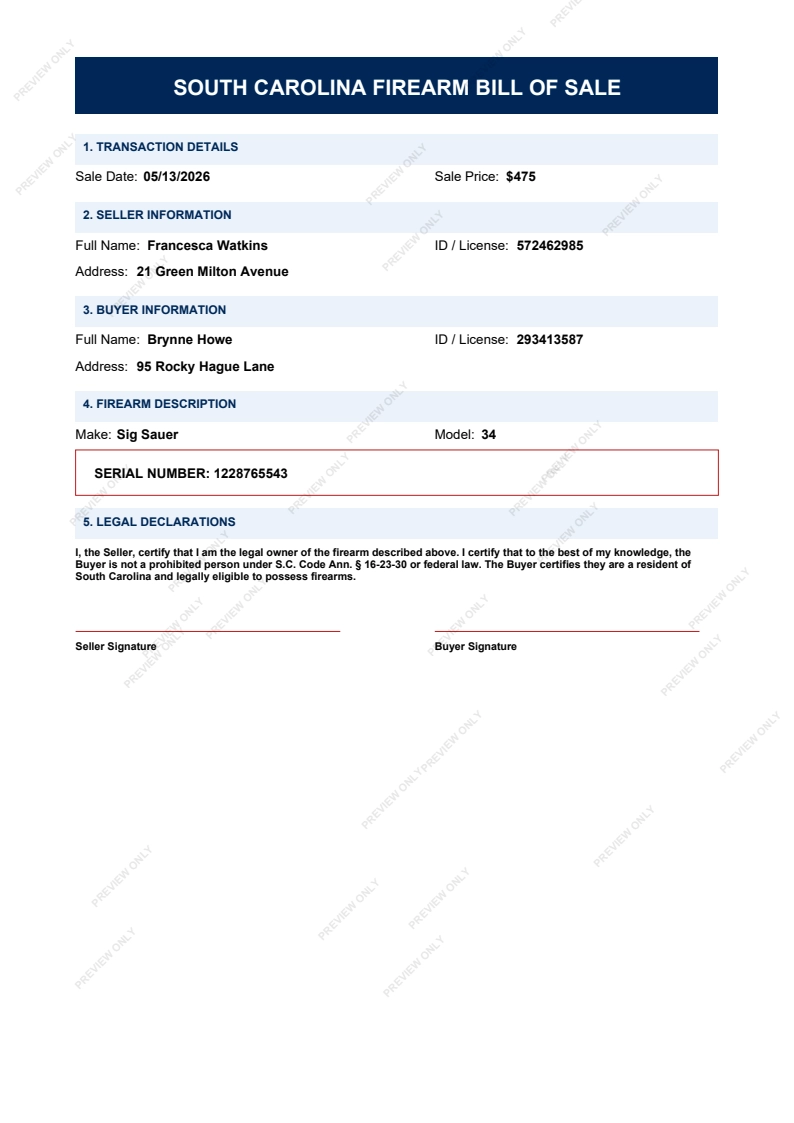
📄 Palmetto State Form Blueprint Preview:
📋 South Carolina Legal Essentials for Private Sellers
1. No Bill of Sale Mandate, But It's Your Only Real Protection
South Carolina doesn't legally require a Bill of Sale for a private handgun transfer, unlike a small number of states with an explicit requirement. But with no state registry and no other paper trail, a simple document recording the buyer's ID, the firearm's serial number, and the transfer date is effectively your only proof the sale happened at all.
⚠️ Don't skip documentation just because South Carolina doesn't require it — the lack of a state paper trail is exactly why your own Bill of Sale carries more weight here, not less.
2. The 2025 Reporting Law Is the Buyer's Problem, But Tell Them Anyway
Since December 1, 2025, South Carolina law requires reporting a lost or stolen firearm within 10 days of discovery. This obligation follows the firearm to its new owner the moment your sale is complete — it's worth mentioning to the buyer so they understand this responsibility starts immediately.
⚠️ Don't assume this reporting requirement is something only the original owner needs to know about — make sure your buyer understands the 10-day clock applies to them from the moment they take possession.
3. Constitutional Carry's Legal Cleanup Continued Into 2026
South Carolina's Constitutional Carry law took effect March 7, 2024, but a legal gap remained: people charged with unlawful carry before that date still had pending cases. In January 2026, the legislature overrode a gubernatorial veto to pass Senate Bill 136, mandating dismissal of those pending charges for otherwise law-abiding individuals.
⚠️ Don't assume Constitutional Carry's legal implementation was fully resolved back in 2024 — related cleanup legislation continued for nearly two years afterward, and similar loose ends can appear with any major law change.
4. Vehicle Carry Is Unusually Permissive, Even by Southern Standards
A handgun can be carried in the glove box, center console, under the seat, or openly on the dashboard in South Carolina without any permit — a notably more permissive rule than many neighboring states that treat a glove box handgun as concealed and requiring a license.
⚠️ Don't assume South Carolina follows the same 'glove box equals concealed' rule common in other states — it doesn't, so a buyer transporting their new purchase this way needs no additional permit here.
5. No Duty to Inform, But That Doesn't Mean No Consequences for Dishonesty
South Carolina imposes no obligation on carriers to proactively tell an officer they're armed. This is a genuinely different approach from neighboring North Carolina, where CHP holders must disclose when approached by an officer.
⚠️ Don't assume South Carolina's rules mirror North Carolina's just because they're neighbors — the duty-to-inform requirement differs meaningfully between the two states, which matters if your buyer plans to carry across state lines.
This information reflects publicly available South Carolina statutes and enforcement practices. Firearm laws can change — always verify the latest rules and consult a qualified attorney.
South Carolina Firearm Transfer FAQ
Is a Bill of Sale legally required for private handgun sales in South Carolina?
Not legally required, but strongly recommended. South Carolina does not mandate a Bill of Sale for private handgun transfers under state law. However, since the state maintains no registry and no other paper trail, a Bill of Sale recording the buyer's identification, the firearm's make, model, and serial number, the agreed price, and the date of transfer is your best protection if the firearm's history is ever questioned.
Are background checks required for private gun sales in South Carolina?
No. Private sales between South Carolina residents are not subject to a background check requirement under state law. However, S.C. Code § 16-23-30 prohibits knowingly selling a handgun to a prohibited person — the 'knowingly' standard means you cannot turn a blind eye to obvious red flags. The Bill of Sale records the buyer's self-certification of eligibility as your good-faith defense. Source: S.C. Code § 16-23-30
What is South Carolina's new stolen firearm reporting requirement?
Effective December 1, 2025, under S.C. Code § 23-31-215, South Carolina gun owners are legally required to report a lost or stolen handgun to law enforcement within 10 days of discovering it is missing. Failure to report within this window can result in criminal charges. As a private seller, inform every buyer of this obligation at the time of transfer — it applies to the new owner the moment the gun changes hands. Source: S.C. Code § 23-31-215
What is South Carolina's Constitutional Carry law?
South Carolina's Constitutional Carry/Second Amendment Preservation Act took effect March 7, 2024. Any adult 18 or older who can legally possess a firearm can now carry openly or concealed without a permit statewide. The optional Concealed Weapons Permit (CWP) through SLED remains available for reciprocity in other states and is shall-issue. In January 2026, lawmakers overrode a gubernatorial veto to pass Senate Bill 136, requiring dismissal of pending unlawful-carry charges for conduct that occurred before the 2024 law took effect.
What are South Carolina's unique vehicle carry rules?
South Carolina has among the most permissive vehicle carry rules in the country. Under S.C. Code § 23-31-510, a handgun may be carried in the glove box, center console, under the seat, or openly on the dashboard without any permit, provided the carrier is 18 or older and can legally possess a firearm. This applies regardless of whether the carrier has a CWP. As a seller, inform buyers that they can legally transport their new purchase in their vehicle without any additional requirements. Source: S.C. Code § 23-31-510
What is the minimum age for private handgun sales in South Carolina?
The minimum age for private handgun sales in South Carolina is 18. This is lower than the federal dealer requirement of 21 for handgun purchases. For long guns, the minimum age is also 18. Always verify the buyer's South Carolina Driver's License or State ID to confirm both age and state residency before completing any transfer.
Does South Carolina have a Duty to Inform law?
No. South Carolina has no Duty to Inform law — CWP holders and Constitutional Carry carriers are not required to proactively disclose to law enforcement that they are carrying a firearm when stopped or detained. However, if an officer asks directly, truthful disclosure is always advisable.
Who is prohibited from owning a gun in South Carolina?
Under S.C. Code § 16-23-30 and federal law, prohibited persons include convicted felons, those with domestic violence convictions, fugitives, unlawful drug users, and those adjudicated as mentally incompetent. South Carolina has no Red Flag law — there is no ERPO mechanism as of 2026. The state also has strong statewide preemption — no local government can enact firearms regulations stricter than state law. Source: S.C. Code § 16-23-30
Does South Carolina recognize out-of-state carry permits?
Yes — South Carolina honors valid concealed carry permits from a number of other states. South Carolina issues non-resident CWPs only to individuals who own real property in the state or to active-duty military personnel stationed there. For private sales, non-residents cannot legally purchase firearms through a private South Carolina sale — they must use an FFL in their home state.
Can I sell to a resident of North Carolina, Georgia, or any neighboring state?
No. Federal law under 18 U.S.C. § 922 prohibits private person-to-person firearm transfers across state lines. South Carolina borders North Carolina and Georgia — and selling directly to a resident of either state without FFL involvement is a federal felony. Always verify the buyer holds a current South Carolina Driver's License or State ID before completing any transfer.
Related Forms & Regional Compliance:
South Carolina is bordered by North Carolina and Georgia. While South Carolina's internal laws are permissive, federal law strictly prohibits the private, hand-to-hand transfer of firearms across state lines to residents of these neighboring states without a licensed FFL dealer. Additionally, sellers should note that neighboring North Carolina recently repealed its handgun permit requirement, while Georgia also recognizes permitless carry.