Last Updated: Aug 08, 2026
Georgia is one of the most firearms-friendly states in the country — no background check required for private sales, no waiting period, no magazine limits, no assault weapons ban. Since April 2022, most law-abiding adults 21 and older can carry openly or concealed without any permit under the Constitutional Carry Act (SB 319). Knowingly selling a firearm to someone prohibited from possessing one still carries serious criminal consequences under Georgia law. Without a signed Bill of Sale, you have no evidence you ever checked. This 2026 form records the buyer's ID or Weapons Carry License number, the firearm's serial number, and the transfer date — your only paper trail in a state that not only keeps no registry, but has made it illegal for any government entity to create one.
📄 Georgia Firearm Blueprint Preview:
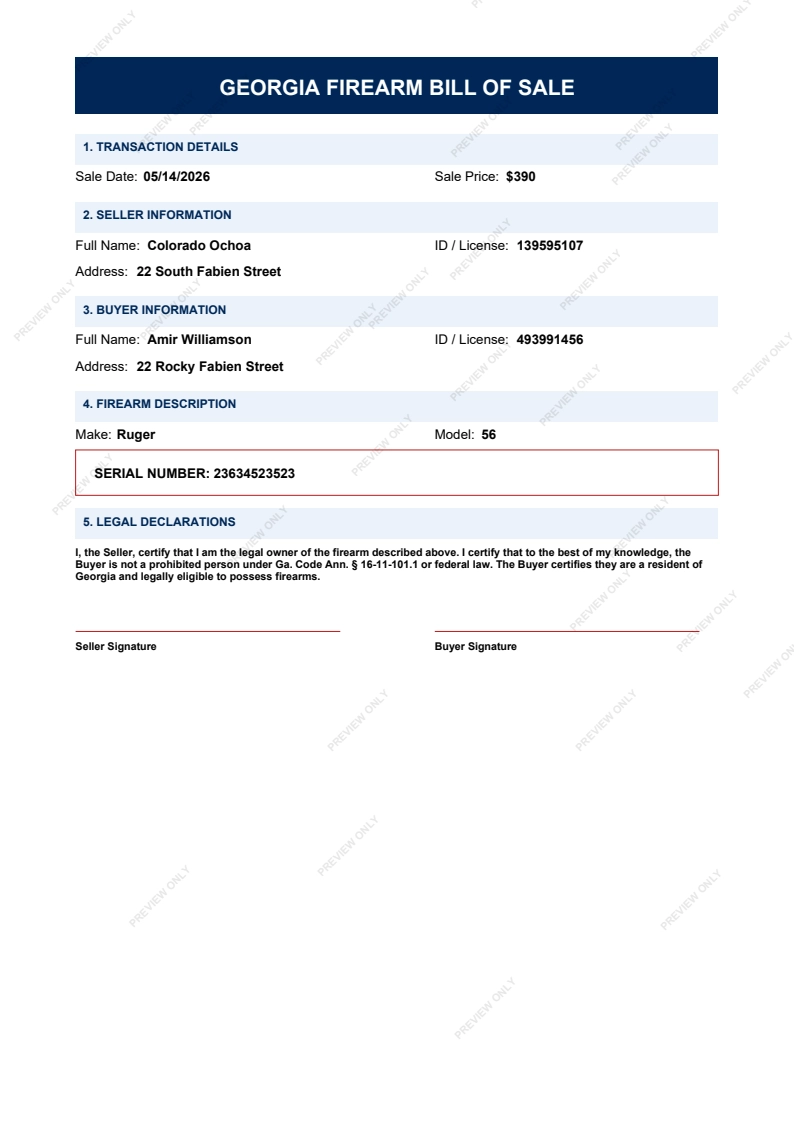
The Georgia Rules End Here — The Form Itself Doesn't Change
Everything above — Constitutional Carry, the age split by firearm type, the ban on local registries — is specific to Georgia. Filling out and signing the Bill of Sale itself follows the same basic steps no matter which state you're in.
See our nationwide Step-by-Step Firearm Bill of Sale Guide for that walkthrough.
📋 Georgia Legal Essentials for Private Sellers
1. Seller Liability Comes From Federal Law, Not a Georgia-Specific Statute
Georgia doesn't have its own 'knowing transfer to a prohibited person' law for sellers — that liability comes from federal law (18 U.S.C. § 922(d)), which makes it a crime to transfer a firearm to someone you know, or have reasonable cause to believe, is prohibited. Separately, Georgia law makes it a felony for a prohibited person, like a convicted felon, to attempt to obtain a firearm in the first place.
⚠️ Don't assume Georgia's lack of a state background check requirement means there's no risk in selling to someone who seems 'off' — federal law still holds you responsible if you had reasonable cause to suspect they were prohibited.
2. Age Requirements Split by Firearm Type
Georgia follows the federal-aligned age standard: 18 for long guns, 21 for handguns. Furnishing a pistol or revolver to anyone under 18 is a distinct felony under Georgia law, carrying up to five years in prison and a $5,000 fine, regardless of whether the sale was private.
⚠️ Don't apply a single age rule to every sale — verify 18 for a rifle or shotgun, but 21 for any handgun, and check ID either way.
3. Open Carry of a Handgun Still Technically Needs a WCL
Constitutional Carry (SB 319, 2022) eliminated the permit requirement for concealed carry of a handgun, but openly carrying a handgun in public technically still requires a valid Georgia Weapons Carry License. Long guns can generally be carried openly without any permit. This is a commonly misunderstood distinction, even among longtime Georgia gun owners.
⚠️ Don't assume Constitutional Carry means a WCL is entirely unnecessary — it still matters for open carry of a handgun, even though it's optional for concealed carry.
4. Georgia Doesn't Just Lack a Registry — It Bans Creating One
As of a 2024 law (HB 1018), it's illegal for any person or government entity in Georgia to knowingly create or maintain a registry of privately owned firearms or their owners. This goes further than simply 'no registry exists' — the state has affirmatively prohibited one from being built, with a narrow exception allowing individuals to keep their own personal ownership records.
⚠️ Don't assume a local police department or municipality can legally start tracking gun sales on their own — under Georgia's 2024 law, that would itself be illegal.
5. Local Storage Ordinances Remain Blocked, Despite Recent Attempts
Georgia's firearm preemption statute already bars cities and counties from regulating firearms beyond state law, and this was tested directly in 2025-2026: a Savannah ordinance requiring guns to be locked in unattended vehicles was struck down in November 2025 as preempted, and Governor Kemp vetoed a bill in May 2026 that would have written 'storage' explicitly into the preemption statute with higher penalties for violating cities.
⚠️ Don't assume a city ordinance about how you must store or secure a firearm applies to you — Georgia's preemption law has consistently blocked these rules, including as recently as 2025-2026.
This information reflects publicly available Georgia statutes and enforcement practices. Firearm laws can change — always verify the latest rules and consult a qualified attorney.
Georgia Firearm Transfer FAQ
Is a Bill of Sale required for private gun sales in Georgia?
Georgia law does not mandate a receipt, but it is your only documentation in a state with no registry. If the firearm is ever traced back to you, a signed Bill of Sale is your proof that ownership changed hands. Georgia's firearm preemption statute keeps regulation uniform statewide, so there's no local database or reporting requirement to fall back on — your private record is what protects you. Source: O.C.G.A. § 16-11-173
Does Georgia require a background check for private sales?
No. Georgia is a permissive state for private transfers — no background check or FFL involvement is required. However, federal law (18 U.S.C. § 922(d)) makes it a crime to knowingly transfer a firearm to someone you know, or have reasonable cause to believe, is prohibited from possessing one. Separately, Georgia law makes it a felony for a prohibited person — such as a convicted felon — to attempt to obtain a firearm at all. A Bill of Sale that records the buyer's self-certification is your best evidence of good faith. Source: O.C.G.A. § 16-11-131
What is the minimum age for private gun sales in Georgia?
It depends on the firearm type. Georgia follows the federal-aligned standard: 18 for long guns (rifles and shotguns), and 21 for handguns. Furnishing a pistol or revolver to anyone under 18 is a separate felony offense in Georgia, regardless of the sale type. Always verify the buyer's Georgia ID to confirm they meet the correct age for what you're selling. Source: O.C.G.A. § 16-11-101.1
What if the buyer has a Georgia Weapons Carry License (WCL)?
A WCL is excellent evidence of eligibility, since it requires the holder to have passed a background check. However, since Constitutional Carry passed in 2022, many eligible buyers no longer carry one, so its absence is no longer itself a red flag.
What is Georgia's Constitutional Carry law and how does it affect private sales?
Governor Kemp signed SB 319 in 2022, allowing 'lawful weapons carriers' 21 and older (or 18 for active-duty military) to carry a handgun without a permit. For sellers, this means the absence of a WCL is no longer unusual — it's now standard for eligible residents to carry without one. Source: Georgia Constitutional Carry Act (SB 319)
What is the open carry rule in Georgia?
This is a unique Georgia quirk. While Constitutional Carry covers concealed carry of a handgun, openly carrying a handgun in public technically still requires a valid WCL. Long guns can generally be carried openly without a permit. This distinction is often misunderstood by owners.
Who is considered a prohibited person in Georgia?
Prohibited persons include convicted felons, those under active domestic violence protective orders, unlawful drug users, and others barred under federal or state law. A convicted felon who attempts to obtain a firearm commits a felony under Georgia law, and a seller who knowingly transfers a firearm to a prohibited person violates federal law regardless of the sale type. Source: O.C.G.A. § 16-11-131
Can I sell a gun to someone from a neighboring state?
No. Federal law prohibits private transfers across state lines. If the buyer is from Florida, Alabama, or any other state, the transaction must go through a licensed FFL dealer in the buyer's home state.
Are NFA items legal to sell privately in Georgia?
Yes, but they require federal registration. The ATF Form 4 process remains mandatory for suppressors, SBRs, and other NFA items. Always verify current federal NFA status via the ATF NFA Division before transferring one.
Does Georgia have a firearm registry?
No — and Georgia law goes further than most states. As of a 2024 law (HB 1018), it's illegal for any person or government entity to knowingly create or maintain a list, record, or registry of privately owned firearms or their owners. Your Bill of Sale is a private document and is never filed with the government. Source: O.C.G.A. § 16-11-129(k)
Related Forms & Regional Compliance:
Georgia is a cornerstone of Southern firearm culture, maintaining high reciprocity with its neighbors. Alabama and South Carolina have both joined Georgia in adopting Constitutional Carry — South Carolina most recently, in March 2024 — while Florida takes a more nuanced approach: private sales are unregulated statewide, but a narrow local exception applies to transactions at public venues like gun shows in Miami-Dade County. If you are conducting a sale involving a resident from Tennessee or North Carolina, remember that federal law strictly prohibits hand-to-hand private transfers across state lines; these transactions must be processed through a licensed FFL dealer in the buyer's home state.