Last Updated: Sep 21, 2026
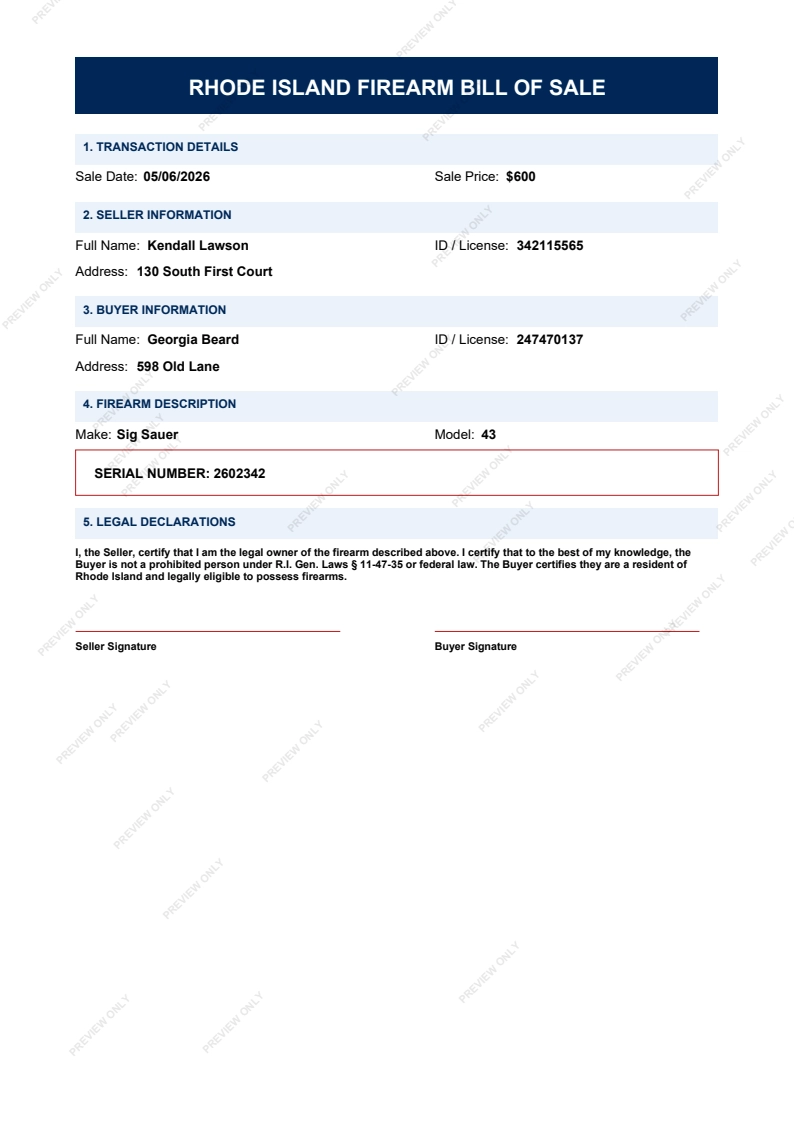
Rhode Island is one of the most regulated states for private gun sales — and July 1, 2026 brought a major new change: the Assault Weapons Ban Act of 2025, prohibiting the sale, transfer, or purchase (though not the continued possession of already-owned firearms) of semi-automatic firearms with certain features. Every private firearm transfer requires a background check and a 7-day waiting period, and the buyer must hold a valid Blue Card (RIDEM Pistol/Revolver Safety Certificate) to purchase a handgun or ammunition. A pending 2026 bill (H8073) would eliminate the assault weapons law's grandfather clause entirely, making existing possession a felony after December 31, 2026 — worth monitoring closely if this affects a firearm you're selling. This Bill of Sale documents the Blue Card number, agreed price, and firearm condition — your private record that supplements the required state paperwork.
Rhode Island's Rules Are Above — The Form Itself Isn't Changing
The Blue Card requirement, the 7-day waiting period, and the pending H8073 assault weapons legislation above are specific to Rhode Island. Filling out and signing the actual Bill of Sale — the fields, the description, the signatures — works the same basic way everywhere.
See our nationwide Step-by-Step Firearm Bill of Sale Guide for that walkthrough.
Rhode Island vs. Regional Neighbors: 2026 Comparison
| Feature | Rhode Island (RI) | Massachusetts (MA) | Connecticut (CT) | Vermont (VT) |
|---|---|---|---|---|
| Private Sale Background Check | Yes | Yes | Yes | Yes |
| Assault Weapons Ban | Yes (Effective 2026) | Yes | Yes | No |
| Magazine Capacity Limit | 10 Rounds | 10 Rounds | 10 Rounds | 10 (Long Guns) / 15 (Handguns) |
| Handgun Purchase Permit | Yes (Blue Card) | Yes (LTC) | Yes (Eligibility Cert) | No |
| Red Flag Law | Yes | Yes | Yes | Yes |
| Statewide Registry | Yes (De-facto via Police) | Yes | Yes | No |
📄 Ocean State Form Blueprint Preview:
📋 Rhode Island Legal Essentials for Private Sellers
1. The Age Floor Is 21 for Every Firearm Type — A Genuine Exception
Rhode Island raised its minimum purchase age from 18 to 21 for all firearms — handguns, rifles, and shotguns alike — in 2022, with limited exceptions for active military. This is unlike most states, where 18 remains the private-sale floor for long guns even when handguns require 21.
⚠️ Don't apply the common 18-for-long-guns pattern seen in most other states — Rhode Island requires 21 across the board, for every firearm type in a private sale.
2. The Magazine Ban Has No Grandfather Clause — A Deliberate Choice
When Rhode Island passed its 10-round magazine limit in 2022, lawmakers explicitly rejected a grandfather clause after the Attorney General argued it would make the law 'unenforceable and functionally meaningless.' Owners had a 180-day window to modify, surrender, or transfer magazines out of state — continued possession after that deadline is illegal no matter when the magazine was acquired.
⚠️ Don't assume a magazine you've owned since before 2022 is automatically legal to possess or sell — Rhode Island's law applies retroactively with no exception for prior ownership, unlike similar laws in neighboring states.
3. The Assault Weapons Ban's Grandfather Clause May Not Last
The Assault Weapons Ban Act of 2025 currently grandfathers existing lawful owners, letting them keep (but not sell or transfer) qualifying firearms acquired before July 1, 2026. A pending 2026 bill, H8073, would eliminate this protection entirely, making possession itself illegal after December 31, 2026.
⚠️ Don't assume the current grandfather clause is permanent — given Rhode Island's demonstrated willingness to reject grandfathering (as it did with the magazine ban), this protection could disappear with relatively little notice.
4. The Blue Card Now Gates Ammunition, Not Just Handguns
Since January 1, 2023, a Blue Card is required not only to purchase a handgun but also to buy ammunition of any type in Rhode Island. This dual requirement means a buyer without a Blue Card faces obstacles beyond just the handgun itself.
⚠️ Don't assume a buyer only needs a Blue Card for the handgun purchase — they'll also need it to legally buy ammunition afterward, which is worth mentioning if you're including any ammunition in the sale.
5. The Attorney General's Carry Permit Is Nearly Impossible to Get
Rhode Island runs two separate carry-permit tracks: local police chiefs issue shall-issue permits fairly routinely, while the Attorney General's office operates on a may-issue basis requiring a 'proper showing of need' and issues very few permits in practice. A buyer's lack of an AG-issued permit says nothing about their eligibility.
⚠️ Don't treat the absence of an Attorney General-issued carry permit as unusual or suspicious — in practice, almost nobody gets one, so a local police department LCCW is the far more common credential to see.
This information reflects publicly available Rhode Island statutes and enforcement practices. Rhode Island's firearm laws are strict and actively evolving through pending legislation — always verify the latest rules and consult a qualified attorney.
Rhode Island Firearm Transfer FAQ
What is Rhode Island's Blue Card and why is it required?
The Blue Card is Rhode Island's Pistol/Revolver Safety Certificate, issued by the RI Department of Environmental Management (RIDEM). It certifies that the buyer has passed a 50-question handgun safety exam with a minimum score of 80%. The exam is free and takes approximately 2 hours. Since January 1, 2023, the Blue Card is required not just for handgun purchases but also to purchase ammunition of any type. As a seller, always verify and record the buyer's Blue Card number before proceeding with any handgun transfer. Source: RIDEM Blue Card
What is Rhode Island's new Assault Weapons Ban effective July 1, 2026?
The Assault Weapons Ban Act of 2025, effective July 1, 2026, prohibits the manufacture, sale, and transfer of semi-automatic firearms with specific features including pistol grips, folding or thumbhole stocks, threaded barrels, and detachable magazines. Current lawful owners who possessed qualifying firearms before July 1, 2026 are grandfathered and may keep their firearms — but cannot sell or transfer them within Rhode Island. A pending 2026 bill (H8073) would eliminate this grandfather clause entirely, making possession itself illegal after December 31, 2026. Penalties for violations can reach up to 10 years in prison. If you own a firearm potentially covered by this law, consult a firearms attorney before listing it for sale.
Is there a waiting period for private sales in Rhode Island?
Yes — Rhode Island has a mandatory 7-day waiting period for all firearm transfers including private sales. After the buyer submits their application to local police or the State Police, 7 full days must pass before the seller can hand over the firearm. The transfer cannot proceed during this window even if the background check is approved immediately.
What is the minimum age for private gun sales in Rhode Island?
The minimum age for all firearm and ammunition purchases in Rhode Island is 21 — for handguns, rifles, and shotguns alike. Rhode Island raised the minimum age for long guns from 18 to 21 in 2022, bringing all firearm categories under the same threshold, with limited exceptions for active military. Always verify the buyer's Rhode Island ID to confirm they are at least 21 before proceeding. Source: RI Attorney General – Firearm Safety Guidance
What is Rhode Island's unique dual carry permit system?
Rhode Island has an unusual hybrid carry system under R.I. Gen. Laws § 11-47-11. Local police chiefs must issue License to Carry Concealed Weapons (LCCW) on a shall-issue basis to qualified applicants. The Attorney General's office operates on a may-issue basis requiring a 'proper showing of need' — and in practice issues very few permits. Rhode Island does not honor any other state's carry permit.
Does Rhode Island require a background check for private sales?
Yes. Rhode Island requires background checks for all gun sales, including private sales. The buyer submits an application to the local police chief or the State Police superintendent, who conducts the background check. If no disqualifying information is found within 7 days, the transfer may proceed. Rhode Island has no ownership registry — records of background checks are not maintained as an ownership database.
What is Rhode Island's 10-round magazine limit?
Rhode Island enacted a 10-round magazine capacity limit in 2022. Unlike most states with similar limits, Rhode Island's law includes no grandfather clause for previously owned magazines — lawmakers explicitly rejected one during debate. Owners were given a 180-day window to modify, surrender to police, or transfer magazines out of state; continued possession after that deadline is illegal regardless of when the magazine was acquired. Include only compliant magazines in any private sale. Source: RI Attorney General – Firearms Legislation Guidance
Who is prohibited from owning a gun in Rhode Island?
Under R.I. Gen. Laws § 11-47-5, prohibited persons include convicted felons, those with certain violent misdemeanor convictions, individuals adjudicated as incompetent or committed for mental health treatment, unlawful drug users, and those under domestic violence restraining orders. Rhode Island also has a Red Flag law — law enforcement can petition the Superior Court for an Extreme Risk Protection Order (ERPO). Always ask the buyer to certify on the Bill of Sale that they are not subject to an active ERPO.
Can I sell to a resident of Massachusetts, Connecticut, or any neighboring state?
No. Federal law under 18 U.S.C. § 922 prohibits private person-to-person firearm transfers across state lines. Rhode Island borders Massachusetts and Connecticut — selling directly to a resident of either state without FFL involvement is a federal felony. Rhode Island also does not honor any other state's carry permit, meaning out-of-state buyers cannot substitute their home state permit for Rhode Island's Blue Card requirement.
Related Forms & Regional Compliance:
Rhode Island shares borders with Massachusetts and Connecticut. Private transfers across state lines are strictly prohibited by federal law and must be facilitated by a licensed FFL dealer. Sellers must be aware that both neighboring states have similarly restrictive laws, including their own long-standing bans on certain semi-automatic firearms and magazine capacity limits.