Last Updated: Aug 07, 2026
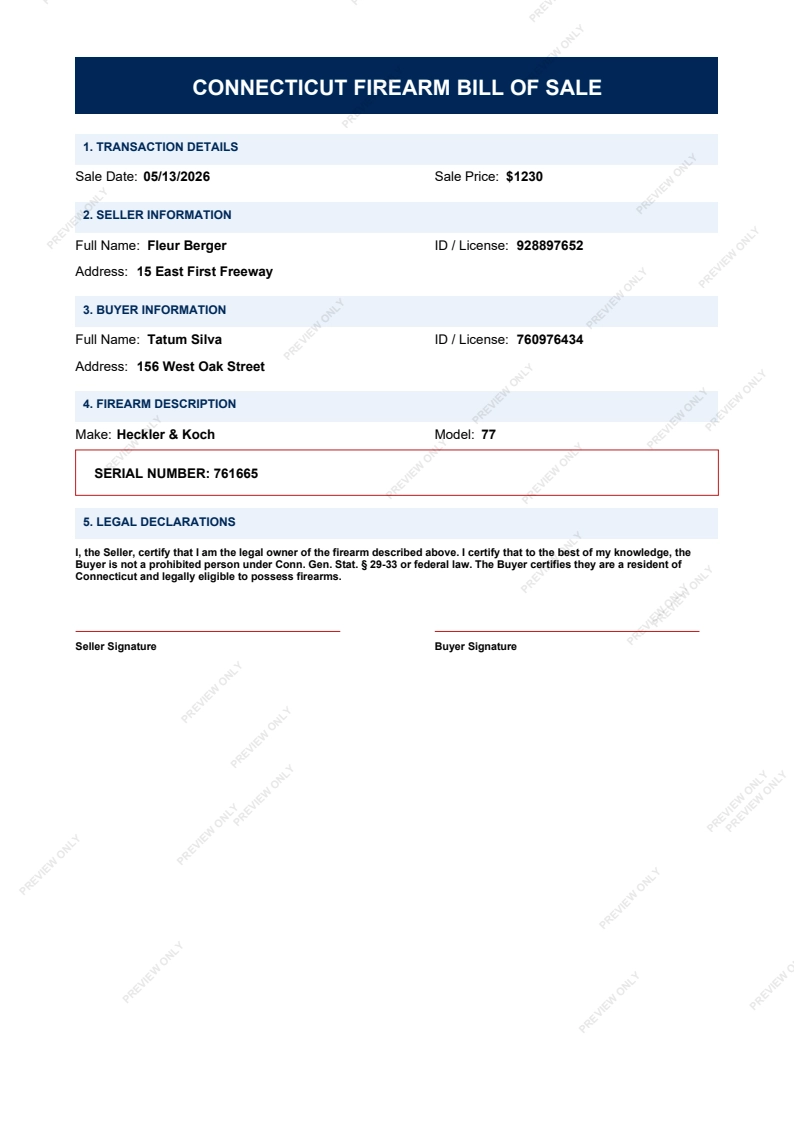
Connecticut has some of the strictest private gun sale rules in the country. Unlike most states, you cannot simply hand a firearm to a buyer here — this applies to both handguns and long guns. Under Conn. Gen. Stat. §§ 29-33 and 29-37a(c), a private seller must contact the DESPP Special Licensing and Firearms Unit directly to obtain a sales authorization number before completing any transfer, and the buyer must already hold a valid Connecticut permit or eligibility certificate for the type of firearm being sold. The required DPS-3-C form is completed in multiple copies — one for the seller, one for the buyer as a receipt, one for local police, and one for DESPP. This Bill of Sale documents the agreed price, the firearm's serial number, and the buyer's permit details as your own private record of the transaction, alongside the required state paperwork.
Connecticut vs. Neighboring States: 2026 Legal Comparison
| Feature | Connecticut (CT) | New York (NY) | Massachusetts (MA) | Rhode Island (RI) |
|---|---|---|---|---|
| Private Sale FFL Required | No (Direct DESPP Authorization Instead) | Yes (for NICS Check) | No (Direct Transfer Between License Holders) | Yes |
| State Authorization Needed | Yes (DESPP Sales Authorization Number) | No (FFL/NICS Only) | Yes (eFA-10 via MIRCS Portal) | No |
| Mandatory Waiting Period | None (Beyond Authorization) | None | None (Beyond Licensing Process) | 7 Days |
| Magazine Capacity Limit | 10 Rounds | 10 Rounds | 10 Rounds | 10 Rounds |
| Assault Weapon Ban | Strict | Strict | Strict | Increasingly Strict |
📄 Connecticut Transfer Blueprint Preview:
What This Page Doesn't Cover
The DESPP authorization process, permit requirements, and waiting periods above are specific to Connecticut. Filling out and signing the Bill of Sale form itself, however, works the same way in every state.
For that walkthrough, see our nationwide Step-by-Step Firearm Bill of Sale Guide.
📋 Connecticut Legal Essentials for Private Sellers
1. You Contact DESPP Directly — There's No FFL Middleman
Unlike states where a dealer runs the paperwork, Connecticut requires the seller to personally contact the DESPP Special Licensing and Firearms Unit and obtain a sales authorization number before completing any transfer. This applies to both handguns and long guns, and the process is the same whether you're selling to a stranger or a longtime friend.
⚠️ Don't assume finding a buyer with a valid permit is enough — you still need to contact DESPP yourself and get an authorization number before the sale can legally proceed.
2. The Buyer's Credential Must Match the Firearm Type
A Connecticut Pistol Permit or Handgun Eligibility Certificate only covers handguns; a separate Long Gun Eligibility Certificate is required to legally receive a rifle or shotgun. A buyer with one credential but not the other cannot legally take that category of firearm from you, no matter how the sale is structured.
⚠️ Don't assume any valid CT firearms credential covers any firearm — verify the buyer holds the specific permit or certificate that matches what you're selling.
3. No Certificate Means a 14-Day Wait for Long Guns
If a long-gun buyer doesn't hold a Long Gun Eligibility Certificate — for example, relying on a hunting license exemption instead — the transfer is subject to a 14-day waiting period before they can take possession. Buyers with a valid eligibility certificate or permit generally avoid this additional wait.
⚠️ Don't assume every long-gun sale can be completed the same day — check which credential the buyer is using, since it directly determines whether a 14-day wait applies.
4. The 3-Handgun-a-Month Limit Is the Buyer's Problem, But Know It Exists
Since 2023, Connecticut law limits handgun purchases to three within any 30-day period, with limited exemptions. You can't practically verify a stranger's purchase history yourself, but the state's DESPP authorization process is designed to catch violations — which is one more reason the authorization step can't be skipped.
⚠️ Don't take a buyer's word that they're 'under the limit' as a substitute for going through the required DESPP authorization — that process is what actually enforces this rule.
5. Assault Weapons and Large-Capacity Magazines Need Prior Registration
Connecticut bans most assault weapons and magazines over 10 rounds outright. Only firearms and magazines that were legally registered with DESPP before the applicable ban deadlines can still be possessed — and transferring one of these grandfathered items privately is tightly restricted and easy to get wrong.
⚠️ Don't assume a firearm or magazine is transferable just because you've owned it for years — confirm its registration status with DESPP before attempting any private transfer of a pre-ban item.
This information reflects publicly available Connecticut statutes and DESPP guidance. Connecticut's firearm laws are among the most detailed in the country and provisions can change — always verify the latest rules and consult a qualified attorney.
Connecticut Firearm Transfer FAQ
Can I sell a gun hand-to-hand in Connecticut?
No. Connecticut requires the seller to directly contact the DESPP Special Licensing and Firearms Unit to obtain a sales authorization number before any private transfer — for both handguns and long guns. Attempting a direct transfer without this authorization is a criminal offense. Source: CGS § 29-33
What permit does the buyer need in Connecticut?
For handguns, the buyer must hold a Connecticut Pistol Permit (CTPP) or a Handgun Eligibility Certificate. For long guns, they need a Long Gun Eligibility Certificate. Always verify and record the permit number on this Bill of Sale. Source: DESPP Permit Portal
Is a Bill of Sale legally required in Connecticut?
The state requires sellers to complete the official DPS-3-C form as part of the DESPP authorization process. This Bill of Sale helps you capture all required information before submitting that official form. Source: DPS-3-C Form
Do I have to report the sale to the police?
Yes. The seller must submit a copy of the completed DPS-3-C form to both the DESPP Commissioner and the local police authority where the buyer resides. Failure to properly report the transfer can carry criminal penalties.
Does Connecticut have a waiting period?
If the buyer already holds a valid CTPP or eligibility certificate, there is generally no additional wait once DESPP authorization is granted. However, long gun purchases made without a Long Gun Eligibility Certificate — for instance, using only a hunting license exemption — are subject to a 14-day waiting period. Source: Connecticut General Assembly – Summary of State Gun Laws
Are assault weapons legal to sell privately in Connecticut?
Only in narrow circumstances. Connecticut bans most assault weapons outright; only firearms that were legally registered before the applicable ban date can still be possessed, and their transfer is highly restricted. Magazines are limited to 10 rounds, with pre-April 2013 magazines grandfathered for possession only. Source: CGS § 53-202a
What is the minimum age for private gun sales in Connecticut?
The minimum age for handguns is 21, tied to the CTPP/Handgun Eligibility Certificate requirement. For long guns, it is 18, provided the buyer holds a valid Long Gun Eligibility Certificate. These requirements apply to private transactions just as they do to dealer sales.
Is there a limit on how many handguns I can sell per month?
Yes. A 2023 Connecticut law limits buyers to three handgun purchases within any 30-day period, with limited exemptions. As a seller, this is worth being aware of, though verifying a buyer's purchase history isn't something you can practically do yourself — the state's authorization process is designed to catch this.
What is Connecticut's Red Flag law and how does it affect private sales?
Connecticut's Extreme Risk Protection Order (ERPO) process — the first of its kind in the nation, enacted in 1999 — allows courts to temporarily remove firearms from individuals deemed a danger to themselves or others. Never transfer a firearm to someone you know is subject to an active ERPO. Source: Connecticut Judicial Branch – Risk Protection Orders
Does Connecticut recognize out-of-state carry permits?
No. Connecticut does not honor any other state's carry permit. Out-of-state residents also cannot purchase handguns directly from a Connecticut private seller; the transaction must go through a licensed FFL dealer in the buyer's home state.
Related Forms & Regional Compliance:
Connecticut maintains some of the most rigorous firearm barriers in the Northeast. Unlike neighboring New York, Massachusetts, and Rhode Island—which all have their own complex permit systems—Connecticut requires a specific state authorization number for every single transfer. If you are conducting a sale involving a resident from these neighboring states, the firearm must be shipped to a licensed FFL dealer in their home state to comply with both Connecticut law and federal interstate commerce regulations.