Last Updated: Aug 05, 2026
Arkansas ranks among the most firearms-friendly states in the country — Constitutional Carry since 2013, no background check for private sales, no waiting period, no registration, and no magazine limits. Private sales are entirely unregulated at the state level beyond federal prohibited-person rules. Arkansas is also home to a major SIG Sauer ammunition manufacturing facility in Jacksonville, reflecting the state's deep-rooted firearms industry presence. That said, under Ark. Code Ann. § 5-73-132, selling, renting, or transferring a firearm to someone prohibited from possessing one carries serious criminal consequences. This Bill of Sale documents the buyer's ID and the transfer date — your only paper trail in a state that keeps no records.
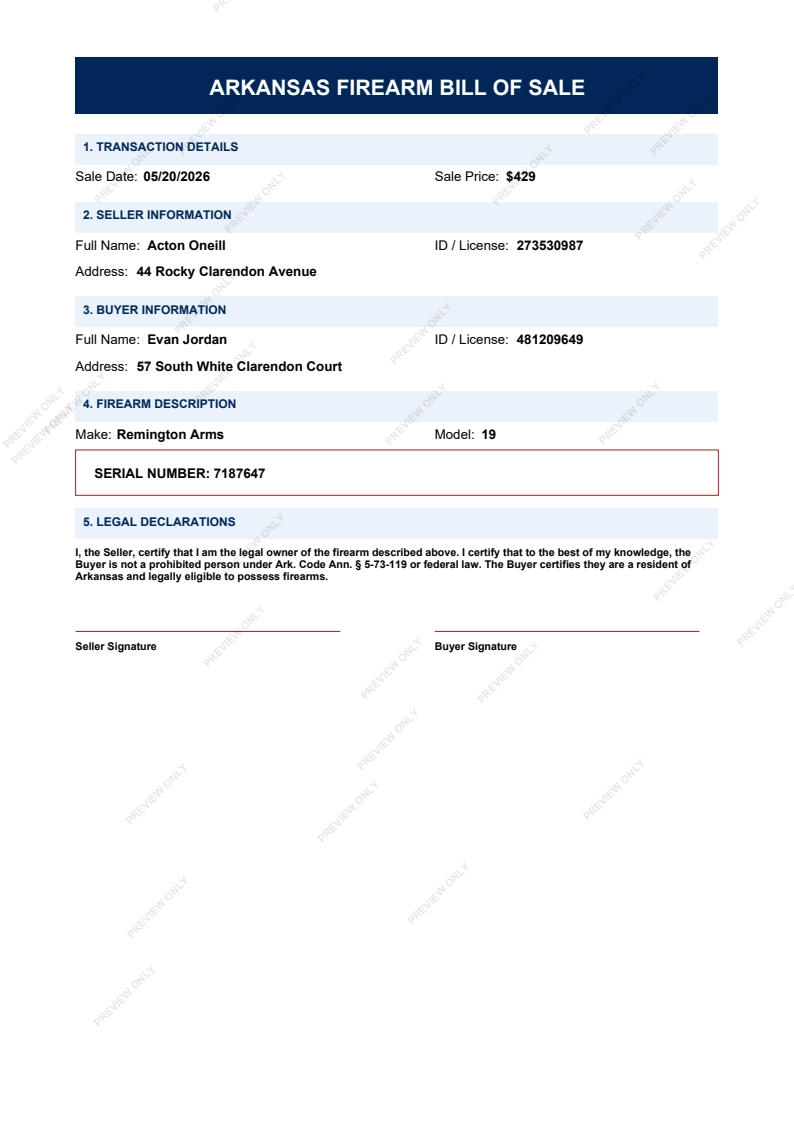
📄 Arkansas Receipt Form Preview:
One More Step Before You Sign
Arkansas law is covered in the sections above. The signing and documentation process itself — identical whether you're in Arkansas or elsewhere — is explained in our general guide.
Check our Step-by-Step Firearm Bill of Sale Guide if you want that walkthrough.
📋 Recent Legal Changes & ATF Practice in Arkansas
1. Constitutional Carry & Stable Private Sale Framework
Arkansas has maintained Constitutional Carry since 2013. As of 2026 there have been no major new restrictions on private firearm transfers. Private sales between Arkansas residents continue to require no background check, no registration, and no waiting period. This long-standing stability makes a detailed Bill of Sale especially valuable for long-term protection.
⚠️ Don't assume 'no background check' means 'no risk' — you can still face criminal liability for knowingly selling to a prohibited buyer, even without a check to catch it.
2. How ATF Trace Works in Arkansas
If a firearm you sold privately is later used in a crime, the ATF will trace the serial number back to you as the last known owner. Because Arkansas has no statewide firearm registry, your completed Bill of Sale — with the buyer's full name, Arkansas-issued ID details, date of transfer, and exact serial number copied directly from the frame — becomes critical evidence during any investigation.
⚠️ Recording the serial number from a box label or receipt instead of the firearm itself is not accepted as proof during an ATF trace.
3. Strong Statewide Preemption & Unique Rules
Arkansas has strong preemption under Ark. Code Ann. §§ 14-54-1411 (municipalities) and 14-16-504 (counties) — no local unit of government can regulate the ownership, transfer, or possession of firearms beyond what's allowed by state or federal law. One notable exception to Arkansas's otherwise hands-off approach: automatic weapons must also be registered with the Arkansas Secretary of State, in addition to federal NFA rules. A 2023 law (Act 659) also increased penalties for prohibited persons found in possession of a firearm.
⚠️ Don't assume a local ordinance you've heard about in a specific city changes your obligations as a private seller — under state preemption, it almost certainly doesn't, with the narrow exception of unsafe-discharge rules.
This information reflects publicly available Arkansas statutes and enforcement practices. Firearm laws can change — always verify the latest rules and consult a qualified attorney.
Arkansas Firearm Transfer FAQ
Is a Bill of Sale required by Arkansas law?
No — Arkansas law imposes no documentation requirement on private sellers, and state agencies are prohibited from maintaining any firearm ownership registry. Without a signed Bill of Sale you have no proof the gun ever left your possession. If the firearm is later recovered at a crime scene or the buyer is discovered to be a prohibited person, this document serves as your strongest evidence that you acted in good faith.
What ID should I ask for in Arkansas?
A valid Arkansas Driver's License or Arkansas state-issued photo ID card. This confirms both the buyer's age (minimum 18 for any firearm in a private sale) and Arkansas residency, which is required for a legal private transfer under federal law. Never accept an out-of-state ID for a private sale. Always record the ID number and expiration date on the Bill of Sale.
Are there magazine capacity limits in Arkansas?
No. Arkansas has no state-level restrictions on magazine capacity or assault weapon features. High-capacity magazines are fully legal for both private ownership and sale. The state also has strong preemption laws that prevent cities and counties from imposing stricter local regulations. NFA items (such as suppressors and short-barreled rifles) are legal with proper federal compliance (ATF approval and tax stamp). See also: NRA-ILA Arkansas State Gun Laws Summary
Who is prohibited from owning a gun in Arkansas?
Under Ark. Code Ann. § 5-73-103 and federal law, prohibited persons include convicted felons, those adjudicated mentally ill, individuals under domestic violence protective orders, unlawful drug users, and those dishonorably discharged from the military. Separately, minors under 18 and out-of-state residents face their own restrictions on acquiring a firearm in a private sale. A 2023 law (Act 659) increased penalties for prohibited persons found in possession of a firearm. Source: Ark. Code Ann. § 5-73-103
What is the minimum age for private gun sales in Arkansas?
The minimum age to acquire any firearm (handgun or long gun) in a private sale in Arkansas is 18. The federal 21-year-old limit applies only to licensed dealers. This makes Arkansas more permissive than many states for private handgun transfers. Always verify age with a current Arkansas Driver's License or State ID and record the ID details on the Bill of Sale.
Can I sell a gun at an Arkansas gun show?
Yes. Private sales at Arkansas gun shows follow the exact same rules as private sales at home. No background check or state paperwork is required. However, federal prohibited person rules still apply, and a well-completed Bill of Sale is highly recommended for your protection, especially in a busy environment where disputes can arise more easily.
Does Arkansas require automatic weapons to be registered with the state?
Yes — this is one of the few unique restrictions in Arkansas firearms law. In addition to federal NFA registration (ATF Form 4), automatic weapons must also be registered with the Arkansas Secretary of State. This state-level requirement goes beyond what most other states demand. Always verify both federal and state compliance before transferring any NFA item.
Is there a waiting period in Arkansas?
No. Arkansas imposes no waiting period on private firearm transfers — the transfer is complete once the Bill of Sale is signed and payment is exchanged. Arkansas also has no Red Flag (ERPO) law as of 2026, making it one of the most permissive states for private sales.
How does this form protect me from liability?
The Bill of Sale includes the buyer's signed declaration that they are not a prohibited person under state or federal law. This creates documented evidence of due diligence, which is critical because Arkansas and federal law criminalize sales where the seller "knowingly" or "should have known" the buyer was prohibited. In the absence of a state registry, this document is often your best (and only) defense if law enforcement or the ATF conducts a trace.
Can I sell to a resident of a neighboring state like Missouri or Texas?
No. Federal law strictly prohibits private person-to-person firearm transfers across state lines. Arkansas borders six states (Missouri, Tennessee, Mississippi, Louisiana, Texas, and Oklahoma). Any such sale must go through a licensed FFL dealer. Always confirm the buyer has a current Arkansas-issued photo ID. Source: 18 U.S.C. § 922