Last Updated: Sep 19, 2026
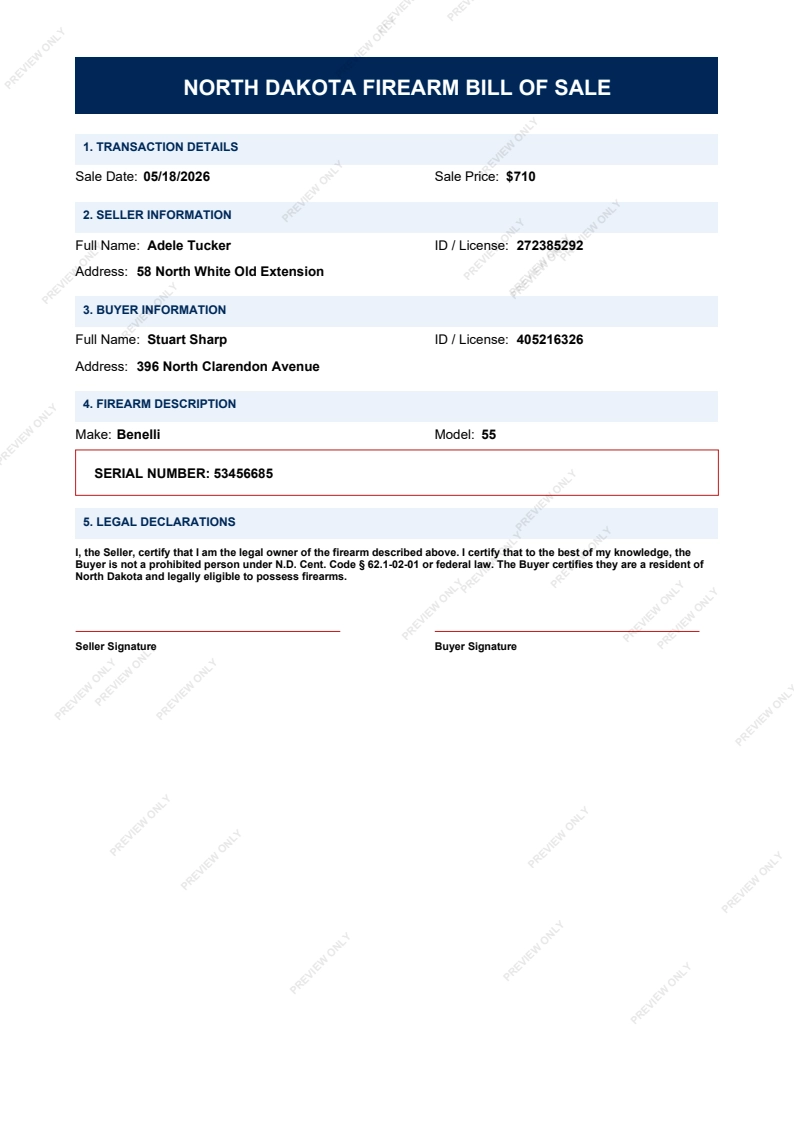
North Dakota is one of the most firearms-friendly states in the country — Constitutional Carry for residents since August 1, 2017, expanded to non-residents on August 1, 2023 (HB 1339), no background check for private sales, no registration, no waiting period, and no magazine limits. In 2025, House Bill 1588 relaxed the state's duty-to-inform rule (permitless carriers now only need to disclose their firearm if an officer asks, rather than immediately upon contact) and changed the default rule for public buildings to allow carry unless a local government specifically opts out. Private sales between residents are entirely unregulated at the state level beyond federal prohibited person rules. This Bill of Sale documents the buyer's ID, the firearm's serial number, and the transfer date — your only paper trail in a state that keeps no records.
North Dakota's Freedoms Are Above — The Form Itself Is Standard
The non-resident carry expansion, the 2025 duty-to-inform changes, and North Dakota's preemption law above are specific to this state. Filling out and signing the actual Bill of Sale — the fields, the description, the signatures — works the same basic way everywhere.
See our nationwide Step-by-Step Firearm Bill of Sale Guide for that walkthrough.
📄 Peace Garden State Form Blueprint Preview:
📋 North Dakota Legal Essentials for Private Sellers
1. The Handgun Age Floor Is 21, Even for Private Sales — Unlike Most Permissive States
Unlike many similarly permissive states where 18 is the private-sale floor for handguns, North Dakota's Attorney General confirms the purchase age for a handgun is 21, even between two private individuals — while possession itself is legal at 18 if the firearm was lawfully acquired. Long guns follow the more typical 18-year floor for both possession and purchase.
⚠️ Don't assume North Dakota follows the common 18-for-private-sale pattern seen in neighboring permissive states — verify 21 specifically for any handgun sale, private or otherwise.
2. Non-Resident Carry Rights Expanded, But That's About Carrying, Not Buying
Since August 1, 2023 (HB 1339), non-residents with valid ID from their home state can carry concealed in North Dakota without a permit, just like residents. This is purely a carry-rights expansion — it doesn't change anything about who can legally purchase a firearm through a private sale here.
⚠️ Don't confuse a non-resident's carry rights with purchase eligibility — a visiting non-resident being able to carry concealed doesn't mean the state has changed its rules about who a private seller can sell to across state lines, which remains governed by federal law.
3. The 2025 Update Loosened the Duty to Inform, But Didn't Eliminate It
House Bill 1588 (2025) changed the duty-to-inform rule for permitless carriers from an immediate, proactive disclosure to one that's only triggered if a law enforcement officer asks. The obligation still exists — it's just narrower in scope than it was before.
⚠️ Don't assume HB 1588 eliminated the duty to inform entirely — it narrowed when the obligation kicks in, but a permitless carrier still must disclose if asked directly.
4. A Class 1 CWL Reflects More Vetting Than a Class 2
North Dakota's Class 2 license only requires an open-book written test and is available at 18, while the Class 1 license requires classroom instruction, demonstrated firearm familiarity, and a live-fire exercise, and requires the applicant to be 21. If your buyer holds a Class 1, that's meaningfully stronger evidence of vetting than a Class 2 or no license at all.
⚠️ Don't treat every North Dakota CWL as equivalent proof of buyer vetting — a Class 1 reflects substantially more training and a higher age floor than a Class 2.
5. Sanctuary Status Doesn't Touch Pre-2021 Federal Law
North Dakota declared itself a Second Amendment Sanctuary state in 2021, directing state resources away from enforcing federal firearm laws enacted after that date. This has no effect on federal laws that predate 2021, including NFA registration requirements and the federal ban on interstate private transfers — those remain fully enforceable regardless of the state's sanctuary declaration.
⚠️ Don't assume North Dakota's sanctuary status means federal gun laws generally don't apply here — it's specifically limited to laws enacted after January 1, 2021, and everything older, including the interstate transfer ban, still fully applies.
This information reflects publicly available North Dakota statutes and enforcement practices. Firearm laws can change — always verify the latest rules and consult a qualified attorney.
North Dakota Firearm Transfer FAQ
Is a Bill of Sale required in North Dakota?
No — North Dakota requires zero documentation for private firearm transfers. But North Dakota has no state-level firearm registry and no permit system, which means without a signed Bill of Sale, you have no proof the gun ever left your hands. The ATF trace follows the paper trail to the last documented owner, and that is you until you can prove otherwise. A signed document with the buyer's ID, the serial number, and the transfer date is your only defense if the firearm surfaces in a criminal investigation years later.
Are background checks required for private sales in North Dakota?
No. North Dakota does not require background checks for private person-to-person transfers between residents — no FFL dealer involvement, no state paperwork, and no waiting period. Federal law under 18 U.S.C. § 922(d) still prohibits selling to a prohibited person, and North Dakota law under NDCC § 62.1-02-01 adds state-level prohibited person categories. The Bill of Sale records the buyer's self-certification of eligibility as your good-faith defense.
What is the minimum age for private gun sales in North Dakota?
The minimum age to possess a handgun is 18 — but the minimum age to purchase a handgun is 21, even in a private sale. An 18-20 year old can legally carry a handgun under Constitutional Carry if they already possess one, but they generally cannot purchase one through a private sale until 21. For long guns, both possession and purchase minimum age is 18. Always verify the buyer's North Dakota Driver's License or State ID to confirm both age and residency.
What is North Dakota's Constitutional Carry and what changed in 2023?
North Dakota has been a Constitutional Carry state since August 1, 2017. Originally, this applied only to residents; however, in August 2023, the residency requirement was removed, allowing non-residents to also carry concealed without a permit. Anyone carrying under Constitutional Carry must have a valid state-issued photo ID on their person while carrying.
What did HB 1588 change in 2025?
HB 1588, signed on April 23, 2025, expanded firearm carry rights in certain locations and updated duty to inform provisions for CWL holders. It also modified some restricted carry location definitions, with the bill becoming effective August 1, 2025.
What is the difference between Class 1 and Class 2 CWL in North Dakota?
North Dakota offers two tiered licenses for reciprocity. Class 2 requires a written exam and is available to residents 18 or older. Class 1 requires additional training and applicants must be at least 21. Recording either license number on a Bill of Sale signals a higher level of vetting.
Does open carry require a permit in North Dakota?
Unloaded open carry of a handgun requires no permit for those 18 or older. However, open carry of a loaded handgun requires a valid Concealed Weapon License. Long guns must also be unloaded in vehicles unless the carrier holds a valid CWL.
What is North Dakota's Second Amendment Sanctuary status?
In 2021, North Dakota became a Second Amendment Sanctuary, limiting law enforcement from cooperating with federal firearm laws enacted after January 1, 2021. However, pre-2021 federal laws, including NFA regulations and interstate transfer requirements, are still fully enforced.
Does North Dakota have a Red Flag law?
No. As of 2026, North Dakota has no Red Flag law, no Extreme Risk Protection Order mechanism, no safe storage mandate, and no magazine limits. Strong statewide preemption prevents cities or counties from enacting stricter local rules.
Can I sell to a resident of Minnesota, Montana, or any neighboring state?
No. Federal law prohibits private transfers across state lines. Selling directly to a resident of Minnesota, South Dakota, or Montana without FFL involvement is a federal felony. Non-residents may carry in North Dakota under Constitutional Carry, but they cannot purchase through a private sale there.
Related Forms & Regional Compliance:
North Dakota is bordered by Montana, South Dakota, and Minnesota. While North Dakota's laws are highly permissive for residents, federal law strictly prohibits the private, hand-to-hand transfer of firearms across state lines to residents of neighboring states without involving a licensed FFL dealer. Additionally, while North Dakota recognizes broad carry rights, residents should be aware that neighboring Minnesota maintains significantly more restrictive carry and permit requirements.