Last Updated: Oct 09, 2026
Washington has one of the most regulated private gun sale environments in the country — and it is getting stricter. Every private firearm transfer must go through a licensed FFL dealer for a background check under RCW § 9.41.113. There is a mandatory 10-business-day waiting period. The sale of semi-automatic rifles defined as assault weapons is banned, and magazines over 10 rounds cannot be sold or transferred. Buyers must already be 21 to purchase a pistol or semi-automatic assault rifle. And starting May 1, 2027, under House Bill 1163 (signed by Governor Ferguson in 2025), buyers will need a state-issued Permit to Purchase — requiring fingerprinting, a background check, and a certified live-fire safety course, valid for 5 years. This Bill of Sale documents the agreed price and firearm condition before you visit the dealer — your private record in a state that requires extensive official documentation.
Washington's Dealer-Run Process Is Above — The Bill of Sale Is Your Own Record
The mandatory FFL transfer, the 10-business-day wait, and the Permit to Purchase arriving in 2027 are specific to Washington. Filling out and signing the actual Bill of Sale — the fields, the description, the signatures — works the same basic way everywhere.
See our nationwide Step-by-Step Firearm Bill of Sale Guide for that walkthrough.
Washington vs. Regional Neighbors: 2026 Legal Comparison
| Feature | Washington (WA) | Oregon (OR) | Idaho (ID) | Montana (MT) |
|---|---|---|---|---|
| Private Sale Without FFL | No (FFL Required) | No (FFL Required) | Yes | Yes |
| Background Check | Mandatory | Mandatory | Not Required | Not Required |
| Waiting Period | 10 Business Days | None | None | None |
| Magazine Limits | 10 Rounds | None (Measure 114 Delayed to 2028) | None | None |
| Assault Weapons Ban | Yes | No | No | No |
| Constitutional Carry | No | No | Yes | Yes |
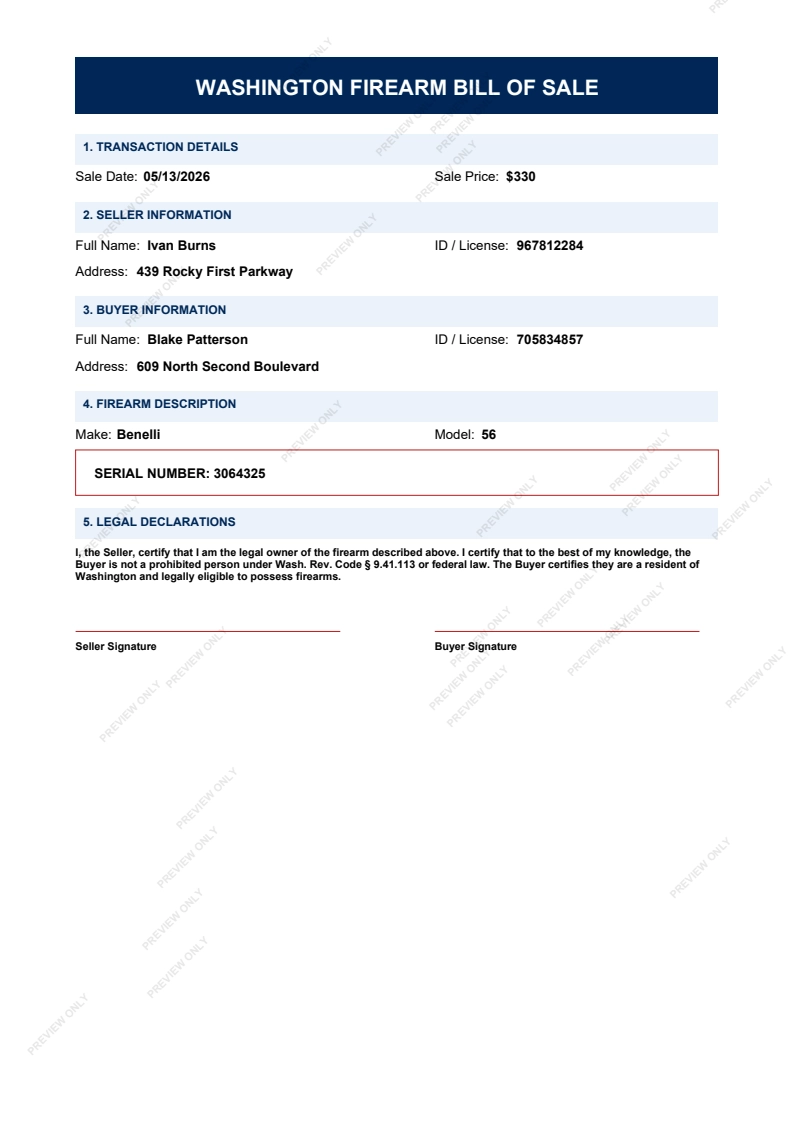
📄 Evergreen State Form Blueprint Preview:
Washington Firearm Transfer FAQ
Are background checks required for private sales in Washington?
Yes — Washington has required background checks for all private firearm transfers since 2014. Under RCW § 9.41.113, both seller and buyer must appear together at a licensed FFL dealer who contacts the Washington State Patrol Firearms Background Division for the check. Washington is a Point of Contact state — checks go through WSP rather than directly to NICS, allowing the state to screen for Washington-specific disqualifiers. A direct hand-to-hand private transfer without dealer involvement is a criminal offense. Source: RCW § 9.41.113
What is Washington's 10-business-day waiting period?
Washington mandates a 10-business-day waiting period from the time the dealer requests the background check until the firearm can be released to the buyer. This requirement originally applied only to semi-automatic rifles starting in 2019, before being extended to cover all firearm transfers in 2024. Unlike federal law, Washington does not allow a default proceed after 3 business days if the check is delayed — the full 10 business days must elapse.
Is a Bill of Sale still useful if the FFL handles the paperwork?
Yes — the dealer's records and ATF Form 4473 protect the state's interests. The Bill of Sale is your private contract documenting the agreed price, the firearm's condition, and the serial number before you hand anything to the dealer. Washington prohibits any person from knowingly delivering a firearm to a prohibited person — a signed Bill of Sale with the buyer's self-certification is your good-faith defense.
What is Washington's assault weapons ban?
Washington prohibits the sale, manufacture, and import of semi-automatic rifles defined as 'assault weapons' under state law. The ban covers semi-automatic centerfire rifles with features such as pistol grips, thumbhole stocks, folding stocks, grenade or flare launchers, flash suppressors, or threaded barrels. Current owners who possessed qualifying firearms before the ban are grandfathered — they can keep their firearms but cannot sell or transfer them within Washington. Verify whether your specific firearm qualifies as an assault weapon under Washington's definition before listing it for sale.
What is Washington's Permit to Purchase system coming in 2027?
HB 1163, signed in May 2025, creates a state-issued Permit to Purchase system effective May 1, 2027. Buyers will need to obtain a 5-year permit from the Washington State Patrol before purchasing any firearm. The process requires completing a certified live-fire firearms safety training course, submitting fingerprints, filling out an application, and passing a fingerprint-based background check. Holders of a valid Concealed Pistol License (CPL) are exempt from the training requirement. As of 2026, WSP is setting up the administrative infrastructure — training curriculum certification begins July 1, 2026.
What is Washington's magazine capacity limit?
Washington prohibits the sale or distribution of magazines capable of holding more than 10 rounds. This applies to both handgun and rifle magazines. Magazines over 10 rounds that were owned before the ban may be possessed but cannot be sold or transferred within Washington. Always verify that any magazines included in a private sale comply with the 10-round limit.
What is Washington's family exemption from the background check requirement?
Washington's family exemption under RCW § 9.41.113 is one of the broadest in the country. It covers spouses, domestic partners, parents, parents-in-law, children, siblings, siblings-in-law, grandparents, grandchildren, nieces, nephews, first cousins, aunts, and uncles. Notably, in-laws ARE included in Washington's exemption — a transfer to a brother-in-law or mother-in-law does not require a background check, which is broader than most states. Source: RCW § 9.41.113
What are Washington's gun-free zones?
SB 5444 (2025), codified at RCW 9.41.300, expanded gun-free zones to include public libraries, zoos, aquariums, and transit facilities. Senate Bill 5098, passed by the Senate in January 2026, would further expand this to parks, government buildings, and places where children are likely to be present — but the bill was amended before passage to exempt Concealed Pistol License (CPL) holders from these additional restrictions. Verify the current status and exact boundaries of these zones before any transfer involving carry considerations. Source: RCW § 9.41.300
Who is prohibited from owning a gun in Washington?
Washington has broader prohibited person categories than federal law under RCW § 9.41.040. Prohibited persons include convicted felons, those with domestic violence misdemeanor convictions, individuals committed to mental institutions, and those convicted of unlawful display or aiming of a firearm. Washington's marijuana situation is also notable — even though marijuana is legal in Washington, federal law still prohibits unlawful users of controlled substances from possessing firearms, and marijuana remains federally controlled. Source: RCW § 9.41.040
Can I sell to a resident of Idaho, Oregon, or any neighboring state?
No. Federal law under 18 U.S.C. § 922 prohibits private person-to-person firearm transfers across state lines. Washington borders Idaho and Oregon — and selling directly to a resident of either without FFL involvement is a federal felony. Note that Washington's assault weapons ban means some firearms that are legal in Idaho or Oregon cannot be legally resold in Washington — if you receive a firearm as a gift or inheritance from out of state, verify its legal status in Washington before attempting to sell it.
Related Forms & Regional Compliance:
Washington is bordered by Oregon and Idaho. While Washington and Oregon both require FFL-facilitated background checks for private sales, Idaho remains one of the most permissive states in the nation. Regardless of state laws, federal law strictly prohibits the private, hand-to-hand transfer of firearms across state lines to residents of neighboring states without a licensed FFL dealer.