Last Updated: Aug 09, 2026
Hawaii is the most regulated state in the country for private gun sales — and unlike most states, 'private sale' here is not really a thing. Under HRS § 134-2, every single firearm transfer, including gifts and sales between friends, requires the buyer to first obtain a county-issued Permit to Acquire (PTA), which involves fingerprinting, a background check, and a minimum 14-day wait before it's issued. After the transfer, the buyer must register the firearm with county police within 5 days under HRS § 134-3. Hawaii is one of the only states in the country with a complete firearms registry — every legally owned gun in the state is on record. This Bill of Sale documents the agreed price and transfer terms before the buyer starts the permit process — your private record of what was agreed and when.
Hawaii Firearms Compliance: 2026 Overview
| Feature | Hawaii (HI) | Mainland Comparison (Typical) |
|---|---|---|
| Permit to Acquire Required | Yes (For Every Gun) | No |
| Mandatory Waiting Period | 14 Days | None |
| Statewide Registry | Yes (Mandatory) | No |
| Registration Deadline | 5 Days | N/A |
| Magazine Limit | 10 Rounds (Handguns) | Varies |
📄 Hawaii Firearm Document Blueprint Preview:
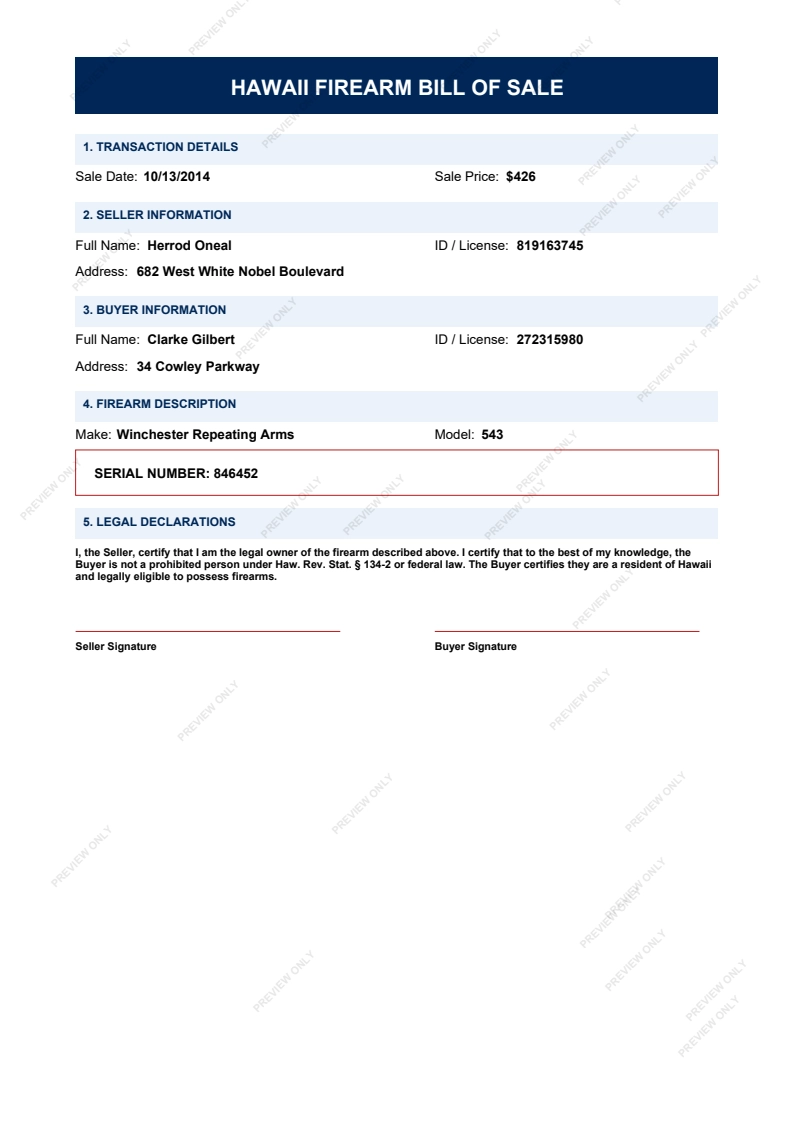
The Universal Part of Any Bill of Sale
Hawaii's Permit to Acquire process, 14-day wait, and registration deadline above are unique to this state. The actual document — what fields to fill in, how to describe the firearm, what both parties sign — works the same everywhere.
See our nationwide Step-by-Step Firearm Bill of Sale Guide for that part.
📋 Hawaii Legal Essentials for Private Sellers
1. There Is No 'Private Sale' Exemption — Every Transfer Needs a Permit
Under HRS § 134-2, the buyer must obtain a county-issued Permit to Acquire before taking possession of any firearm, whether it's a sale, a gift, or a trade between longtime friends. The permit process includes fingerprinting, a background check, and a minimum 14-day wait — a handgun permit covers one firearm and expires in 10 days if unused; a long gun permit is valid for a year and covers multiple purchases.
⚠️ Don't hand over a firearm the moment a deal is agreed — the buyer must complete their county's PTA process first, and physical possession before that is illegal for both of you.
2. The 5-Day Registration Clock Starts at Possession, Not Purchase
Once the buyer takes possession using their approved PTA, they have 5 days to register the firearm with county police under HRS § 134-3. Hawaii is one of the only states with a truly comprehensive registry — virtually every legally owned firearm in the state is on file.
⚠️ Don't assume registration is the buyer's problem alone — as the seller, confirm they understand the 5-day deadline, since an unregistered firearm traced back to a sale you documented can still draw scrutiny your way.
3. Hawaii Has No Preemption — County Rules Can Vary
Unlike most states, Hawaii has no statewide firearm preemption law. Each county (Honolulu, Hawaii, Maui, and Kauai) administers its own Permit to Acquire process and can impose its own procedural requirements, so the exact experience of buying or selling can differ depending on which island the buyer lives on.
⚠️ Don't assume the PTA process works identically on every island — the buyer should confirm current requirements directly with their own county police department, not assume Oahu's process applies statewide.
4. Magazine and Assault Weapon Rules Apply to Transfers, Not Just New Purchases
Hawaii caps handgun magazines at 10 rounds and bans assault pistols by name and feature test — these rules apply just as much to a privately transferred firearm as to one bought new from a dealer. Suppressors and short-barreled rifles are banned outright for civilians.
⚠️ Don't assume a magazine or firearm is transferable just because you've owned it for years — Hawaii's restrictions apply to the item itself, not just to new retail sales.
5. Where You Meet to Complete the Sale Matters
Since 2023, Act 52 has banned firearms from numerous 'sensitive places' — including parks, beaches, and bars — and a June 2026 U.S. Supreme Court ruling upheld most of these restrictions. Meeting a buyer at a public beach or park to hand over a firearm, even one that's fully permitted, can itself violate the law.
⚠️ Don't treat the location of the handoff as an afterthought — meet at a private residence or another location where firearm possession is clearly legal, not a public park, beach, or venue serving alcohol.
This information reflects publicly available Hawaii statutes and enforcement practices. Hawaii's firearm laws are among the most detailed in the country and have recently been shaped by ongoing litigation — always verify the latest rules and consult a qualified attorney.
Hawaii Firearm Transfer FAQ
Can I sell a gun privately without police involvement in Hawaii?
No. Under Haw. Rev. Stat. § 134-2, every transfer requires a Permit to Acquire (PTA). The buyer must apply at their county police department, undergo a background check, and wait a minimum of 14 days before they can take possession of the firearm.
What is the 5-day registration rule in Hawaii?
Once the buyer takes possession of the firearm using their PTA, they have exactly 5 days to return to the police station to register the firearm in their name. Hawaii is one of the few states with a mandatory, comprehensive firearm registry.
Do I sign the Bill of Sale before or after the 14-day wait?
Both. You should execute the document initially so the buyer has the correct serial number and seller info to bring to the County Police for their Permit to Acquire (PTA) application. The actual physical exchange of the firearm only happens after the 14-day waiting period is over and the buyer presents their approved permit.
Does Hawaii have a magazine capacity limit?
Yes. Hawaii prohibits magazines for pistols that hold more than 10 rounds. While long gun magazines were historically less regulated, 2026 guidelines emphasize strict compliance with the 10-round limit for all handguns as per HRS § 134-8.
Is a background check required for every sale?
Yes. The background check is part of the PTA process. Even if the buyer already owns 20 guns, they must undergo a fresh background check and wait the 14-day period for *each* new permit application.
What is the 'Sensitive Places' law in Hawaii?
Since 2023, Act 52 has designated numerous 'sensitive places' where firearms are prohibited even for licensed carriers — including parks, beaches, bars and restaurants serving alcohol, schools, hospitals, and public transit. A June 2026 U.S. Supreme Court ruling upheld most of this law, including the ban on guns in parks and beaches. When meeting a buyer to finalize a Bill of Sale, make sure you're in a location where firearm possession is legal — ideally your home, the buyer's home, or a designated safe-transfer location, not a public park or beach. Source: HRS § 134-9.5 (Act 52)
Related Forms & Regional Compliance:
Hawaii has no neighboring states, and interstate transfers are exceptionally complex. Any firearm brought into Hawaii from the mainland must be registered with the county police within 5 days of arrival. Selling a firearm to a resident of another state (e.g., California or Washington) requires shipping the firearm to a licensed FFL dealer in that state; hand-to-hand transfers across the ocean are a violation of federal law.