Last Updated: Aug 05, 2026
Alaska is one of the most permissive states for private firearm transfers in the nation. With Constitutional Carry since 2003, there is no background check, registration, or waiting period required for private sales between Alaska residents. That said, AS § 11.61.200 makes it a class C felony to knowingly sell or transfer a concealable firearm to someone convicted of a felony, or to knowingly sell or transfer any firearm to a buyer who is visibly impaired by alcohol or drugs. Recording the buyer's Alaska-issued ID alongside the firearm's exact serial number is what allows you to demonstrate that due diligence later, if the firearm is ever traced by law enforcement or the ATF — especially valuable in a state where law enforcement response times can be measured in hours.
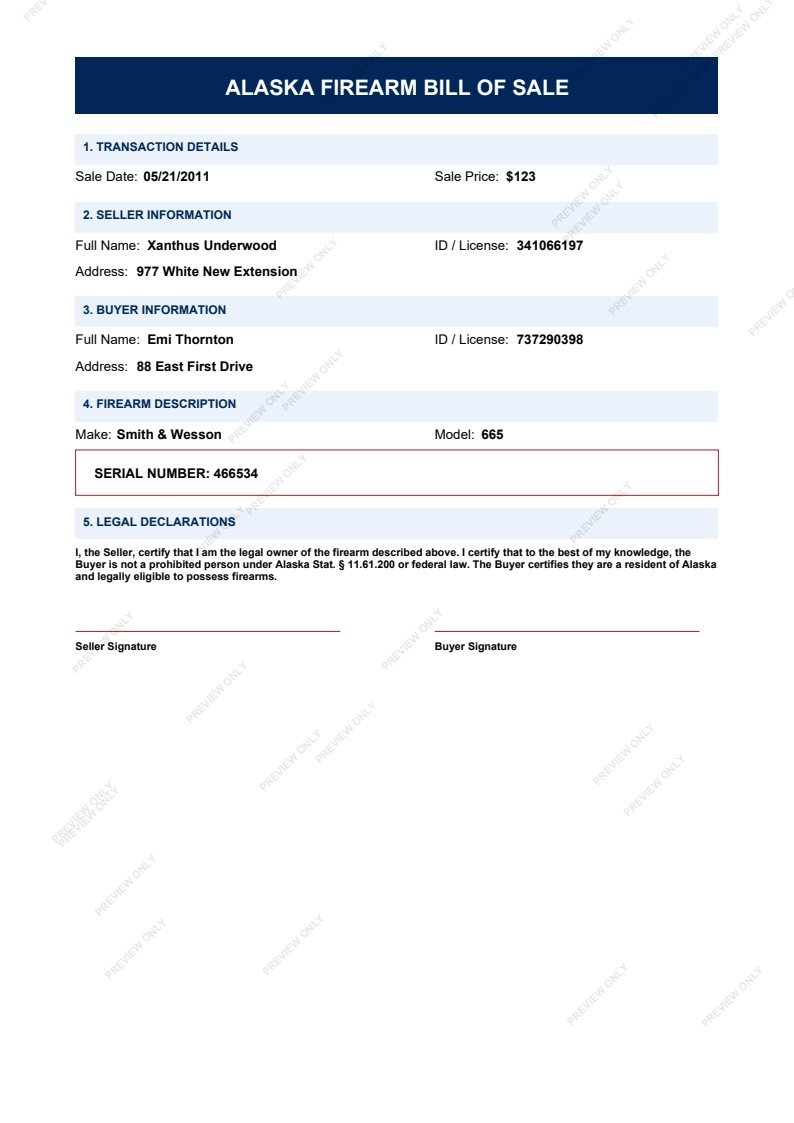
📄 Printable Transfer Document Preview:
Filling Out the Form Itself
The Alaska-specific requirements are outlined above. If you'd like a broader walkthrough of the signing and record-keeping process — the parts that don't change from state to state — it's covered separately.
Our nationwide Step-by-Step Firearm Bill of Sale Guide covers it in detail.
📋 Recent Legal Changes & ATF Practice in Alaska
1. Constitutional Carry & Stable Private Sale Framework
Alaska has maintained Constitutional Carry since 2003, one of the earliest states to do so. As of 2026 there have been no major new restrictions on private firearm transfers. Private sales between Alaska residents continue to require no background check, no registration, and no waiting period. This stability makes proper documentation even more important for long-term protection.
⚠️ Don't assume 'no background check' means 'no risk' — you can still face felony liability for knowingly selling to a prohibited buyer, even without a check to catch it.
2. The Private-Sale Age Floor Is Lower Than Most Assume
Alaska state law sets 18 as the minimum age to sell any firearm, including a handgun, to a private buyer — the 21-year floor most people know only applies to purchases from a licensed dealer (FFL) under federal law. AS § 11.61.210(a)(6) makes it a crime to knowingly sell a firearm to anyone under 18.
⚠️ Don't apply the federal dealer age of 21 to your own private sale by mistake — verify 18 with a valid Alaska ID and you're on the safer side of state law.
3. How ATF Trace Works in Alaska
If a firearm you sold privately is later used in a crime, the ATF will trace the serial number back to you as the last known owner. In Alaska's vast geography — where law enforcement response can take hours or even days — a detailed Bill of Sale with the buyer's full name, Alaska-issued ID details, date of transfer, and exact serial number copied from the frame is your strongest defense during an investigation.
⚠️ Recording the serial number from a box label or receipt instead of the firearm itself is not accepted as proof during an ATF trace.
4. Local Governments Have Almost No Power Here
AS § 29.35.145 reserves firearm regulation to the state — a municipality cannot pass an ordinance on the possession, sale, transfer, or licensing of firearms, with narrow exceptions like discharge restrictions or rules for municipal buildings. This means Anchorage, Fairbanks, Juneau, and rural communities all follow the same private-sale rules.
⚠️ Don't assume a local ordinance you've heard about in a specific city changes your obligations as a private seller — under state preemption, it almost certainly doesn't.
This information reflects publicly available Alaska statutes and enforcement practices. Firearm laws can change — always verify the latest rules and consult a qualified attorney.
Alaska Firearm Transfer FAQ
Is a Bill of Sale legally required for private gun sales in Alaska?
No, Alaska does not require a Bill of Sale. However, with no state registry and no background check requirement, this document is your only reliable paper trail. Alaska law still prohibits selling to a prohibited person, and in Alaska's vast terrain, a signed Bill of Sale with buyer ID and serial number is your strongest protection if the firearm is ever traced. Source: AS § 11.61.200
What is the minimum age to buy a handgun privately in Alaska?
Alaska state law sets 18 as the minimum age to buy any firearm, including a handgun, from a private seller — AS § 11.61.210(a)(6) makes it a crime to knowingly sell a firearm to anyone under 18. The 21-year floor most people associate with handguns only applies to purchases from a licensed dealer (FFL) under federal law. Always verify age with a valid Alaska-issued ID. Source: AS § 11.61.210
What identification is required for a private firearm sale in Alaska?
You should verify a valid Alaska Driver's License or state-issued ID. This confirms both residency and age. Out-of-state IDs raise a red flag — federal law generally requires the buyer to be an Alaska resident for a private handgun transfer.
Does Alaska have a waiting period or background check for private sales?
No. Alaska has no waiting period and no background check requirement for private sales between residents. The state has been Constitutional Carry since 2003. However, you are still prohibited from knowingly selling to an ineligible person. Source: AS § 11.61.200
How does Constitutional Carry affect sellers in Alaska?
Since 2003, eligible Alaskans can carry without a permit. This means you cannot rely on a carry permit as proof of eligibility. Always verify a current Alaska ID and document the transfer with this Bill of Sale.
Who is a prohibited person in Alaska?
Under AS § 11.61.200, it's a felony to knowingly sell or transfer a concealable firearm to someone convicted of a felony, or to sell any firearm to a buyer visibly impaired by alcohol or drugs. Federal law adds further categories, including fugitives and those adjudicated mentally ill. Source: AS § 11.61.200
Can I sell NFA items like suppressors or short-barreled rifles privately in Alaska?
Alaska is NFA-friendly, but all transfers of suppressors, SBRs, SBSs, or machine guns still require ATF Form 4 and a $200 tax stamp. A Bill of Sale does not replace this federal requirement. Source: ATF Form 4
What if the firearm has no serial number?
Pre-1968 antique firearms without serial numbers are common in Alaska. Provide a detailed description (make, model, caliber, markings) on the Bill of Sale. Never alter or remove a serial number on a modern firearm.
Can I sell a firearm to a non-resident or visitor in Alaska?
Generally no. Federal law prohibits private transfers of firearms to non-residents in most cases — the buyer must be an Alaska resident, or the sale must go through a licensed FFL dealer. Source: 18 U.S.C. § 922
Related Forms & Regional Compliance:
Unlike neighboring states in the Pacific Northwest such as Washington and Oregon, which require universal background checks for private firearm transfers, Alaska remains one of the most permissive states. As a Constitutional Carry state since 2003, no FFL dealer or background check is required for private sales between Alaska residents. However, federal law strictly prohibits private person-to-person transfers across state lines. Any sale to a resident of another state must go through a licensed FFL dealer.